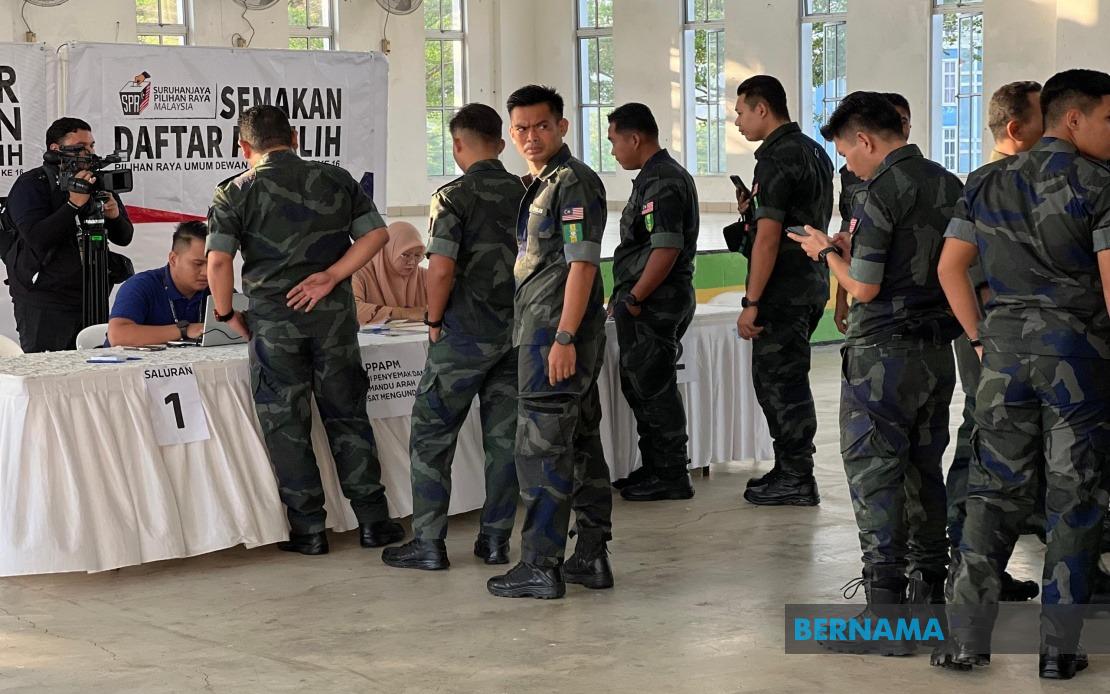
The machinery for Johor's 16th state election moved into high gear as the Election Commission (EC) activated 64 early voting centres across the state from 8 am, allowing members of the security forces and their spouses to participate in the democratic process before ordinary voters go to the polls. The early voting arrangement accommodated 24,751 eligible personnel from the Malaysian Armed Forces, Royal Malaysia Police, and General Operations Force, reflecting standard electoral practice that permits uniformed services to cast votes in advance due to their operational commitments on election day.
The distribution of voting locations reflected the composition of the security force electorate in Johor. The Malaysian Armed Forces and their family members utilised 11 dedicated polling centres to process their 12,041 ballots, whilst the remaining 53 centres accommodated 12,710 voters from police and General Operations Force ranks along with their spouses. This organisational structure, overseen by the EC, ensured efficient crowd management and maintained the integrity of the voting process across multiple locations throughout the state's various administrative districts.
Operations at the early voting centres progressed in a staggered fashion, with facilities closing progressively from noon onwards until 6 pm according to the EC's predetermined schedule. This phased closure approach allowed authorities to manage voter flow systematically and prevented bottlenecks that might compromise voting procedures. The timing of these closures also aligned with operational requirements, ensuring security personnel could return to their duties without undue delay following their participation in the electoral process.
Weather observations from field reporting indicated generally favourable conditions across several key districts. Batu Pahat, Muar, Pontian, and Tangkak all experienced sunny skies during the early voting period, which would have facilitated orderly crowd management and reduced any logistical complications arising from adverse weather. Such conditions typically support higher turnout rates and smoother administrative operations, contributing to the overall effectiveness of the early voting exercise.
The early voting mechanism represents an important accommodation within Malaysia's electoral framework, recognising that members of the security forces—including defence personnel, police officers, and paramilitary troops—must maintain operational readiness and cannot always be released for voting on the main election day. This arrangement ensures these citizens retain their fundamental democratic rights whilst preserving institutional functionality. The precedent applies consistently across all Malaysian elections, whether federal or state-level, and reflects international best practice in managing electoral participation among uniformed services.
Looking ahead to Saturday's main polling day, approximately 2.7 million ordinary voters across Johor's 56 state constituencies will exercise their voting rights. This substantially larger electorate represents the broader cross-section of the Johor population, encompassing all categories of citizens eligible to participate in state elections. The sheer numerical scale of Saturday's operations will present significant logistical challenges for the EC, requiring coordination of polling stations, poll workers, security arrangements, and vote counting procedures across the entire state.
For Malaysian observers and international analysts monitoring electoral developments in Southeast Asia, Johor's state election carries considerable significance. As the nation's southernmost peninsular state and home to Malaysia's second-largest city, Johor's electoral outcomes frequently signal broader political trends and public sentiment. The state has historically been a political bellwether, with results often foreshadowing shifts in federal-level support and coalition alignments. This particular election will test voter appetite for governance continuity or change in a state long dominated by the Barisan Nasional coalition.
The early voting process also serves as a technical rehearsal for the EC's operational capacity and data management systems. Any issues identified during the 24,751-voter early exercise can inform adjustments before Saturday's vastly larger operation, contributing to smoother procedures when millions of ordinary Johor residents queue at polling stations. The staggered early voting schedule similarly provides valuable experience in managing timed facility closures and vote tabulation procedures that will be replicated across numerous locations during the main ballot.
For regional readers, particularly those in Singapore and Brunei with family ties across the Causeway and with the Malaysian peninsula, Johor's electoral significance extends beyond state-level administration. The outcome will influence trade policy frameworks, cross-border relations, infrastructure development priorities, and labour migration arrangements affecting hundreds of thousands of cross-border workers and their families. Continued economic coordination between Johor and neighbouring regions depends substantially on the political stability and policy consistency that electoral outcomes establish.
The participation of security personnel through early voting exemplifies Malaysia's commitment to inclusive democratic processes that adapt to institutional realities. Rather than suspending voting rights for those in public service, the electoral system accommodates their participation through flexible arrangements. This approach strengthens the democratic legitimacy of election outcomes, as the votes of all eligible citizens—regardless of profession or circumstances—contribute to determining state governance. The 24,751 early voters joining Saturday's anticipated 2.7 million will collectively shape Johor's political direction for the coming term.

