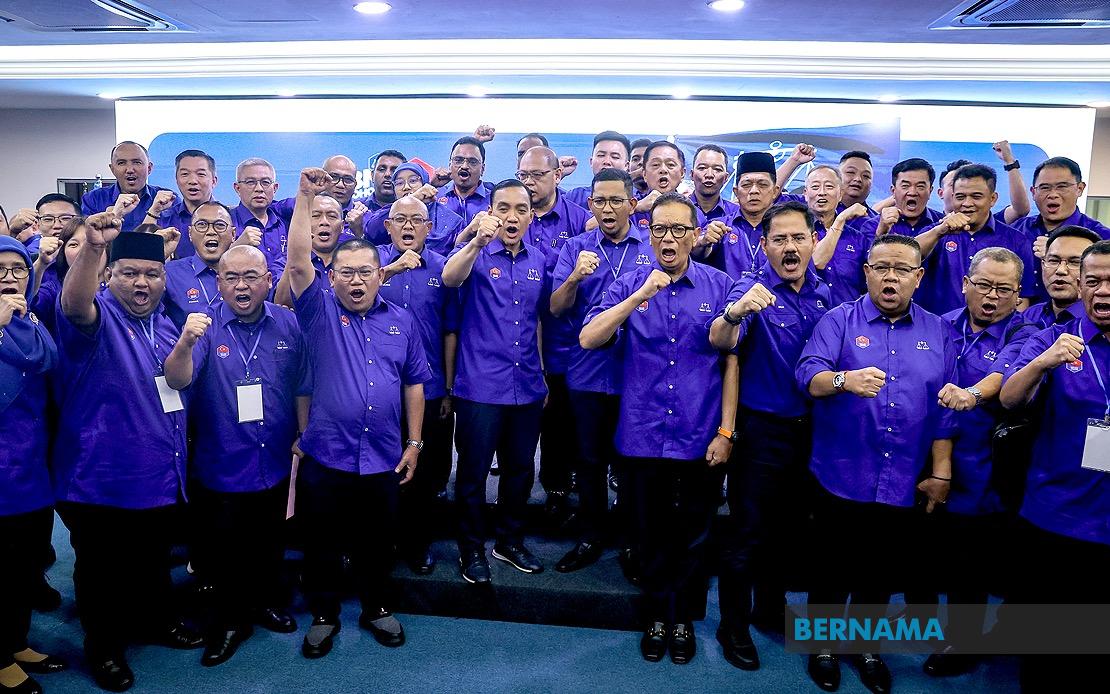
Johor Barisan Nasional has finalised its candidate roster for the 16th state election, presenting a carefully calibrated mixture of political veterans and newcomers across all 56 contested seats. The announcement, made by coalition chairman Datuk Onn Hafiz Ghazi in Johor Bahru, reflects the leadership's strategy to maintain continuity while refreshing the party's presence on the ground. The slate comprises 37 UMNO representatives, 15 from the Malaysian Chinese Association and four from the Malaysian Indian Congress, representing the traditional ethnic power-sharing arrangement that underpins BN's structure across Malaysia.
The composition underscores UMNO's dominant position within the Johor coalition, accounting for roughly two-thirds of the total candidature. This distribution mirrors the party's historical strength in the state, where it has maintained firm control of the legislative assembly across multiple election cycles. The MCA contingent reflects the significant non-Malay electorate in Johor's urban and semi-urban constituencies, while MIC's representation addresses the needs of the Indian-origin community scattered across various seats. Onn Hafiz emphasised that the selection process carried the explicit backing of national BN chairman Datuk Seri Dr Ahmad Zahid Hamidi, lending formal legitimacy to the choices made at state level.
One of the most closely watched decisions centres on the Machap seat, which Onn Hafiz himself will defend. The Johor Menteri Besar's personal candidacy signals confidence in his political standing following his victory in the 2022 election. His continued representation of Machap provides stability at the leadership level, suggesting the ruling coalition intends to project an image of strong incumbent governance heading into the polls. The seat's significance extends beyond symbolism; Machap serves as a barometer of voter sentiment in the agricultural heartland of central Johor, where rural concerns about livelihood and development carry substantial weight.
The reintroduction of Datuk Seri Dr Adham Baba to Pasir Raja represents a strategic decision to leverage the former health minister's established political brand and constituency relationships. Adham previously held the seat for two consecutive terms spanning 2008 to 2018, during which he built a recognisable profile as a legislator attuned to local grievances. His subsequent tenure as Tenggara MP, first from 2004 to 2008 and again from 2018 to 2022, kept him within the federal political orbit despite losing his state seat. Positioning Adham in Pasir Raja amounts to a calculated attempt to recapture ground that has not been under his direct stewardship for the past six years, relying on accumulated goodwill and name recognition to offset any erosion of support during his absence.
Adham's role as Tenggara UMNO division chief adds an organisational dimension to his candidacy, suggesting he brings not merely personal appeal but also control over party machinery within that geographic unit. His professional credentials as former minister lend him gravitas at a time when voters increasingly scrutinise leaders' track records and competence. However, his return to state politics after a hiatus also presents a test: whether his federal-level experience translates into resonance with voters whose priorities may have shifted substantially since his last state contest.
Notable absences from the slate reveal equally important political calculations. Datuk Seri Hasni Mohammad, the former Menteri Besar and incumbent assemblyman for Benut, has not been renominated, effectively ending his candidacy after serving in the state legislature. His replacement by UMNO working secretary Datuk Mohd Sumali Reduan signals either a strategic shift in party priorities for the seat or an internal assessment that fresh leadership would better serve BN's electoral prospects in Benut. Such decisions, though clothed in neutral language, frequently reflect broader party manoeuvres and shifts in factional influence within UMNO's Johor branch.
The retention of nine out of ten former executive councillors who stood in 2022 demonstrates a high re-nomination rate for senior figures within the outgoing administration. This continuity suggests confidence in the incumbents' performance and vote-getting ability, reducing the disruption typically associated with wholesale candidate changes. The sole exception involves Khairin-Nisa Ismail @ Md On, formerly chairman of the State Women, Family and Community Development Committee, who will not defend Serom. Her exclusion may reflect either performance concerns specific to that seat or broader shifting priorities regarding gender representation and committee assignments.
Onn Hafiz's remarks during the announcement ceremony offered guidance on campaign conduct, emphasising that nomination should be understood as a trust rather than a privilege or reward. This framing attempts to reinforce party discipline and ethical standards at a time when electoral campaigns can become highly charged and personalised. His call for courteous, respectful and prudent campaigning aligns with broader efforts by BN leadership to present the coalition as a responsible, institutional force compared to opposition parties. In the Malaysian context, such appeals carry symbolic weight, invoking shared values of decorum and national interest.
For Malaysian and Southeast Asian observers, the Johor lineup holds broader significance. Johor remains one of peninsular Malaysia's most politically contested states, functioning as a bellwether for national sentiment. BN's ability to retain control of the state legislature depends heavily on whether its candidates can mobilise traditional supporters while appealing to voters concerned about economic performance, service delivery and governance quality. The inclusion of experienced figures like Adham Baba alongside younger or less prominent candidates suggests a deliberate attempt to balance proven vote-winners with emerging talent, hedging against the risk that any single cohort proves electorally vulnerable.
The coalition's candidate selection also occurs against the backdrop of broader Malaysian politics, where Johor's relationship with federal governance has become increasingly salient. Development investment, federal-state coordination on infrastructure and resource allocation all depend on smooth relations between Johor's ruling party and national government. BN's Johor slate thus carries implications extending beyond state boundaries, touching on how effectively the coalition can coordinate across federal and state levels in delivering on electoral promises and maintaining voter confidence.
Looking forward, the Johor election will test whether BN's strategy of incumbency combined with carefully chosen reinforcements can sustain electoral dominance in a state that has seen growing opposition activity and shifting voter demographics. The performance of candidates such as Adham Baba in recaptured seats will offer crucial indicators of whether nostalgia for past leaders and name recognition can overcome structural changes in voter behaviour. For the region and for Malaysia's political trajectory, Johor's outcome may well signal whether BN's traditional formula of coalition governance, party discipline and hierarchical candidate selection remains viable in an era of more fluid voter allegiances.