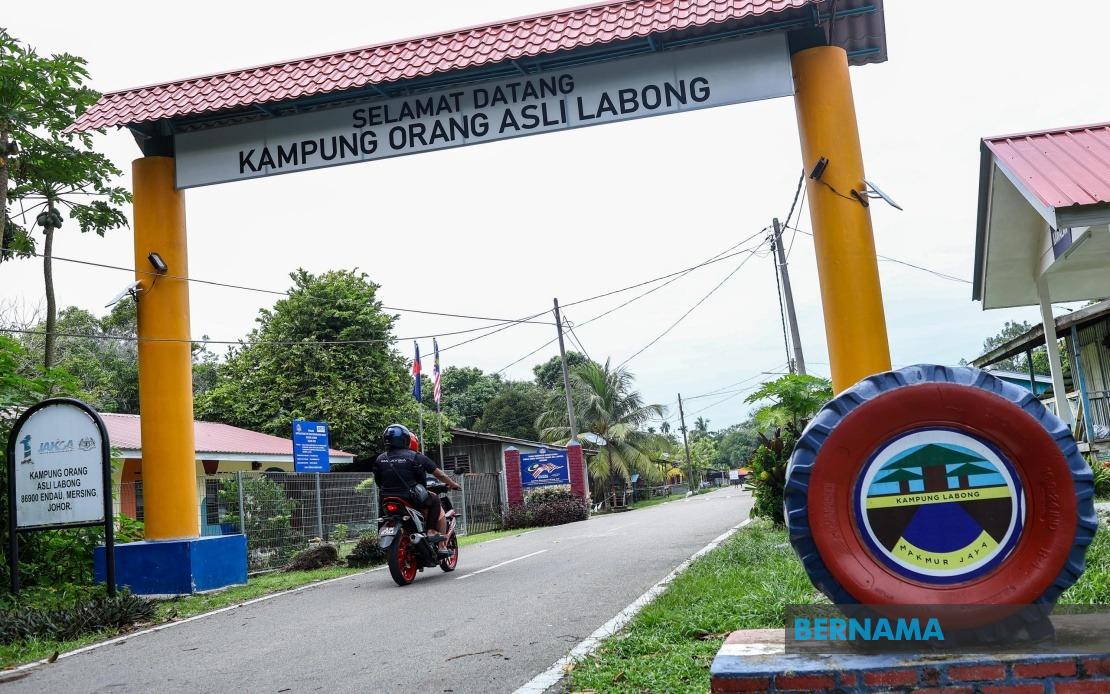
The Johor state government's ongoing collaboration with the Department of Orang Asli Development (JAKOA) is producing substantive gains for indigenous settlements across the state, with residents of Kampung Orang Asli Labong in Mersing describing tangible improvements in community welfare and administrative capacity. The initiative represents a structured approach to indigenous development that moves beyond traditional welfare provision to encompass leadership development and institutional strengthening within Orang Asli villages.
At the heart of these efforts lies a recognition that effective community advancement requires empowered local leadership capable of navigating relationships between indigenous populations and government bureaucracies. Mabot Sela, the 80-year-old Tok Batin of Kampung Orang Asli Labong, exemplifies how targeted capacity-building can enhance indigenous leadership. Through his involvement in JAKOA-organised leadership training programmes, he has acquired administrative knowledge and governance skills that extend beyond traditional customary authority, enabling him to serve more effectively as an intermediary between his community and state agencies. This dual legitimacy—combining customary respect with modern administrative competency—creates a more robust foundation for addressing village-level challenges and opportunities.
The financial dimension of Johor's approach has also proven consequential. The state government's decision to increase monthly allowances for village heads and other Orang Asli community leaders addresses immediate material pressures that often constrain effective governance. For Mabot, the additional resources have alleviated personal healthcare burdens, a significant concern given the typically limited access to medical facilities in remote indigenous settlements. This seemingly modest financial adjustment carries broader implications: when community leaders are less preoccupied with personal economic survival, they can devote greater attention to collective welfare and development priorities, creating space for more strategic long-term planning rather than reactive crisis management.
Beyond individual leaders, the programmes resonate with broader community aspirations for advancement. Sekoi Janja, a 68-year-old resident, articulates a generational perspective that distinguishes past survival-based livelihoods dependent on forest resources from contemporary development expectations. Her hope that younger Orang Asli generations will access enhanced opportunities reflects an understanding that static preservation of traditional practices may not serve evolving community needs or preferences. This outlook underscores an important development principle: indigenous empowerment should expand options rather than constrain them, allowing communities to decide their own trajectories rather than having futures determined by external actors.
Skills development emerges as a critical gap in current provision, according to trader Norma Lonchai. Her observation that Orang Asli communities require capacity-building and income-generation opportunities beyond straightforward financial assistance identifies a meaningful limitation in purely transfer-based welfare approaches. While direct assistance addresses immediate poverty, sustainable advancement typically demands employment-ready skills, market linkages, and business literacy. Lonchai's emphasis on livelihood diversification suggests that indigenous communities are seeking pathways toward economic participation rather than indefinite dependency, a sentiment that development practitioners and policymakers should heed carefully.
The scale of Johor's commitment becomes apparent through budget allocations. The state government's RM3.8 million allocation last year supporting nine separate initiatives benefiting over 18,000 Orang Asli residents demonstrates substantial resource commitment. This multi-pronged approach—incorporating welfare provision, educational support, infrastructure development, and community projects—reflects sophisticated understanding that indigenous advancement requires simultaneous intervention across multiple domains. Infrastructure improvements, for instance, can facilitate market access for indigenous producers, while education investments build human capital for future employment and entrepreneurship.
The clustering of these interventions matters significantly for Malaysian indigenous communities. Rather than isolated programmes addressing single issues, coordinated packages create complementary effects where improvements in one area amplify benefits in others. Better village infrastructure supports educational access; skills training combines with improved allowances to enable business formation; leadership capacity strengthens community advocacy for additional resource allocation. This systems-level thinking distinguishes progressive indigenous development from fragmented charitable approaches.
Persistent environmental challenges nevertheless demonstrate that community advancement remains incomplete. The recurring problems of crop damage by wild elephants and dangers posed by roaming cattle highlight how Orang Asli agricultural interests can conflict with broader ecosystem pressures and other economic actors. These concerns transcend simple development provision, requiring integrated environmental management and potentially compensation mechanisms that recognise indigenous communities as stewards whose resources are affected by competing land uses. Addressing such issues requires government agencies to extend beyond welfare administration into active problem-solving partnerships with indigenous communities.
For regional observers, Johor's experience offers instructive lessons about indigenous development approaches. The state's model emphasises community-level governance capacity alongside material provision—an approach contrasting with purely extractive or paternalistic paradigms that have historically marginalised indigenous peoples across Southeast Asia. By investing in local leadership and creating platforms for community voice, as evidenced by residents articulating specific needs and aspirations, Johor creates ownership of development processes rather than imposing external agendas. This participatory dimension proves essential for sustainable outcomes, particularly where indigenous communities possess deep historical knowledge and legitimate interests in resource management decisions affecting their territories.

