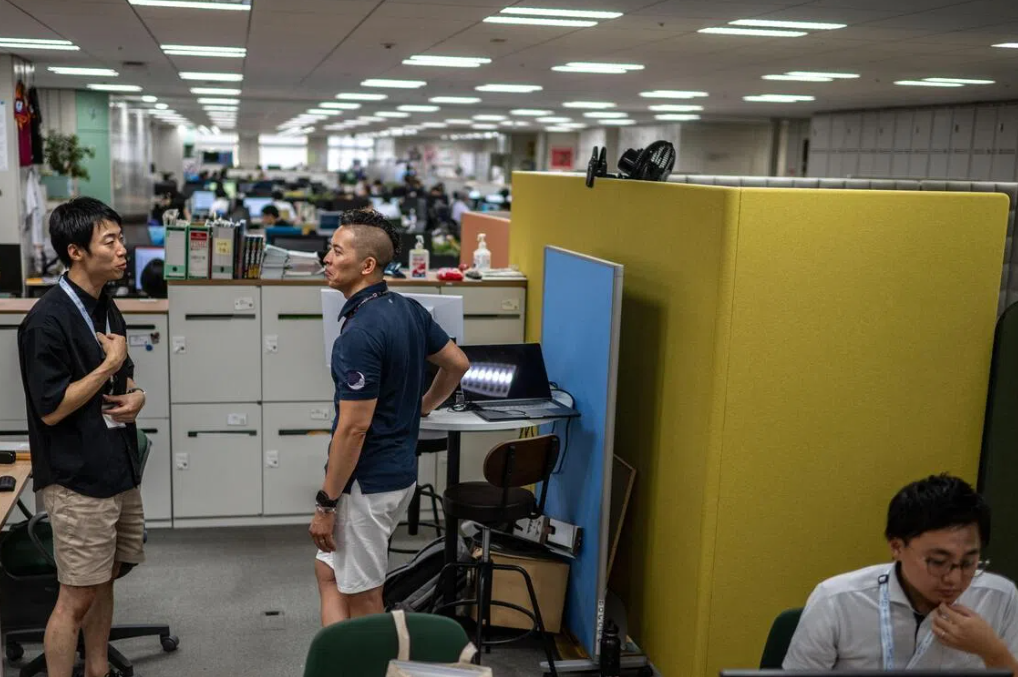
Japan's metropolitan government is discovering that relaxing workplace dress codes to address dangerous summer heat comes with unexpected social friction. Tokyo's expanded Cool Biz initiative, which began in April, aims to help office workers endure the country's brutal seasonal temperatures by permitting T-shirts, trainers and shorts instead of traditional business attire. Yet the seemingly straightforward push to lighten clothing has collided with cultural sensitivities around appearance and professionalism, particularly regarding the visibility of male workers' leg hair in shared office spaces.
The phenomenon has crystallised around an online term gaining traction among Japanese women: "sunehara", or "leg hair harassment". The phrase encapsulates widespread discomfort expressed by female employees about being exposed to colleagues' exposed shin hair during the workday. What city officials envisioned as a practical health measure—allowing workers to dress more comfortably in sweltering conditions—has instead sparked broader conversations about workplace norms, body consciousness and gender dynamics in Japanese corporate culture. The irony is not lost on observers: a campaign designed to reduce physical stress from heat exposure has instead generated psychological stress around bodily presentation.
Tokyo environmental official Noboru Watanabe attempted to clarify the government's position to international media, emphasising that authorities sought merely to expand worker choice rather than mandate specific garments. His statement that "there should be no issue as long as the work attire is not offensive to anyone" reveals the conceptual challenge facing policymakers. Determining what constitutes offensive dress in a professional context involves deeply subjective cultural judgments that vary widely across demographics, generations and individual sensibilities. Japan's traditionally conservative corporate dress culture, where conformity and discretion have long been valued, makes this transition particularly fraught.
Quantifying the divide proved illuminating. A June survey conducted by Gorilla Clinic, a men's cosmetic treatment chain, discovered remarkably narrow opposition to shorts-wearing in offices: 53.5 per cent of respondents opposed the practice, while 46.5 per cent supported it. The statistical near-split masks a significant gender disparity. Women respondents substantially outnumbered men among those expressing reservations, suggesting that acceptance of exposed male leg hair varies considerably by sex. Concerns about body shape and visible body hair emerged as primary objections, indicating that resistance stems not from abstract professionalism but from genuine discomfort with male bodies on display in workplace settings.
The survey data reflects broader anxieties about appearance standards that disproportionately affect women in professional environments. Paradoxically, the controversy has redirected focus onto male grooming practices and body consciousness. Akifumi Funatsu, a director at the cosmetic clinic, reports a notable uptick in men seeking laser hair removal services. These clients increasingly frame the procedure not as vanity but as "social etiquette when wearing shorts"—a recalibration of masculine grooming expectations driven by workplace norms. The shift suggests that masculinity in Japanese corporate culture is becoming subject to the same scrutiny and maintenance standards previously concentrated on female appearance.
Tokyo's current Cool Biz push represents the evolution of a campaign with nearly two decades of history. In 2005, then-environment minister Yuriko Koike, now Tokyo's governor, launched the original initiative aimed at reducing air-conditioning consumption by encouraging short-sleeved shirts while eliminating jackets and ties. The campaign gained momentum through high-profile political endorsement when Prime Minister Junichiro Koizumi appeared publicly in business casual attire, lending legitimacy to the departure from strict dress codes. What began as an environmental conservation measure gradually normalised casual workplace dress, particularly in technology and startup sectors less bound by traditional hierarchies.
The 2011 earthquake and tsunami accelerated acceptance of relaxed dress standards. With Japan's power supply strained by the nuclear crisis, the government introduced "Super Cool Biz", further liberalising workplace clothing rules. This policy response to environmental emergency established precedent for dress-down measures during periods of energy stress or climate challenge. Over subsequent years, casual attire became increasingly normalised in progressive companies, creating generational and sectoral variation in workplace dress expectations. The Tokyo government's recent extension to explicitly permit shorts represents the logical endpoint of this liberalisation trajectory—yet has proven the point where significant social resistance crystallises.
The timing of expanded Cool Biz coincides with Japan facing genuinely severe climatic conditions. Extreme summer temperatures combined with high humidity create dangerous conditions where human bodies struggle to cool themselves through perspiration, leaving workers vulnerable to heat-related illness. During a single week in July, seven people died of heatstroke nationwide, while 4,580 were hospitalised. The Fire and Disaster Management Agency's public health messaging emphasises hydration, air-conditioning access and gradual heat acclimatisation. These official guidelines acknowledge that existing coping mechanisms—air-conditioning and protective clothing—may prove inadequate without additional interventions.
Consumers have responded to escalating heat by adopting technological solutions previously considered marginal or novelty items. Cooling fans integrated into clothing, specialised cooling wipes, heat-reflective umbrellas and portable battery-powered fans have shifted from luxury items to practical necessities. This consumer innovation demonstrates market adaptation to climate stress, yet such solutions remain inaccessible to lower-income workers. The Cool Biz campaign, by contrast, represents a zero-cost adaptation strategy requiring only psychological adjustment to normalised dress codes. The friction emerging around shorts-wearing suggests that even minimal-cost adaptations encounter resistance when they challenge internalised professional norms.
The controversy also reflects Japan's particular relationship with gender expression and bodily visibility in public and professional contexts. Japanese workplace culture has historically maintained strict boundaries separating professional personas from bodily self-presentation. Male formal dress—dark suits, long sleeves, ties—establishes visual uniformity and professional distance. The shift toward visible legs and arms transgresses these carefully maintained boundaries in ways that generate gendered discomfort. Women accustomed to workplace environments where professional identity deliberately obscures bodily characteristics report discomfort when male colleagues' bodies become more visible, suggesting that professional norms partially function to desexualise and defamiliarise workplace interactions.
The debate also illuminates tensions between environmental sustainability and social comfort in policy implementation. Cool Biz emerged from genuine conservation imperatives during energy crises, yet cultural adaptation to policy changes proves slower than technological change. While air-conditioning systems can be adjusted instantly, social norms governing appearance shift gradually across generations. Policymakers assuming that practical benefits would overcome aesthetic objections underestimated the depth of cultural attachment to particular dress codes. The leg hair harassment controversy suggests that successful climate adaptation policies require not only practical measures but sustained cultural change efforts that explicitly address and reshape workplace norms.
Moving forward, Tokyo officials face the challenge of either enforcing more specific dress code guidelines—potentially undermining the original flexibility objective—or accepting that workplace shorts adoption will proceed unevenly, with significant generational and gender-based variation. The controversy may ultimately accelerate normalisation as younger workers become dominant in office settings and as repeated heat crises make casual dress seem increasingly practical rather than transgressive. Alternatively, the social friction around shorts could catalyse investment in alternative cooling technologies and workplace modifications that achieve temperature reduction without challenging dress code norms. Either path will reveal which considerations ultimately outweigh others in Japan's negotiation between environmental necessity and cultural convention.

