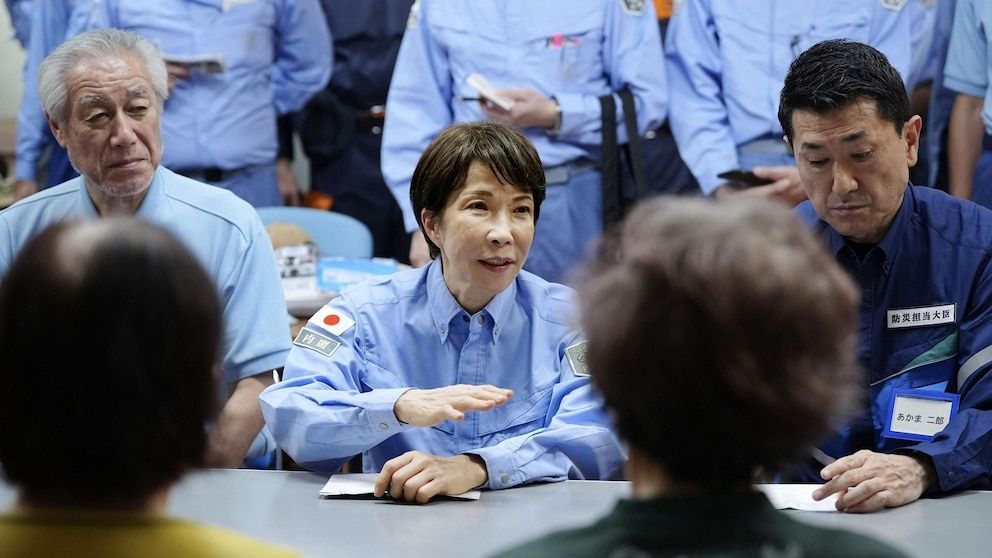
Prime Minister Sanae Takaichi made her initial visit to Kumamoto Prefecture on Monday as cleanup operations gathered pace in Japan's southwestern region following a devastating magnitude 7.1 earthquake that struck the southern main island of Kyushu on Tuesday, August 4. The natural disaster has claimed 38 lives, including two whose deaths were hastened by the post-earthquake environment: one person succumbed to heat stroke while sheltering in a vehicle, while another fatality remains under investigation by prefectural authorities. The visit underscores the political urgency facing Japan's government as it confronts both the immediate humanitarian crisis and the longer-term recovery challenges that characterise large-scale seismic events.
The combination of environmental factors has created an unusually harsh backdrop for disaster recovery operations. Across the affected areas, residents are now working to clear vast quantities of debris—broken furniture, damaged appliances, and structural rubble—from residential zones and commercial districts for collection. Simultaneously, the Japan Meteorological Agency has warned that temperatures would reach nearly 40 degrees Celsius (104 Fahrenheit) on Monday, intensifying the physical strain on rescue workers, evacuees, and those attempting to salvage possessions from damaged homes. This convergence of heat and destruction mirrors conditions that have historically complicated post-disaster recovery in Japan's more vulnerable regions.
Water scarcity has emerged as a critical bottleneck for both emergency responders and displaced residents. More than 46,000 households remain disconnected from water supplies, while fuel shortages compound the logistical difficulties facing the region. These infrastructure failures carry implications beyond immediate comfort: inadequate water access impedes sanitation, increases infection risks in crowded shelters, and exacerbates heat-related illness dangers during sweltering daytime hours. The accumulation of these challenges reflects a familiar pattern in seismic-prone regions, where cascading failures in basic utilities often prove as consequential as the initial physical damage.
Shelter conditions reveal the scale of displacement across Kumamoto. More than 8,500 people remain housed in makeshift emergency facilities—converted community centers, school gymnasiums, and classroom spaces—many of which lack air-conditioning. Additional evacuees have sought refuge in vehicles parked at town hall lots or in parks, or remain in open-air camps near their damaged residences. In the towns of Uki and Hikawa, construction crews have begun assembling temporary housing units to accommodate those whose homes are either destroyed or uninhabitable. Some hotels and inns have voluntarily opened their rooms to evacuees, though this represents a partial solution to a displacement challenge affecting tens of thousands of people.
Disaster research specialists have long highlighted the public health consequences of inadequate shelter provision following major earthquakes. Crowded emergency facilities typically suffer from insufficient sanitation infrastructure, minimal privacy, inadequate medical supervision, and psychological stress arising from prolonged displacement. These conditions create breeding grounds for infectious disease outbreaks while exacerbating pre-existing health conditions among vulnerable populations—the elderly, children, and those with chronic illnesses. Kumamoto Prefecture appears to exemplify these documented risks, with overcrowding and heat exposure combining to produce what experts term a secondary disaster phase.
Takaichi's Monday visit included an aerial survey of damaged areas conducted from an army helicopter, followed by an inspection of one of the prefecture's better-appointed shelters, equipped with cardboard partition beds and air-conditioning systems. The carefully curated nature of this particular facility subsequently drew criticism on social media platforms, with observers arguing that the prime minister's visit predominantly showcased conditions that do not represent the majority of Kumamoto's evacuees. This critique highlights persistent tensions between political communication and ground-level disaster reality—a pattern evident in other recent seismic crises across East Asia and Southeast Asia.
Kumamoto Governor Takashi Kimura used his meeting with Takaichi to emphasise the destabilising effects of the "abnormal heat" battering residents already coping with the earthquake's direct impacts. Kimura explicitly requested expanded government support for improving conditions at evacuation centres, citing critical shortages of clean water access and medical care provision. In response, Takaichi committed that the national government would "quickly examine" appropriate assistance measures and move forward with proactive interventions, language suggesting the government recognises the urgency of preventing a secondary humanitarian crisis within the disaster zone.
A developing controversy concerning corporate responsibility has added another layer to the disaster narrative. Habita, a local general store chain operating a retail outlet within the collapsed Aeon Mall in the town of Kashima, has acknowledged instructing two employees—both subsequently killed in a gas explosion—to return into the damaged building to secure sales proceeds in a safe. Two company executives attended the wake of 22-year-old Kurumi Otake on Sunday and offered apologies to her grieving parents. Her mother, confronting the executives, expressed the anguish that would resonate across Japanese society: "I wish someone had stopped her. My daughter is not coming back." The incident raises profound questions about corporate decision-making during emergencies and the value assigned to inventory relative to employee safety.
The mall explosion occurred after approximately 3,000 shoppers had been evacuated to the parking lot following the initial quake, yet some employees remained inside the building. The Aeon Mall operator attributed the explosion to a gas leak that developed following structural damage from the earthquake. Rescue operations recovered five survivors and the bodies of seven individuals from within the collapsed structure. The incident illustrates how seismic events can trigger cascading failures in building systems, transforming damaged structures into hazardous environments where human judgment and corporate priorities become matters of life and death.
The overall damage assessment reveals the earthquake's substantial destructive force. Approximately 700 homes have been destroyed completely, whilst more than 11,300 buildings sustained varying degrees of damage across Kumamoto Prefecture. The injury toll extends beyond the confirmed 38 fatalities, with 114 people injured across the region. These figures suggest that whilst the death toll, though tragic, remained relatively contained compared to historical precedents, the displacement crisis and infrastructure damage present recovery challenges that will persist for months or years.
For Malaysia and other Southeast Asian nations, Kumamoto's experience offers instructive lessons regarding post-disaster policy priorities. The intersection of seismic vulnerability, extreme heat exposure, and inadequate emergency shelter infrastructure demonstrates how natural hazards interact with existing social and environmental conditions to amplify human suffering. As tropical and subtropical regions across Southeast Asia face both intensifying seismic threats and rising average temperatures, the Kumamoto response patterns—both failures and emerging solutions—merit careful study by disaster management authorities and urban planners throughout the region.

