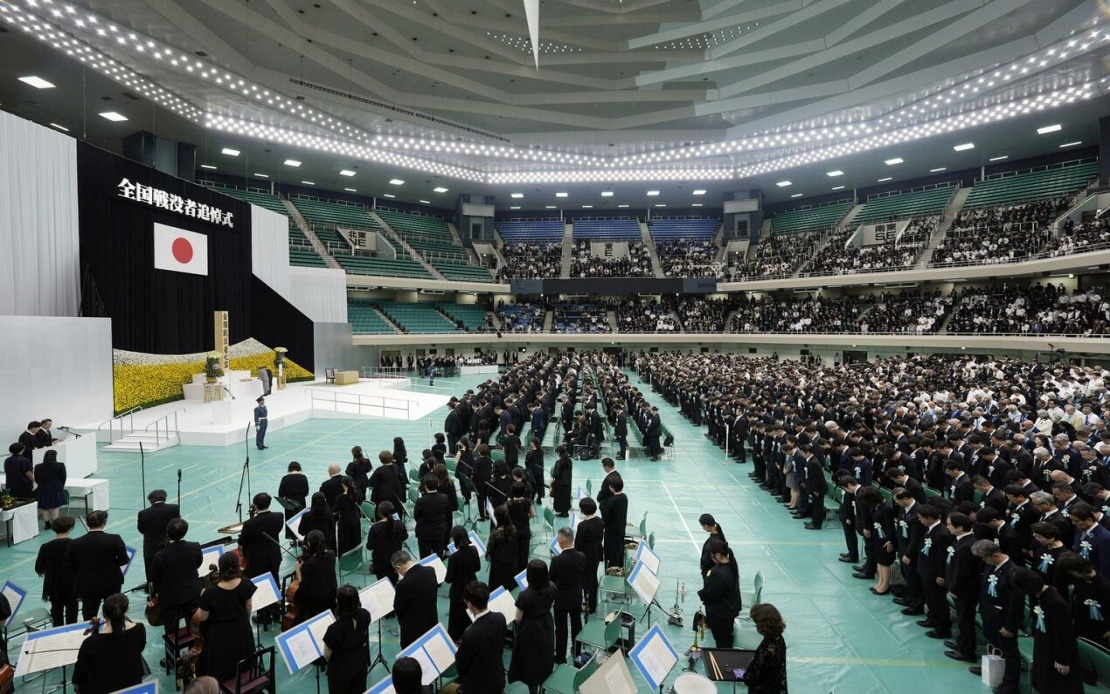
Japan commemorated the 81st anniversary of its surrender in World War II on Saturday with a government-sponsored ceremony in Tokyo, though Prime Minister Sanae Takaichi's remarks highlighted a notable divergence from recent precedent in how the nation's wartime past is acknowledged. The memorial gathering, attended by Emperor Naruhito and Empress Masako, honoured approximately 2.3 million military personnel and roughly 800,000 civilians who perished during the conflict that concluded in 1945. Takaichi's participation marked her inaugural attendance at the annual event since assuming office last October, and her carefully worded remarks revealed important signals about the current administration's positioning on historical accountability and national identity.
The rhetorical shift in Takaichi's address proved significant when examined against the language employed by her immediate predecessor. While she affirmed Japan's commitment to "consistently walked the path of a nation that values peace and made all possible efforts for world peace and prosperity," she deliberately omitted the explicit reference to national "remorse" that her predecessor Shigeru Ishiba had introduced at the previous year's ceremony. Ishiba, regarded as a relatively dovish figure within the governing Liberal Democratic Party, had broken a 13-year silence by explicitly mentioning Japan's "remorse" at the August 15 observance, alongside a "resolute pledge to renounce war." By contrast, Takaichi's formulation emphasised continuity and commitment without the introspective language her predecessor had reintroduced.
Takaichi, widely recognised for her hawkish orientation on national security matters, similarly avoided any direct reference to Japan's wartime aggression in Asia—a geographic and historical specificity that has become increasingly absent from official prime ministerial remarks in recent years. Her strategic silence on Japan's military campaigns across China and the Korean Peninsula mirrors the approach adopted by recent administrations, yet stands in notable contrast to the pattern that predominated before Shinzo Abe's return to office in December 2012. During the intervening decades, Japanese leaders had generally acknowledged the nation's wartime aggression and expressed corresponding remorse as part of the commemorative ritual. The consistency with which Takaichi and other recent prime ministers have sidestepped such acknowledgments represents a gradual reframing of official historical memory.
The distinction between the positions of Takaichi and Ishiba reflects broader ideological currents within Japan's conservative political establishment. Ishiba's willingness to employ the language of remorse, even within the context of his dovish orientation, underscored how even moderate voices had come to recognise the importance of historical acknowledgment in contemporary commemorative practice. Takaichi's departure from this framework, particularly given her explicit security-focused agenda, suggests a deliberate choice to recalibrate national narrative away from what some might characterise as self-critical historiography. Her statement that "no matter how time flows, we will remain committed to this resolute pledge, passing it down across generations" emphasised forward-looking commitment rather than backward-looking accountability.
Emperor Naruhito's participation in the ceremony and his remarks provided a counterbalance to the prime minister's formulation. The Emperor, maintaining consistent practice from previous years, explicitly referenced "deep remorse" in his address and reiterated his hope that citizens would "continue to pass down the memories of the suffering endured during and after the war." This distinction between the Imperial and prime ministerial positions is itself notable—the Emperor's language has remained notably more consistent in acknowledging the emotional and moral dimensions of the historical reckoning, whereas successive prime ministers have gradually shifted toward more neutral territorial language. The noon moment of silence, commemorating the precise moment when Emperor Hirohito's radio broadcast announced Japan's surrender in 1945, provided a moment of unified national reflection despite these rhetorical differences.
The timing of this anniversary carries particular significance given the contemporary strategic environment surrounding Japan. The 81st memorial observance occurs amid escalating regional tensions, particularly in West Asia, and coincides with Japan's substantial reorientation of its defence policy. The nation has substantially increased spending on national security and progressively relaxed regulatory restrictions on defence equipment exports—measures that signal a more assertive posture in security matters. Takaichi's rhetorical approach at the memorial aligns with this strategic pivot, suggesting that the evolution of official historical memory is not incidental to security policy but potentially reflective of it. The recalibration of how Japan frames its past appears connected to how it envisions its future role in regional and global security architecture.
For Southeast Asian nations and the broader region, the subtle but significant shifts in Japan's official historical narrative merit careful attention. Malaysia and other regional states have maintained complex relationships with Japan's postwar trajectory, balancing appreciation for its economic contributions and security partnerships with awareness of historical grievances stemming from the occupation period. The direction in which Japan's official historical memory trends influences not only bilateral relationships but also the broader regional consensus on historical accountability and reconciliation. When prime ministerial remarks increasingly sidestep explicit mention of wartime aggression, it creates implications for how younger generations in Japan understand the region's shared history and for how neighbouring societies perceive Japan's engagement with that history.
The archival record of these annual commemorative ceremonies reveals a clear pattern: Japan's official acknowledgment of wartime responsibility has become progressively more circumscribed rather than more forthright. The return to power of security-focused leaders like Takaichi appears correlated with the retreat from explicit remorse language that characterised even the preceding decade. This trajectory stands in contrast to how some other nations that engaged in major military conflicts have approached historical reckoning—through truth commissions, curriculum reforms, and sustained institutional acknowledgment. Japan's approach, by contrast, appears to involve a gradual normalisation of historical minimalism, accomplished through rhetorical choices that do not require explicit denial but instead simply omit previously accepted reference points.
The implications of these shifts extend beyond symbolic or ceremonial dimensions. Historical narratives shape how societies understand their obligations to neighbours, how educational systems frame the past, and ultimately how future generations approach questions of regional cooperation and conflict prevention. When a nation's political leadership progressively removes language of accountability from official ceremonies, it sends signals not merely about historical interpretation but about the weight the current administration assigns to regional reconciliation versus other policy priorities. For Malaysian observers and policymakers, Takaichi's remarks represent an important data point in understanding the direction of Japanese political thought and the potential implications for how historical grievances are managed in bilateral and multilateral contexts across Southeast Asia.

