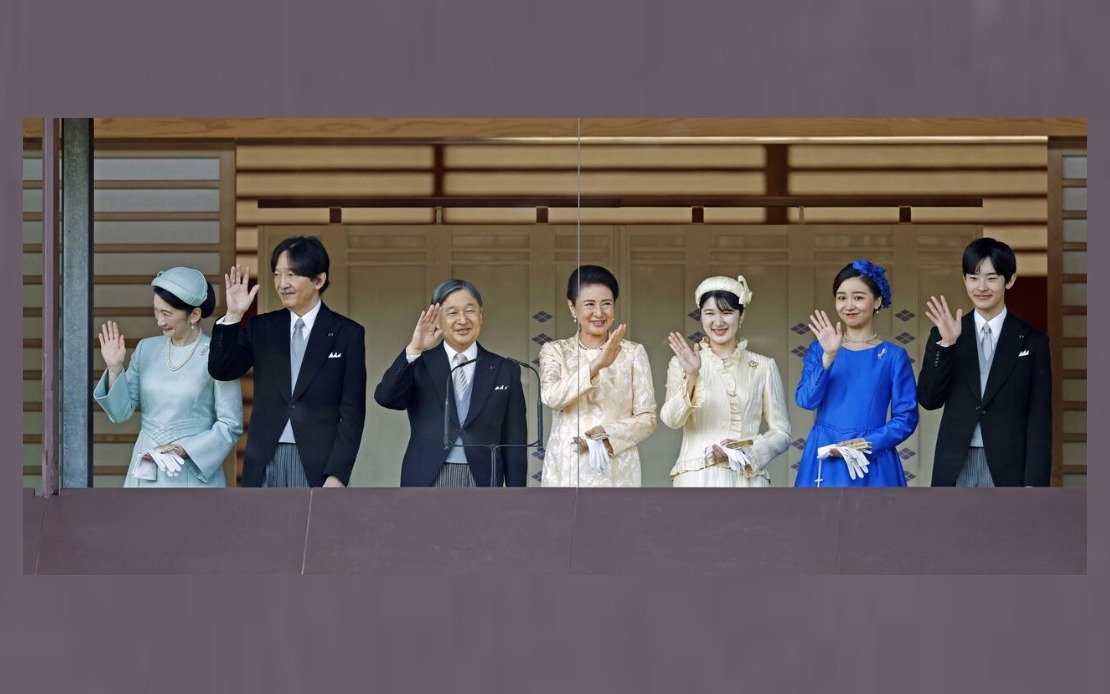
Japan's historic overhaul of its Imperial House Law has triggered considerable unease among the officials tasked with supporting the imperial family, even as public sentiment splinters between those backing reform and those questioning how the government has handled the deeply consequential change. The revision, passed by parliament on Friday, represents the first major amendment since 1947 and addresses a pressing demographic challenge threatening the viability of the world's oldest continuous monarchy: the imperial family has dwindled to just 16 members, prompting Prime Minister Sanae Takaichi's conservative administration to act decisively.
At the heart of the reform lies a practical solution designed to replenish the imperial lineage. Under the new rules, males aged 15 and older from 11 former imperial branch families that relinquished their royal status in 1947 are now eligible for adoption into the imperial family. The policy also permits princesses to retain their royal title should they marry commoners, a measure that officials and staff alike acknowledge offers genuine relief. Yet the legislation stops conspicuously short of opening the door to female succession, a limitation that fundamentally reflects conservative priorities and has sparked friction with a public increasingly open to seeing a woman ascend the Chrysanthemum Throne.
Imperial Household Agency officials recognize the necessity of the change while wrestling with profound uncertainties about its execution. One senior official acknowledged the breakthrough candidly: "It's significant in that there is now a path toward securing a stable number of imperial members." The same official, however, revealed the institutional pragmatism underlying implementation. "The decision has been made. If there comes a day when we see an adopted person join the imperial family, we'd have no choice but to support them so they steadily carry out their official duties and earn the affection of the people," the official said, underscoring the acceptance born of acceptance itself—the law is written, and the bureaucracy must now make it work.
Yet skepticism runs deep even among potential candidates for adoption. Asahiro Kuni, an 81-year-old member of the Kuninomiya branch from one of the targeted families, voiced the doubt that may well haunt the reform's effectiveness. "I wonder if anyone would actually step forward to be adopted. It doesn't seem very realistic," he told Kyodo News. This candid assessment hints at a practical problem the legislation may not resolve: even with legal possibility, the social and cultural gravity of joining Japan's imperial institution could deter qualified candidates, leaving the numeracy problem only partially addressed.
Concern about continuity and understanding poses another layer of institutional worry. Agency officials fret that adoptees may not fully grasp the symbolic nature of the imperial system as defined by Japan's post-war Constitution, or whether they will authentically embody the values that recent emperors have sought to convey through their public service. Emperor Naruhito and Empress Masako, herself a former diplomat who became the first empress from a non-aristocratic background, have modeled imperial duty as active engagement with the Japanese people, from disaster-affected regions to foreign state visits. This contemporary vision of monarchy demands more than ceremonial presence; it requires genuine connection to the nation's character and concerns. Introducing members from outside the bloodline raises legitimate questions about whether such alignment can be cultivated or transmitted.
The treatment of female imperial members under the new law reveals the conservative calculation that structured the entire reform. Princess Aiko, Emperor Naruhito's only daughter, remains constitutionally barred from succession despite her direct lineage, a restriction that polls suggest conflicts with public preferences. Under the amended law, however, she and the four other unmarried female members of the imperial family—including Princess Kako, daughter of Crown Prince Fumihito—now face an unprecedented decision: if they marry commoners, they may choose to retain royal status rather than automatically lose it upon departure, as was previously required. Yet this apparent liberalization conceals a complicated emotional and social burden. As one senior agency official noted with evident concern, "Given the current state of the Imperial Household and public expectations, it will be quite difficult for them to leave. This has become a rather harsh choice." The expectation that princesses will remain unmarried or sacrifice family cohesion by having spouses and children remain commoners while they retain royal status introduces a uniquely modern form of constraint.
The fracture in public sentiment reflects broader anxieties about how Japan's institutional evolution is being negotiated. Younger Japanese, particularly those near Princess Aiko's generation, voiced frustration not with the reform itself but with the opaque process that produced it. Miyu Nakao, 22, highlighted a disconnect between public sentiment and governmental action: opinion polls consistently show strong support for female succession, yet the government's unilateral decision-making left the public sidelined. "The government has made a decision on the imperial system all by itself," she said, her criticism targeting not the outcome but the democratic deficit in reaching it. A 20-year-old college student in Osaka echoed this concern about insufficient public engagement, noting that even young people lack basic familiarity with the Imperial House Law itself.
Conversely, older Japanese demonstrated more acceptance of the reform's practical necessity. Shinichi Kokubun, 76, who met Emperor Naruhito, Empress Masako, and Princess Aiko during their visit to tsunami-devastated Futaba in Fukushima Prefecture, assessed the change pragmatically: "It depends on how those adopted would behave. If they can stand by the people just as the emperor does, I don't think there will be any problem." His statement captures a generational view that prioritizes institutional stability and the emperor's symbolic function over constitutional principle.
The deeper political tension animating the reform concerns what Japan's conservatives are attempting to foreclose. Critics argue that permitting adoption from former imperial families while explicitly excluding female succession represents a deliberate architectural choice to preserve male-only descent. This prioritization contradicts contemporary Japanese public sentiment and internationally accepted democratic norms regarding gender equality. By channeling succession through adopted males from collateral lines rather than through Princess Aiko and her generation, the government signals that institutional tradition and patrilineal continuity rank above both democratic input and constitutional modernization. The measure succeeds in addressing the immediate numeracy crisis, but at the cost of entrenching a succession system that many Japanese—and the broader international community—regard as anachronistic.
For Malaysia and other Southeast Asian democracies, Japan's imperial succession debate offers instructive lessons about how tradition and modernization intersect in governance. The reform demonstrates both the resilience of hereditary institutions in advanced democracies and the persistent tension between popular preference and elite institutional prerogatives. As Asian monarchies navigate their own questions about succession, gender roles, and democratic legitimacy, Japan's cautious approach—solving the numerical problem while forestalling fundamental constitutional change—suggests a pattern likely to influence regional precedent. Yet the unease among implementing officials and the evident frustration among younger Japanese also signal that half-measures may prove unstable over time.

