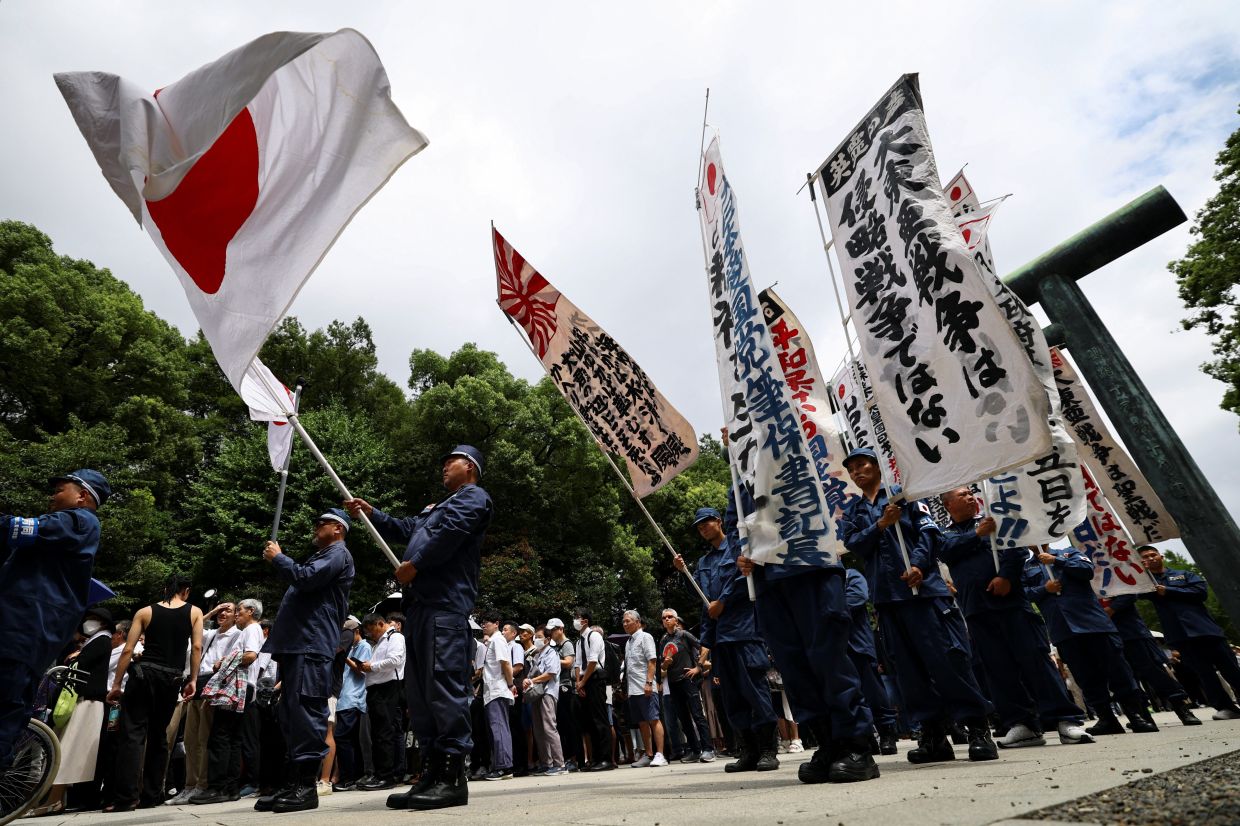
Japan's defence minister, Shinjiro Koizumi, paid respects at the Yasukuni shrine on Saturday, August 15, marking the 81st anniversary of Japan's surrender in World War II. The visit stands out not for occurring, but for what did not: Prime Minister Sanae Takaichi conspicuously remained absent from the memorial site, a deliberate choice that signals careful diplomatic manoeuvring at a particularly fraught moment in Asia-Pacific relations. For decades, Yasukuni has represented one of the region's most sensitive historical flashpoints, and the decisions made by Japan's political elite about whether to visit have profound implications for Tokyo's standing with its neighbours.
Yasukuni shrine houses memorials to approximately 2.5 million war dead, predominantly Japanese soldiers, but also includes the names of convicted war criminals from Imperial Japan's imperial ventures across Asia during the 1930s and 1940s. China and South Korea have consistently interpreted visits by senior Japanese officials as insufficiently contrite gestures toward the documented atrocities committed during that period—including massacres, sexual slavery, and occupations that shaped the entire modern history of East Asia. The shrine thus occupies an unusual position in Japanese national life: simultaneously a sacred space for honouring the fallen and a symbol of unresolved historical reckoning that neighbouring nations view with deep suspicion.
Takaichi's decision to abstain from visiting Yasukuni, despite having been a regular attendee before assuming office in October, represents a strategic retreat from her previous posture. There had been genuine speculation that she might follow the precedent set by her mentor, former Prime Minister Shinzo Abe, who visited in December 2013 on the first anniversary of his return to power—a decision that provoked fierce condemnation from both Beijing and Seoul, and drew a notably disapproving statement from Washington, Japan's most important security ally. By contrast, her father, former Prime Minister Junichiro Koizumi, was the last sitting premier to visit on August 15 itself, doing so in 2006. The fact that Takaichi sent a monetary offering to the shrine while staying away physically appears designed as a compromise: acknowledging the memorial's significance while avoiding the provocative symbolism of a personal appearance.
Koizumi's attendance as defence minister, while less inflammatory than a prime ministerial visit, nonetheless carries substantial diplomatic weight. Japanese defence ministers have visited Yasukuni previously, with Minoru Kihara doing so in 2024, but each such occasion attracts scrutiny from regional capitals. The defence ministry portfolio is particularly sensitive given Japan's ongoing military expansion and its increasingly assertive strategic posture. Unlike civilian administrative roles, the defence minister's participation in Yasukuni remembrances can be interpreted as the armed forces themselves endorsing particular historical narratives—a reading that unsettles governments in Beijing, Seoul, and Pyongyang who worry about the resurgence of Japanese militarism.
Takaichi herself has emerged as a controversial figure in regional diplomacy precisely because she has abandoned the diplomatic ambiguity that typically characterizes Japan's approach to historical questions. In November, she suggested publicly that Japan might intervene militarily in any armed conflict over Taiwan, a statement that crossed a line Beijing had long warned Tokyo not to cross. China views Taiwan as an integral part of its territory and has repeatedly threatened forcible reunification if political integration fails. By explicitly discussing Japanese military involvement in such a scenario, Takaichi effectively challenged a cornerstone of Beijing's strategic doctrine. The consequences have been swift: China has warned its citizens against travel to Japan, imposed targeted trade restrictions, and intensified military patrols around disputed islands in the East China Sea.
This escalating tension forms the backdrop against which Takaichi's Yasukuni abstention must be understood. China's defence ministry spokesperson, Senior Colonel Chen Xi, issued a pointed statement on August 14 warning against Japanese "neo-militarism" and demanding that Tokyo "earnestly reflect on itself, recognise and atone for its crimes." The language employed—evoking postwar international order and cautioning against "dangerous acts of remilitarisation"—suggests that Beijing views Japan's military expansion not as a reasonable response to regional security challenges but as a troubling resurrection of imperial ambitions. Russia's ambassador to Japan, alongside his Chinese counterpart, released a joint statement emphasizing their countries' sacrifices during the Second World War, a reminder that the conflict's aftermath continues to structure geopolitical alignments in the region.
Paradoxically, even as tensions with China simmer, Japan's relationship with South Korea has stabilized somewhat in recent years. In January, Takaichi and South Korean President Lee Jae Myung engaged in an impromptu musical performance together, with Takaichi on drums and President Lee singing. Similarly, Koizumi participated in a friendly ping-pong match with his South Korean counterpart. These moments of personal rapport suggest that Seoul, while maintaining historical grievances about wartime conduct, may be gradually compartmentalizing those concerns from contemporary security cooperation. Yet South Korean sensitivity to Yasukuni visits remains pronounced, and any appearance that Japan is backsliding on historical accountability could quickly undermine these nascent improvements.
Japan's military trajectory under Takaichi's stewardship represents a more fundamental shift than the symbolism of shrine visits. She has accelerated programmes to expand Japan's defence capabilities while consciously dismantling the pacifist constitutional framework that has constrained Japanese rearmament since 1945. Defence spending is increasing, capabilities are being modernized, and Tokyo is openly repositioning itself as a potential counterweight to Chinese power projection. From the perspective of Beijing and Moscow, these developments corroborate their warnings about Japanese militarism; from Tokyo's vantage point, they represent necessary adaptation to a deteriorating security environment marked by Chinese assertiveness and North Korean nuclear development.
The broader context includes Vladimir Putin's visit to Russia's Kuril Islands on August 14, the first by a sitting Russian president, which prompted sharp protests from Japan, which also claims the territories. This manoeuvre suggests that Moscow and Beijing are coordinating to test Japanese resolve and demonstrate great-power willingness to challenge Japan's territorial claims. Yasukuni's own appeal to visitors to refrain from wearing military-style uniforms reflects anxieties about extremist elements appropriating the shrine's commemorative purpose. Though the shrine's guidance emphasized that refusals to comply would not result in forcible removal, the very fact that such requests were necessary underscores how Yasukuni remains contested terrain where historical memory, national identity, and geopolitical rivalry intersect.
For Malaysian and Southeast Asian observers, these developments merit close attention. Japan's pivot toward greater military autonomy affects regional security architectures in which Southeast Asian nations participate, from ASEAN Regional Forum discussions to bilateral defence arrangements. A more militarily assertive Japan might seem reassuring to governments concerned about Chinese hegemony, yet could also trigger unpredictable reactions from Beijing that destabilize the broader region. Furthermore, the unresolved historical tensions between Japan and its neighbours create friction that complicates the regional cooperation mechanisms upon which ASEAN prosperity partially depends. Takaichi's careful diplomatic positioning on Yasukuni—neither fully embracing nor entirely rejecting the shrine—may represent an attempt to thread an impossible needle: reassuring the region of Japan's peaceful intentions while simultaneously pursuing military modernization that suggests otherwise.
The August 15 commemorations ultimately illustrate how historical memory functions as a live political force in contemporary Asia. Unlike European countries that have largely transcended postwar resentments through institutionalized cooperation, East Asia continues to grapple with interpretations of mid-twentieth-century violence that directly affect present-day strategic calculations. Takaichi's absence from Yasukuni likely reflects calculations that a prime ministerial visit would trigger escalatory responses from China at a moment when Tokyo wishes to preserve some degree of diplomatic space. Yet Koizumi's attendance ensures that Japan continues signalling respect for those who died in imperial wars, a gesture that Beijing interprets as inadequate historical reckoning. This recurring cycle of contestation over how nations remember their wartime conduct remains one of the region's most destabilizing features, with implications extending far beyond Japan's borders.

