Japanese families planning summer holidays face a mounting financial squeeze as the weakening yen drives up overseas travel costs, pushing aggregate outbound trips down to 2.17 million during the July-August period—the first contraction since tourism rebounded following the Covid-19 pandemic. Major travel operator JTB Corp reports an 8.8 per cent decline compared with the same period last year, signalling that consumer confidence has shifted as purchasing power erodes and inflation persists across sectors including aviation and hospitality.
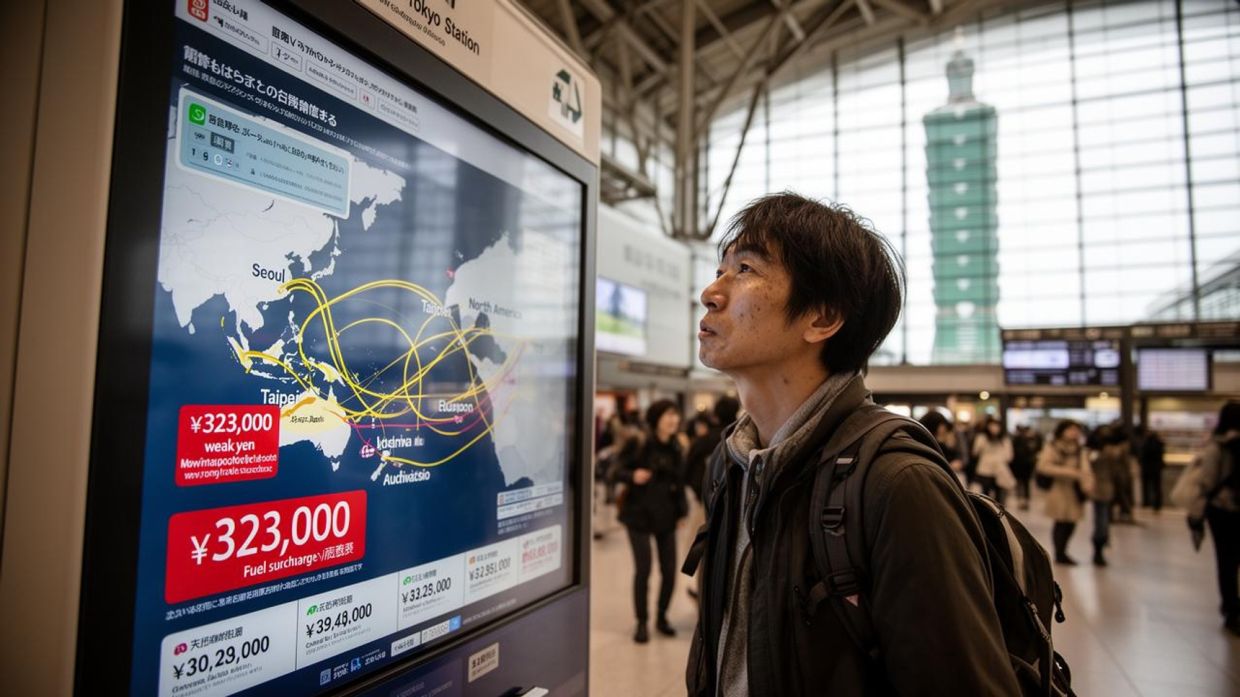
The deterioration in travel sentiment reflects a broader economic malaise gripping Japanese households. While average spending per overseas trip is projected to increase 6.3 per cent to 323,000 yen, this apparent rise masks genuine financial strain: travellers are paying more for the same experiences because the yen has weakened against major currencies. The combination of unfavourable exchange rates and fuel surcharges—inflated by geopolitical tensions in West Asia that have spiked aviation fuel prices—has rendered traditional long-haul destinations increasingly unaffordable for middle-income families. The mathematics are stark: what cost 300,000 yen two years ago may now require 320,000 yen, forcing households to recalibrate holiday budgets.
Geographical shifts in travel patterns reveal how price-conscious Japanese travellers are becoming. South Korea has emerged as the overwhelmingly preferred destination, capturing 26.2 per cent of outbound holiday trips, followed by Taiwan at 16.2 per cent. These proximate neighbours offer multiple advantages that appeal to budget-conscious families: lower airfares due to shorter flight times and intense regional competition among carriers, reduced currency headwinds since East Asian currencies have strengthened relative to the yen, and comparable tourism infrastructure and attractions to pricier long-haul alternatives. The strategic positioning of these destinations within a few hours' flight from Japan positions them as natural beneficiaries of Japanese consumers' shift toward value-conscious holidays.
The contraction in travel to China illustrates how geopolitical friction translates into immediate economic consequences. Visits to China are projected at just 10.1 per cent of destinations, representing a fifty per cent halved volume compared with the previous summer. Prime Minister Sanae Takaichi's remarks on Taiwan in November of the previous year, perceived as provocative by Beijing, exacerbated existing diplomatic tensions and appear to have deterred Japanese travellers from visiting mainland China. This serves as a microcosm of how diplomatic incidents can ripple through tourism markets, particularly when combined with economic headwinds that make travellers scrutinise choices more carefully.
Domesticated tourism provides another barometer of changing consumer behaviour. Domestic trips are forecast to decline 4.4 per cent to 69 million journeys, suggesting that even travel within Japan's borders is losing appeal as households tighten discretionary spending. However, the composition of domestic tourism remains stable: the Kanto region centred on Tokyo attracts the largest share at 19.0 per cent, the Kinki region in western Japan captures 14.9 per cent, and Hokkaido in the north accounts for 11.2 per cent. Despite lower overall volumes, these established destinations retain their appeal, indicating that travellers are postponing or cancelling trips altogether rather than dramatically shifting to alternative regions.
Spending patterns on domestic holidays further corroborate the thesis of selective retrenchment. While average per-person expenditure on domestic trips is projected to rise 3.2 per cent to 48,500 yen, the arithmetic mirrors that of international travel: rising prices rather than increased consumption. Travellers are likely consolidating trips into shorter durations, selecting more modest accommodation, and being deliberate about discretionary purchases during holidays. The apparent spending increase masks underlying volume reductions in the middle market, as families compress their plans into tighter, more economical itineraries.
JTB's analysis identifies a critical polarisation emerging within Japanese society regarding consumption patterns during economic uncertainty. The travel agency notes that a growing divergence exists between households substantially cutting back on vacation expenses—shortening trip lengths, selecting budget accommodations, or forgoing travel entirely—and a smaller cohort of affluent consumers determined to maintain their desired holiday experiences regardless of cost. This bifurcation reflects Japan's broader inequality challenge and the widening gap between households with wage growth sufficient to offset inflation and those experiencing real income stagnation. For lower and middle-income families, the summer of 2024 represents a watershed moment where traditional overseas holidays transition from routine to luxury.
The implications for Southeast Asian tourism are nuanced. While Japan remains a crucial source market for regional destinations, the shift toward nearby Asian neighbours benefits countries like South Korea and Taiwan disproportionately. Malaysian resorts, beaches, and tourism infrastructure—traditionally popular with Japanese families—may experience softer demand unless operators aggressively price their offerings to compete with regional alternatives. The temporary nature of this downturn depends critically on whether the yen stabilises and whether Japanese wage growth accelerates sufficiently to restore purchasing power.
JTB derived its projections from a June online survey targeting individuals who planned trips of at least one night during the specified summer period, a methodology that captures potential rather than actualised travel. These figures therefore represent planning intentions rather than confirmed bookings, suggesting that some planned trips may yet be cancelled if economic conditions deteriorate further or if sentiment shifts more sharply toward precautionary saving. The survey captures a moment of hesitation rather than definitive consumer behaviour, warranting careful monitoring of actual travel statistics as the summer season unfolds.
The broader lesson from Japan's summer travel contraction extends beyond tourism statistics. The weakness reflects how currency depreciation, imported inflation, and geopolitical friction combine to constrain discretionary spending even in developed economies with substantial household savings. For Malaysian policymakers and tourism operators, the Japanese market's current vulnerability underscores the importance of diversifying source markets and maintaining competitive pricing structures. As regional tourism recovers from pandemic-induced disruptions, the ability to attract price-sensitive travellers from developed markets may prove as important as competing for premium-segment visitors.

