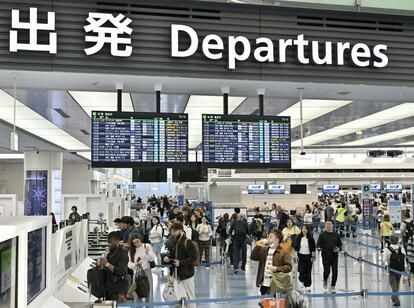
Japan's government implemented significant new travel levies on July 1, tripling the departure tax to 3,000 yen per person while dramatically hiking entry visa fees—the first increase in nearly half a century. The restructured charges reflect Tokyo's escalating struggle with managing unprecedented visitor volumes, even as it seeks to maintain Japan's appeal as a tourism destination. The simultaneous reduction in domestic passport fees demonstrates the administration's attempt to balance revenue-raising with public acceptance of the broader policy shift.
The international tourist tax, now set at 3,000 yen per departure, represents a substantial jump from the previous 1,000 yen levy. Collected directly through airline, cruise line, and travel agency ticket purchases regardless of passenger nationality, the tax applies to virtually all travellers leaving Japan by air or sea. The government projects the expanded tax will generate approximately 130 billion yen in the fiscal year beginning April 2026, compared with roughly 49 billion yen collected in the previous fiscal period. This threefold revenue expansion provides substantial financial ammunition for Tokyo's anti-congestion initiatives.
Foreign visitor visa fees have undergone equally dramatic restructuring. Single-entry visas now cost 15,000 yen, up from 3,000 yen, whilst multiple-entry visas jumped to 30,000 yen from 6,000 yen. Foreign Minister Toshimitsu Motegi characterised the increase as long overdue, attributing it to accumulated inflation and the yen's depreciation since the fees were last adjusted in 1978. He suggested the hikes would not immediately deter tourism, yet the magnitude of the increases—particularly the fivefold jump—represents a significant barrier for budget-conscious travellers, especially from neighbouring Southeast Asian countries where visa costs are typically lower.
The implications for Malaysian and regional travellers warrant careful consideration. Malaysia maintains a visa-exempt arrangement with Japan for short-term visits, exempting most Malaysian citizens from these new fees. However, Malaysian workers, business people, and students requiring visa extensions or multiple-entry visas will face substantially steeper costs. The increases may particularly affect migrant workers and those engaged in regular cross-border commerce, populations for which visa costs constitute meaningful expenses. Additionally, Malaysian travel agencies processing Japanese visa applications for third-country nationals will encounter higher processing costs to pass along to clients.
Japan's tourist tax revenue will primarily fund measures designed to redistribute visitor pressure away from chronically congested destinations. The government plans to establish dedicated areas at popular photography spots that have become overwhelmed by foreign visitors, particularly Instagram-famous locations. Beyond congestion management, funds will support regional tourism development initiatives including converting local railway networks into attractions and renovating station infrastructure. These investments aim to encourage visitors to explore provincial areas, reducing concentration in Tokyo, Kyoto, and Osaka where infrastructure and services have been strained by record tourist arrivals.
The departure tax structure includes carefully designed exemptions. Children under two years old are exempt, as are transit passengers remaining in Japan less than 24 hours. Travellers who purchased tickets before July 1 paid the original 1,000 yen rate, providing a transition period. The government is also implementing a phased collection approach through existing travel infrastructure, minimising disruption whilst ensuring comprehensive coverage across all departure methods.
Concurrently, the government reduced domestic passport fees to offset public opposition to the departure tax. Standard 10-year passports for adults dropped from 16,300 yen to 9,300 yen when applied at designated counters, with further discounts to 8,900 yen for online applications. Five-year passports for minors were standardised at 4,800 yen, or 4,400 yen online, down from variable age-based rates. This deliberate offsetting suggests the government anticipates domestic political resistance and seeks to frame the policy as proportionally fair between domestic and international travellers.
Japan's move reflects broader global trends in managing tourism sustainability. Unlike some destinations implementing strict visitor caps, Tokyo has chosen market mechanisms—pricing and infrastructure investment—to regulate demand whilst generating revenue for solutions. The strategy assumes that modest price increases will moderate growth without triggering significant declines. Whether this proves effective depends heavily on Japanese tourism's price elasticity, a question that will become clearer in coming months as booking patterns emerge.
The timing is notable given Japan's explicit goal to attract 60 million annual visitors by 2030, up from approximately 50 million pre-pandemic. Raising visa fees whilst tripling departure taxes might seem contradictory to expansion goals, but the government has signalled these measures target symptom management rather than demand reduction. The regional tourism initiatives and congestion relief measures represent a productivity play—extracting more sustainable value from the same or slightly reduced visitor volumes by distributing spending across wider geography.
For Malaysia and Southeast Asia, the policy carries subtle signals about Japan's evolving tourism positioning. The government is clearly willing to accept modest demand moderation from price-sensitive segments in exchange for managing negative externalities. This particularly affects budget travellers from middle-income Southeast Asian countries, potentially reshaping regional visitor profiles toward higher-spending demographics. Singaporean, Thai, and Filipino tourists may face different cost-benefit calculations compared with earlier years, potentially redirecting some demand toward less expensive regional alternatives.
The visa fee increase also positions Japan differently within the G7 context. Foreign Minister Motegi noted that Japan's previous visa charges had been comparatively low among wealthy nations, implying the increases represent convergence toward peer-country levels. This normalisation reduces Japan's cost advantage relative to destinations like South Korea, Hong Kong, and Australia that already charge premium visa fees. For regional travellers accustomed to cheap Japan visas, the new regime represents a material change in travel economics.
Implementation challenges will test the policy's effectiveness. Airlines and travel agencies must integrate the tax into ticketing systems, potentially creating transition friction. Regional carriers serving Southeast Asian routes will need to recalculate fares and surcharges, affecting ticket pricing across the region. The visa fee increase requires coordination across consulates and embassies worldwide, with Malaysia's three Japanese embassies in Kuala Lumpur, Kota Kinabalu, and Johor Bahru all implementing the changes simultaneously.
The ultimate test of these measures lies in their outcomes. If they successfully distribute visitor pressure whilst generating sufficient revenue for meaningful infrastructure improvements, the model could become a template for other overtourism-affected destinations. If they prove insufficient to address congestion or trigger unexpected demand destruction, Japan may pursue more aggressive interventions. For Malaysian visitors and stakeholders in the tourism supply chain, monitoring implementation and initial results over the next 12 months will clarify whether this represents a permanent repricing of Japan travel or a temporary adjustment to be reversed if targets prove difficult to meet.

