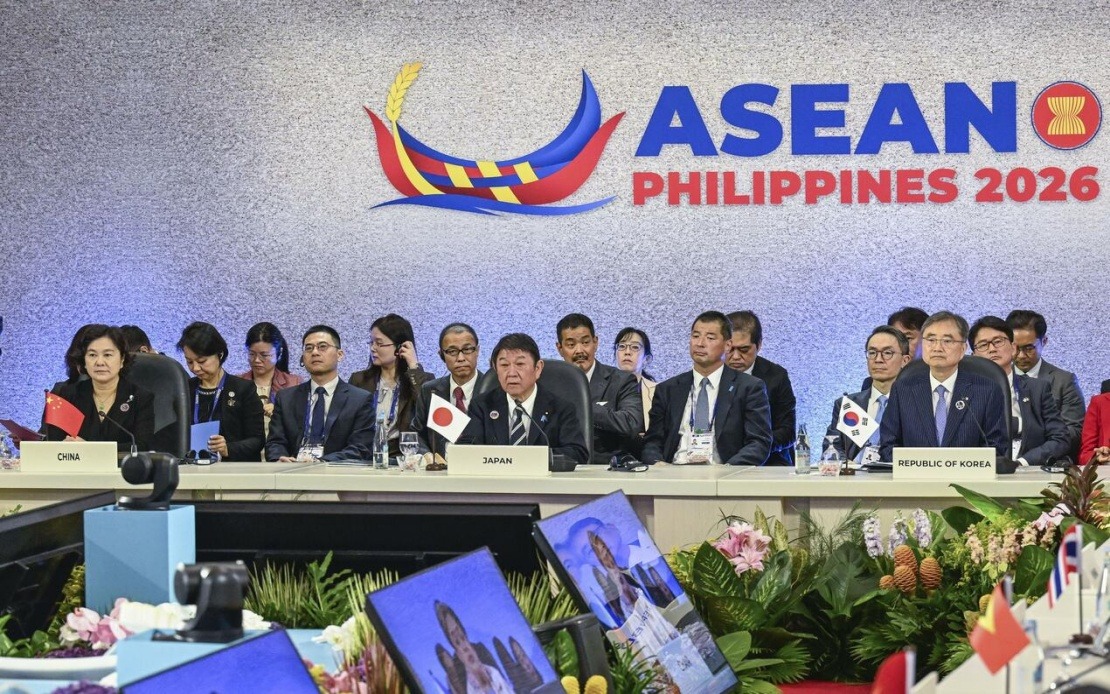
Japan has signalled its intention to deepen regional partnerships on critical issues including energy resilience and cybercrime prevention, pledging coordinated action at a high-level gathering in Manila involving foreign ministers from ASEAN, China, and South Korea. The commitment underscores Tokyo's strategic investment in multilateral frameworks that balance Chinese influence while anchoring regional stability through established institutional mechanisms.
Japanese Foreign Minister Toshimitsu Motegi articulated Japan's vision during discussions with his counterparts from member nations, framing the cooperative agenda within the context of the ASEAN-plus-three framework. Vice Foreign Minister Hua Chunying represented China at the gathering, stepping in for Foreign Minister Wang Yi, reflecting Beijing's continued engagement with the regional grouping despite broader geopolitical tensions.
Motegi emphasised that the combined economic output of ASEAN and its dialogue partners—China, Japan, and South Korea—now exceeds one quarter of global gross domestic product, a figure that underscores the region's outsized influence on international economic and political outcomes. This economic weight translates into considerable leverage in addressing transnational challenges that span energy markets, digital security, and financial systems. The implication for Malaysia and other ASEAN members is clear: the bloc's unified voice carries substantial gravitational pull in global forums.
Energy security emerged as a priority concern during the discussions, with participating nations recognising the necessity to fortify regional supply chains in response to escalating tensions in West Asia. The instability affecting Middle Eastern oil production has prompted neighbouring economies to reassess their energy diversification strategies and strengthen interconnections between regional suppliers and consumers. For Malaysia, which balances significant oil and gas production with downstream refining capacity, such coordination offers both opportunities to expand market access and risks if geopolitical disruptions intensify.
Japan's commitment to backing ASEAN's centrality in regional architecture reflects a deliberate policy choice to ensure the bloc maintains its position as a neutral convening platform rather than becoming subordinated to any single great power. Motegi reiterated Tokyo's endorsement of the ASEAN Outlook on the Indo-Pacific, the bloc's own strategic vision launched to preserve freedom of navigation, respect for international law, and economic openness across the maritime domain. This alignment signals Japan's recognition that ASEAN-led initiatives, rather than external frameworks imposed by Tokyo, Beijing, or Washington, offer the most durable foundation for regional consensus.
The convergence between Japan's free and open Indo-Pacific concept and ASEAN's outlook has created a pragmatic basis for cooperation that sidesteps zero-sum competition between major powers. Motegi indicated that Tokyo intends to leverage the ASEAN-plus-three mechanism to amplify these shared principles, effectively creating nested forums through which policy alignment can advance without requiring formal confrontation or public competition.
Online scams and digital fraud have emerged as acute transnational challenges affecting all economies in the region, with criminal networks exploiting jurisdictional boundaries and varying regulatory standards to perpetrate financial crimes. Japanese commitment to combating such activity reflects both self-interest—protecting Japanese citizens and companies operating across Southeast Asia—and recognition that coordinated law enforcement and technology standards benefit all participants. For Malaysia, where telecommunications infrastructure connects major population centres and financial hubs, such collaboration becomes essential to protecting citizens from increasingly sophisticated cybercriminal operations.
The ASEAN-plus-three framework itself carries historical significance as an institutional response to the 1997 Asian financial crisis, when coordinated action among the grouping prevented economic contagion from spreading unchecked. The framework has since evolved beyond its original crisis-management mandate to address contemporary challenges ranging from pandemic response to maritime security. The continuing relevance of this mechanism, demonstrated through regular ministerial meetings and summit-level engagement, suggests that institutionalised cooperation remains more resilient than ad-hoc bilateral arrangements.
Leadership transitions within major democracies can reshape diplomatic priorities and resource allocation. Motegi's subsequent engagement with newly appointed British Foreign Secretary Ed Miliband illustrated Japan's parallel commitment to strengthening ties with traditional Western allies, even as Tokyo deepens Asian regional partnerships. This dual-track approach reflects Japan's strategic position as a bridge between established Western institutions and an increasingly confident Asia-Pacific region where economic dynamism and geopolitical competition have intensified.
For Malaysian policymakers monitoring these developments, the signals emerging from ministerial discussions carry immediate implications. Energy cooperation frameworks could expand opportunities for Malaysian oil and gas companies, while joint cybercrime initiatives might enhance domestic security infrastructure. Simultaneously, ASEAN's ability to maintain centrality in regional forums—supported by commitments like Japan's—preserves the space for smaller and medium-sized economies to exercise disproportionate influence through coalition-building within the bloc.
The pledges articulated at this meeting reflect an understanding among Japan and its partners that regional stability depends on maintaining institutional channels for dialogue and practical cooperation, even amid great power competition. Whether these commitments translate into substantive policy changes and resource commitments will become evident as implementation mechanisms develop over coming months.

