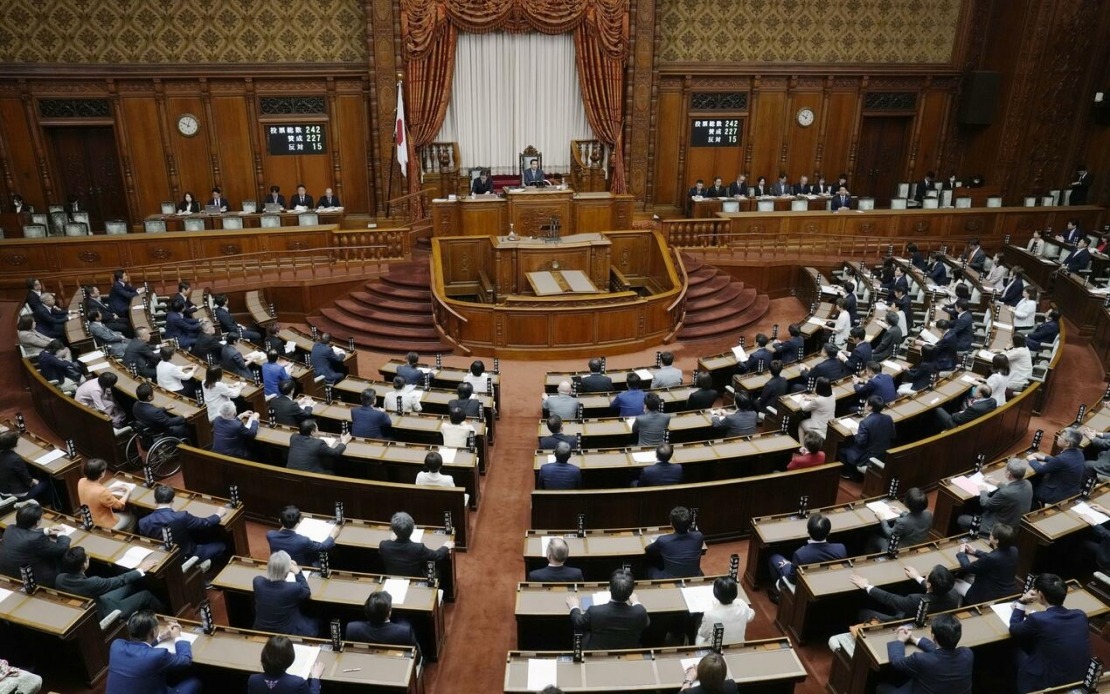
Japan has taken a significant step in modernising its defence posture by securing parliamentary approval for a comprehensive restructuring of its Air Self-Defence Force that explicitly incorporates space operations into the branch's official remit. The legislation, passed by the House of Councillors on Friday, marks a strategic pivot reflecting Tokyo's assessment that contemporary security challenges increasingly extend beyond traditional air and sea domains into the space domain, where both civilian infrastructure and military capabilities depend critically on satellite systems.
The reorganisation will introduce a new space-focused command structure set to become operational during the fiscal year ending March 2027. At the core of this transformation will be a dedicated space operations group, positioned under the leadership of a lieutenant general, designed to consolidate Japan's capacity to monitor activity in orbital space and maintain comprehensive awareness of the space domain. This structured approach aims to enhance satellite surveillance capabilities and ensure the Self-Defence Forces can operate effectively in an environment where adversaries increasingly view space as a strategic battleground. The timing reflects growing anxieties in Tokyo about the militarisation of space and the vulnerability of Japan's reliance on satellite infrastructure for both civilian and defence purposes.
Defence Minister Shinjiro Koizumi articulated the rationale behind the restructuring with particular emphasis on how space assets have become integral to everyday Japanese life. Beyond military applications, satellite systems underpin critical civilian functions including GPS navigation, weather forecasting and the map applications that millions of Japanese citizens use routinely through their smartphones. This civilian-military nexus means that any disruption to space infrastructure poses risks extending far beyond defence considerations, affecting economic activity, disaster response capabilities and public safety. Koizumi's framing of space defence as a comprehensive national priority, rather than a purely military concern, signals Tokyo's intent to build institutional frameworks capable of protecting Japan's broader dependence on orbital systems.
Concurrently, the legislation authorises the appointment of a second senior vice defence minister, a structural enhancement designed to distribute workload responsibilities within Japan's defence establishment. This additional appointment carries particular significance given the intensity of modern security crises and the management demands imposed by large-scale natural disasters. Japan's experience with catastrophic earthquakes and other emergencies has highlighted the necessity for robust command-and-control structures capable of managing both security contingencies and humanitarian responses simultaneously. The new position also facilitates expanded high-level defence dialogue with the United States and other security partners, reflecting Japan's strategy of deepening institutional ties with allied nations.
The recruitment and retention challenges facing the Self-Defence Forces have become increasingly acute as Japan confronts demographic decline and a shrinking working-age population. The legislation addresses these challenges by enhancing post-retirement benefits for SDF members, recognising that the current benefit structure places career military personnel at a disadvantage compared to their counterparts in the broader civil service. Since mandatory retirement ages for defence force personnel are typically substantially earlier than standard civil service retirement ages, improved post-service benefits represent a practical mechanism for attracting and retaining skilled personnel in an increasingly competitive labour market. This investment in personnel welfare reflects Tokyo's understanding that modern defence capabilities depend fundamentally on maintaining professional, experienced military forces.
A particularly significant element of the restructuring involves upgrading the Ground Self-Defence Force's 15th Brigade, currently based in Naha in Okinawa Prefecture, to full divisional status. This elevation carries profound strategic implications for Japan's southwestern defence architecture, as the Ryukyu archipelago represents an increasingly contested zone of strategic competition in East Asia. China's expanding maritime activities and the assertiveness of its coastguard have created persistent pressure on Japan's control of waters and islands in this region. By strengthening the institutional capacity and resource allocation to the Okinawa-based command, Tokyo signals its determination to maintain effective control over these territories and respond credibly to potential challenges. The upgrade also acknowledges the unique security challenges posed by the geographic dispersion and remoteness of Japan's southwestern islands, which require specialised command structures and resource concentrations.
Japan's defence evolution reflects broader shifts in regional security dynamics that carry implications for the entire Indo-Pacific region, including Southeast Asia. As China's military modernisation and assertive behaviour extend Japan's security perimeter into space and the maritime commons, Tokyo's strategic adjustments serve as harbingers of transformed security competitions that may ultimately affect other regional players. The emphasis on space capabilities, in particular, signals recognition that future great power competition will increasingly involve orbital assets, creating new vulnerability vectors for all states dependent on satellite infrastructure. Malaysia and other Southeast Asian nations, similarly dependent on space-based systems for communications, navigation and resource management, may find Japan's space defence initiatives relevant to their own emerging security challenges.
The legislative package demonstrates Japan's capacity to undertake comprehensive defence modernisation within the constraints of its constitutional framework and civilian control traditions. Unlike some regional competitors, Japan pursues military strengthening through transparent parliamentary processes, with explicit public articulation of strategic rationales. This transparency, combined with Japan's alliance relationships and its integration into established international law frameworks, positions its defence developments as stabilising rather than destabilising, even as the absolute scale of military capability increases. The contrast with more opaque defence developments elsewhere underscores divergent approaches to security competition in the region.

