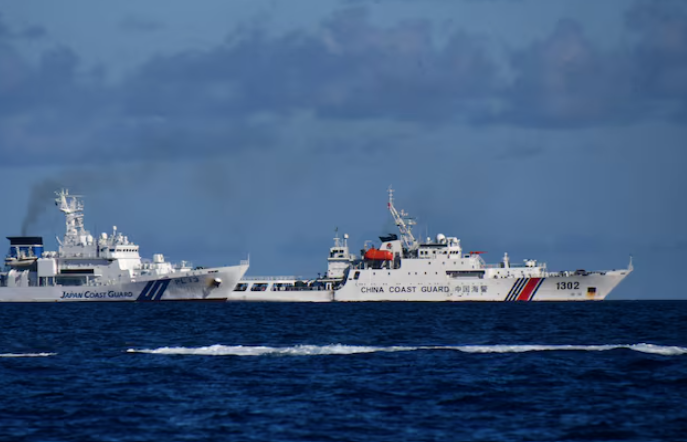
Japan's coast guard successfully expelled two Chinese coast guard vessels from disputed waters near the Senkaku Islands on Tuesday, in a move that underscores the persistent maritime tensions simmering between Tokyo and Beijing over one of Asia's most contentious territorial flashpoints. The Chinese ships, which were approaching a Japanese fishing vessel operating in the area, were forced to depart Japanese-claimed waters by approximately 9:20am local time, according to an official statement from Japan's coast guard, which emphasized the incident as a violation of international law.
The Senkaku Islands, referred to as the Diaoyu by China, represent one of the most enduring sources of friction in the region. Located strategically between Taiwan and Japan's Okinawa, these small but geopolitically significant islands have become a focal point for broader concerns about maritime security, territorial integrity, and the balance of power in the East China Sea. The competing claims reflect deeper historical grievances and contemporary strategic interests, with both nations viewing control over the islands as essential to their maritime sovereignty and access to potentially resource-rich waters in the surrounding region.
While Chinese coast guard vessels regularly patrol waters around the disputed islands—a pattern that has become almost routine since the 1990s—the Tuesday incident carries particular significance due to the direct threat posed to Japanese civilian fishermen. The fact that Chinese ships were actively approaching a Japanese fishing boat rather than simply conducting patrols represents an escalation in the nature of these confrontations. Japan's coast guard responded by positioning itself between the Chinese vessels and the Japanese fishing boat, demonstrating its commitment to protecting civilian maritime activities within its claimed territory.
The incident arrives against a backdrop of deteriorating bilateral relations that have intensified significantly since November, when Japanese Prime Minister Sanae Takaichi made public statements regarding Tokyo's potential military intervention in the event of armed aggression against Taiwan. China, which views the self-governed island as a renegade province and has never renounced the use of force to achieve reunification, responded sharply to these comments. Beijing's subsequent actions have included formal diplomatic protests, discouragement of Chinese citizens from traveling to Japan, and the imposition of targeted trade restrictions on select Japanese firms—measures designed to impose economic pressure while signaling political displeasure.
The broader context of these tensions extends beyond the Senkaku dispute itself. The East China Sea remains contested territory where multiple nations possess overlapping maritime claims and where significant energy reserves may lie beneath the seafloor. China has progressively expanded its coast guard operations throughout these waters, deploying vessels not only near the Senkaku Islands but also in other disputed zones, despite repeated Japanese protests and international appeals to respect the status quo. This pattern suggests a long-term strategy of asserting presence and establishing precedents for control.
June's previous incursion by Chinese vessels into Japanese-claimed waters occurred on June 10, though that incident did not involve direct contact with Japanese fishing boats. The rarity of situations where Chinese ships actually approach Japanese civilian vessels suggests that Tuesday's episode may represent either a deliberate change in operational tactics or an isolated aggressive maneuver. Either interpretation carries implications for future maritime interactions in the region and raises questions about whether China intends to increase pressure on Japan's fishing industry and maritime activities.
Japan's coast guard has emphasized its commitment to responding "calmly and resolutely" to future challenges while adhering to international and domestic legal frameworks. This measured rhetoric contrasts with the underlying tensions and risks inherent in repeated maritime confrontations between two major powers operating in confined waters. The coast guard statement stressed that it would "take every possible measure to ensure the security of our territorial waters," indicating that Tokyo views these incidents as matters of national interest requiring sustained attention and robust operational responses.
The strategic stakes extend beyond immediate territorial concerns. The Senkaku dispute functions as a test case for how international maritime law applies in contested zones, and how regional powers negotiate their competing interests. For Southeast Asian nations including Malaysia, which face their own territorial disputes in the South China Sea and maintain complex relationships with both Japan and China, the pattern of escalation in the East China Sea carries cautionary lessons about the potential for isolated incidents to trigger broader confrontations.
Beijing's decision to encourage its citizens to avoid Japan and to impose trade measures represents an attempt to leverage economic and social pressure alongside military and maritime tactics. These multi-layered approaches signal that China views current tensions as extending far beyond water-based disputes. The combination of coast guard operations, diplomatic protests, travel advisories, and trade restrictions creates a comprehensive pressure campaign designed to influence Japanese policy and demonstrate costs to Tokyo's positioning on Taiwan and regional security matters.
Looking forward, the trajectory of these confrontations will likely depend on how both nations calibrate their responses to future incidents. Japan's demonstrated willingness to physically position its coast guard between Chinese vessels and Japanese fishing boats sets a precedent for active defense of claimed territories. Simultaneously, China's apparent willingness to approach Japanese civilian vessels suggests it may be testing Tokyo's resolve or seeking to generate incidents that could be leveraged diplomatically. The sustainability of this pattern remains uncertain, particularly given the risks inherent in sustained maritime brinkmanship in heavily trafficked waters where a single miscalculation or equipment failure could trigger an unintended escalation.

