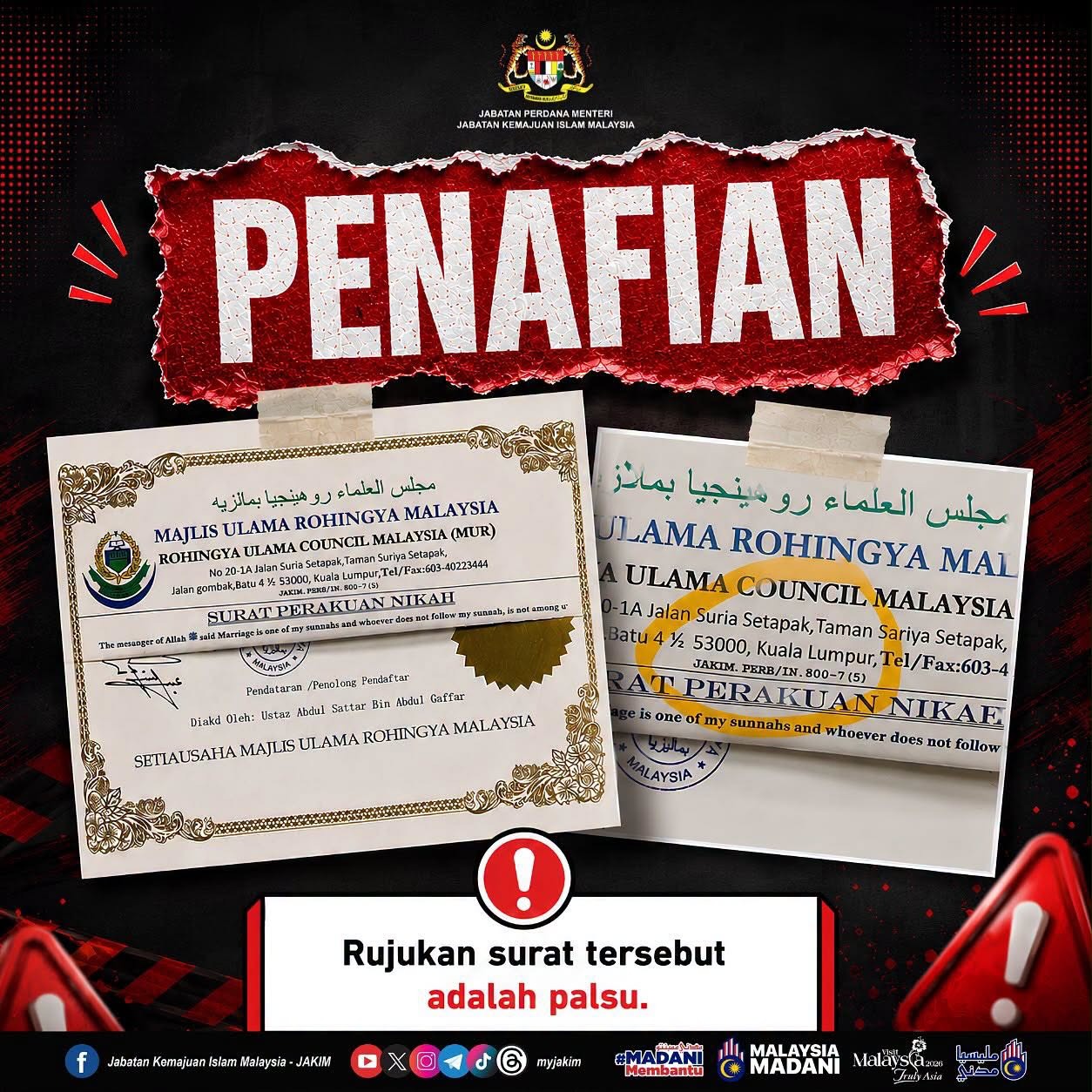
The Department of Islamic Development Malaysia (JAKIM) has moved swiftly to discredit a fraudulent document that circulated widely on social media, stating that a marriage declaration letter attributed to the Malaysia Rohingya Ulama Council carries a counterfeit reference number with no legitimate connection to the department. The announcement, made through JAKIM's official Facebook page on July 15, represents a significant warning to the public about the proliferation of forged religious documents in the digital age.
The problematic letter displayed the reference number "JAKIM.PERH/LN.800-7(5)," which created the false impression of official governmental endorsement. Upon investigation, JAKIM confirmed that this reference code is entirely fabricated and does not correspond to any authentic documentation system maintained by the department. The discovery underscores the ease with which malicious actors can exploit religious and governmental credibility by manufacturing official-appearing credentials, a particularly dangerous practice when applied to marriage-related matters that carry both legal and spiritual significance in Malaysian society.
In its formal statement, JAKIM clarified that neither itself nor any of the state-level Islamic religious councils and departments has ever appointed the Malaysia Rohingya Ulama Council or any similar organisation to manage, certify, or validate marriage-related documentation. This distinction is crucial for Malaysian Muslims seeking to formalize marriages through proper channels, as it establishes a clear boundary between legitimate religious authorities and self-appointed bodies operating outside the established regulatory framework. The department's explicit denial of any association with the named organisation serves to protect the integrity of Malaysia's Islamic institutional architecture.
The implications of this case extend beyond a single fraudulent document. The viral spread of the fake letter on social media platforms demonstrates how quickly misinformation can circulate within religious and immigrant communities, potentially affecting people's understanding of legitimate marriage procedures. For the Rohingya community in Malaysia, where many face legal and documentation challenges, the existence of such counterfeit materials poses particular risks, as vulnerable populations may be more susceptible to accepting false credentials out of desperation to formalize personal relationships through apparently official channels.
JAKIM has responded to the incident by issuing guidance to the public, recommending that anyone encountering doubtful religious documents should verify their authenticity directly with the department or the appropriate state Islamic religious authority before accepting them as genuine. This proactive approach shifts some responsibility to individual citizens while simultaneously reinforcing the need for systematic authentication mechanisms within Malaysia's Islamic administration. The recommendation reflects a broader challenge facing government agencies in the digital era—the constant need to educate the public about distinguishing authentic communications from sophisticated counterfeits.
Minister in the Prime Minister's Department (Religious Affairs) Dr Zulkifli Hasan indicated that a formal investigation would commence once complete information about the document and its circulation had been gathered. This investigation will likely focus on identifying the source of the fraudulent letter, understanding the intent behind its creation, and determining whether it was part of a broader scheme to issue fake religious documents or an isolated incident. The involvement of the ministerial office signals the seriousness with which the government treats threats to the legitimacy of Islamic institutional processes.
The case illuminates the broader vulnerability of Malaysia's Islamic administrative systems to document fraud, particularly given the reliance on reference numbers and official letterheads to establish credibility. As digital forgery techniques become increasingly sophisticated, religious authorities across Malaysia will need to implement enhanced verification systems that go beyond surface-level reference number checks. This might include digital signatures, secure databases accessible only to authorized personnel, and public-facing verification portals where individuals can confirm document authenticity in real time.
For the Rohingya community specifically, the incident highlights both their vulnerability to exploitation through forged documents and the fragmentation of their institutional representation in Malaysia. The attribution of the fake letter to the Malaysia Rohingya Ulama Council suggests either that the council's name was appropriated without authorization or that the council itself may have been implicated in the fraud—a distinction that future investigations will need to clarify. Either scenario raises questions about how migrant and refugee communities in Malaysia can establish legitimate representative institutions that are simultaneously recognized by state authorities.
The broader context includes Malaysia's ongoing efforts to regulate Islamic affairs at both federal and state levels while maintaining the constitutional autonomy of state religious authorities. This decentralized approach creates both strengths and vulnerabilities. While it allows religious councils to remain responsive to local community needs, it also creates potential gaps in coordination and verification systems that fraudsters can exploit. The JAKIM statement represents an attempt to bridge these gaps by making clear that the federal department maintains oversight even as state councils retain primary jurisdiction.
As Malaysian society continues to navigate the intersection of digital communication and institutional legitimacy, cases like this one will likely become more common. The government's response demonstrates a necessary first step—immediate denial of association with fraudulent documents—but longer-term solutions will require technological innovation, enhanced public awareness, and potentially new legislative frameworks that establish clear penalties for document forgery in the religious and matrimonial sphere. For now, JAKIM's appeal to the public to verify documents independently serves as a reminder that institutional credibility ultimately depends on widespread public understanding of what legitimate channels and procedures actually look like.

