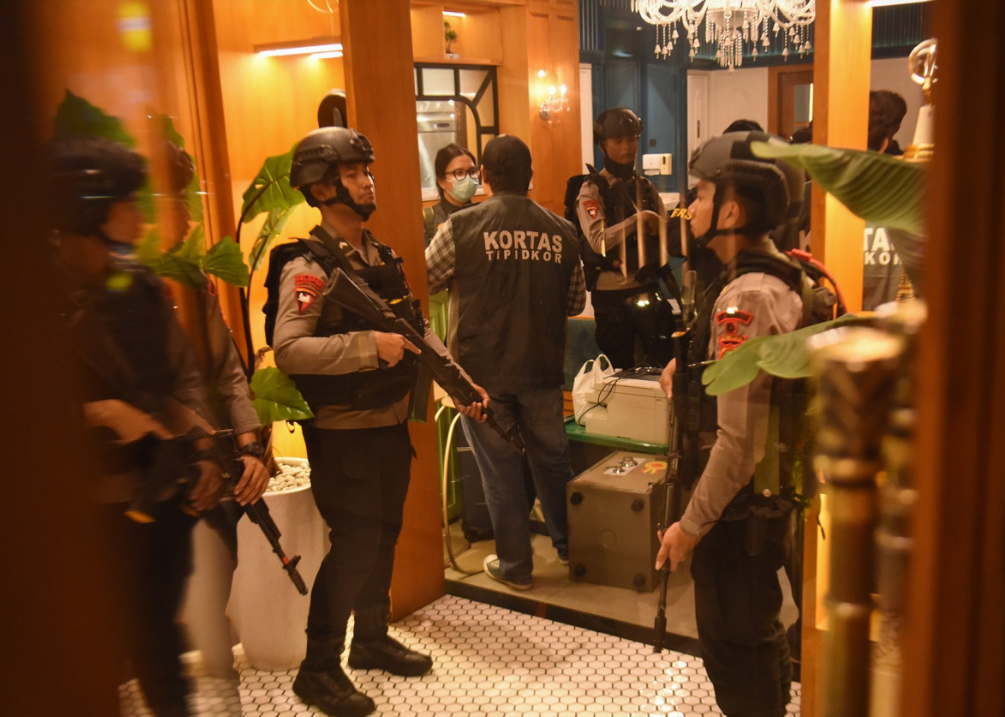
A heavily armed police operation spanning multiple Jakarta locations has uncovered one of the country's largest corruption-related asset seizures in recent memory, with nearly US$26.3 million in gold bars and foreign currency discovered at properties linked to Febrie Adriansyah, who until this month served as Indonesia's deputy attorney general for special crimes. The dramatic early-morning raids, which began on Wednesday afternoon and extended into Thursday's dawn hours, revealed a startling concentration of wealth held across residential properties, money-changing operations, and upscale commercial establishments in and around the capital, raising fresh questions about institutional safeguards within Indonesia's justice system.
The operation centred on a sprawling residence in Sentul, a leafy suburban hillside community approximately one hour's drive south of Jakarta, where authorities discovered seven suitcases containing 74 kilograms of gold bullion alongside substantial holdings of foreign currency. The Sentul property, which belongs to Adriansyah, became the focal point of media attention as television and photographic imagery of gleaming gold bars and neatly stacked banknotes in multiple denominations circulated rapidly through Indonesian news outlets and social media platforms. These images of concentrated wealth have already crystallised public perception of the scandal, transforming what might have remained an abstract corruption investigation into visceral visual evidence of alleged malfeasance at the highest levels of Indonesia's law-enforcement hierarchy.
During the same coordinated sweep, units from Jakarta's police force alongside officers from the National Police's corruption crime division, supported by Mobile Brigade tactical teams equipped with long-barrel firearms and full protective gear, descended upon de'Clan Signature, an upscale dining establishment in the Cipete neighbourhood of South Jakarta. Behind a cabinet-concealed safe approximately two metres in height, officers located documents and substantial quantities of cash denominated in multiple foreign currencies worth several million dollars. The seizure continued immediately next door at Koin Money Changer, where a second safe yielded hundreds of thousands of additional rupiah banknotes, suggesting a sophisticated infrastructure for managing illicitly-obtained funds across multiple physical locations and asset classes.
The coordinated nature of the raids—encompassing at least a dozen separate locations stretching from central Jakarta to its outlying districts—suggests a long-term investigation into a potentially extensive financial network. Properties targeted included a residence at the high-end Pacific Place apartment complex near the Jakarta stock exchange, various corporate offices scattered throughout the metropolitan area, and a Gandaria-area South Jakarta house connected to Don Ritto, a lawyer also named as a suspect in the investigations. Ritto reportedly maintains business interests in entities linked to both the raided restaurant and money-changing operation, according to corporate registration records cited by local media outlets. The breadth of the operation implies that investigators have mapped interconnected layers of financial activity and property ownership extending well beyond Adriansyah's individual holdings.
Febrie Adriansyah, who held the deputy attorney general position for special crimes for over four years before resigning in the operation's immediate aftermath, has been formally named as a suspect in corruption and money-laundering investigations. However, he has not been placed under formal detention, a status distinction that carries significant legal implications under Indonesian criminal procedure. Adriansyah has acknowledged ownership of the Sentul property but firmly denied that the seized assets belong to him, asserting instead that the origin and legitimate ownership of the discovered wealth will emerge through the legal process. This assertion—that substantial quantities of gold and foreign currency discovered at his residence somehow belong to other parties—forms the crux of what prosecutors will need to establish during any eventual trial proceedings.
The discovery has ignited broader debate within Indonesian legal and political circles regarding whether the nation's anti-corruption architecture is functioning effectively or whether the escalating frequency of such scandals indicates systemic institutional decay. The public display of seized assets, while effective in generating public concern about corruption, simultaneously raises uncomfortable questions about whether detection and enforcement mechanisms are adequate to prevent such accumulation in the first instance, or whether they merely serve to prosecute cases after massive institutional damage has occurred. For Southeast Asia more broadly, Indonesia's anti-corruption credibility carries outsized importance given its position as the region's largest economy and third-most populous nation.
Mahfud MD, a constitutional law specialist of considerable standing who formerly served as Indonesia's Constitutional Court chief justice and coordinating minister for political, legal and security affairs, has publicly questioned fundamental procedural decisions surrounding the investigation's management. Through his YouTube channel, Mahfud raised concerns that the transfer of investigative authority from the police to the Attorney General's Office lacks statutory foundation under Indonesia's criminal procedure code and potentially exposes the case to pre-trial legal challenges that could derail prosecution. His intervention carries particular weight given his intimate knowledge of Indonesia's constitutional and criminal justice frameworks, suggesting that procedural irregularities in high-profile corruption cases remain a persistent structural vulnerability.
Mahfud's intervention also signals a potential institutional turf dispute between Indonesia's Corruption Eradication Commission, the independent anti-corruption body established specifically to investigate official malfeasance, and the Attorney General's Office, which has assumed primary investigative responsibility in this case. He has explicitly advocated for the Corruption Eradication Commission to assume control of the investigation, arguing that the independent agency's mandate and institutional autonomy position it better to pursue the case without becoming enmeshed in potential political interference. This jurisdictional question carries implications extending beyond Adriansyah's individual case, touching upon fundamental questions about which institutions within Indonesia's justice system possess sufficient independence and capacity to investigate corruption at the most senior levels.
The timing and scale of the discovery raises awkward questions about oversight mechanisms that might have functioned during Adriansyah's tenure. His position as deputy attorney general responsible for special crimes placed him at the apex of Indonesia's corruption-fighting apparatus, theoretically positioned to understand and potentially exploit vulnerabilities in investigative and enforcement procedures. The seizure of assets in his name after he had occupied such a sensitive position for over four years suggests either that internal controls proved wholly inadequate to detect illicit enrichment at the highest levels, or that senior officials possessed sufficient position and knowledge to shield activities from scrutiny until circumstances beyond their control precipitated disclosure.
For Malaysian observers and policymakers, the Jakarta scandal offers cautionary perspective on institutional risks inherent in justice systems where senior appointed officials occupy positions combining investigative, prosecutorial, and administrative authority. The integration of corruption investigation responsibility within a single official's portfolio creates potential conflicts of interest and reduces institutional checks and balances that might prevent or detect malfeasance. Malaysia's experience with the Malaysian Anti-Corruption Commission, which operates as an independent agency with specific mandate limitations, reflects a conscious institutional design attempting to avoid the jurisdictional ambiguities currently bedevilling Indonesia's response to this case.
The broader implications for Southeast Asia's anti-corruption trajectory remain uncertain. Indonesia has periodically undertaken high-profile investigations demonstrating investigative capacity and media attention focused on corruption remains robust. Simultaneously, the discovery of assets in a former deputy attorney general's possession underscores that even institutions ostensibly dedicated to fighting corruption remain vulnerable to internal exploitation. The coming weeks will reveal whether Indonesia's legal system can prosecute this case with procedural regularity sufficient to withstand appellate scrutiny, whether the Corruption Eradication Commission assumes investigative control as Mahfud advocates, and whether the scandal prompts institutional reforms addressing the jurisdictional and oversight questions his intervention has highlighted. The implications extend beyond Indonesia's borders, influencing regional perceptions of whether Southeast Asia's most significant economies possess institutional capacity for genuine accountability at the highest levels of government.

