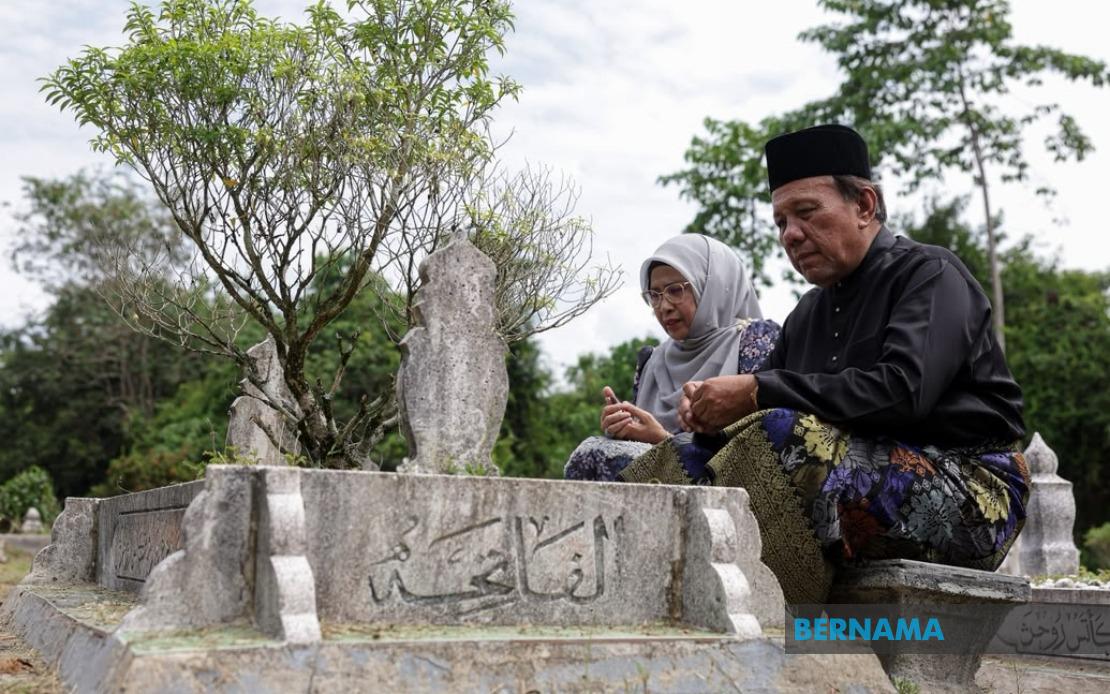
Datuk Ismail Lasim marked his assumption of office as Negeri Sembilan Menteri Besar with a poignant personal gesture, visiting the graves of his late parents at Tebing Tinggi Muslim cemetery in Kuala Pilah shortly after taking the oath of office. Accompanied by his wife Datin Noraishah Othman and dressed in traditional black Malay formal wear, the newly elected chief minister observed a moment of reflection at the burial site, paying tribute to his family roots as he embarked on his new political responsibilities.
The swearing-in ceremony took place at Istana Besar Seri Menanti, where Ismail received his oath of office before Tuanku Muhriz Tuanku Munawir, the Yang di-Pertuan Besar of Negeri Sembilan. The formal investiture represents the culmination of Ismail's political ascent within the state, capitalizing on his victory in the Juasseh state assembly seat during the electoral exercise held the previous day.
Ismail's parents, whose memory he honoured on his first day in office, have been deceased for several years. His father, the late Lasim Yaman, passed away on March 5, 2020, at the advanced age of 97, while his mother, the late Bedah Othman, died on September 16, 2014. The gesture of visiting their graves underscores the significance many Malaysian political figures place on acknowledging family legacy and personal values even as they assume positions of public authority.
The electoral outcome that propelled Ismail into the chief minister's position reflects broader political dynamics within Negeri Sembilan. Barisan Nasional emerged as the dominant force in the 16th state election, securing 18 of the state assembly's seats. Perikatan Nasional complemented this performance by winning seven seats, creating a combined supermajority that provided both coalitions with a commanding two-thirds advantage in the legislature. This decisive result contrasts with the fractured political landscape witnessed in several other Malaysian states in recent years, where slim majorities have sometimes necessitated delicate coalition management.
The configuration of political forces in Negeri Sembilan carries implications beyond the state itself. The performance of Barisan Nasional in securing such a substantial number of seats demonstrates the coalition's continued resonance in at least certain state constituencies, particularly given the backdrop of the coalition's mixed fortunes across Malaysia. The alliance between Barisan Nasional and Perikatan Nasional in forming the state government represents a practical accommodation between two major political groupings, suggesting that despite broader national political competitions, pragmatic cooperation remains feasible at the state level when electoral arithmetic dictates.
For Ismail personally, the transition into the chief minister role represents a significant career milestone. His background and performance in the Juasseh seat evidently gained sufficient support from his party leadership to position him for elevation to the state's highest executive post. The timing of his visits to his parents' graves speaks to Malaysian cultural traditions that emphasize filial piety and the acknowledgement of ancestral influence even during moments of personal achievement and elevated responsibility.
The governance challenges ahead for Ismail's administration will likely encompass the standard portfolio of state-level concerns: economic development, infrastructure, social services, and the management of federal-state relations. Negeri Sembilan, situated centrally within Peninsular Malaysia and proximate to the federal capital, occupies a position that traditionally has allowed it to leverage both its geographic advantages and historical significance within the federation. The state government's ability to work effectively with federal authorities and coordinate with neighbouring states will influence its capacity to deliver on development objectives.
The two-thirds supermajority secured by the Barisan Nasional and Perikatan Nasional combination provides the government with substantial legislative flexibility. Such a majority permits the passage of state constitutional amendments if necessary and reduces the likelihood of legislative gridlock or procedural obstruction. However, it also carries expectations among constituents for assertive governance and tangible delivery of promised benefits and development projects.
The broader political narrative encompassing this state election reflects the continued vitality of electoral competition within Malaysia's federal system. Despite national-level political currents and positioning, state elections remain distinct contests where local factors, personalities, and regional issues exercise meaningful influence. The performance of different political coalitions across various states provides important signalling regarding electoral sentiment and the relative standing of political organizations among different demographic and geographic constituencies throughout the country.

