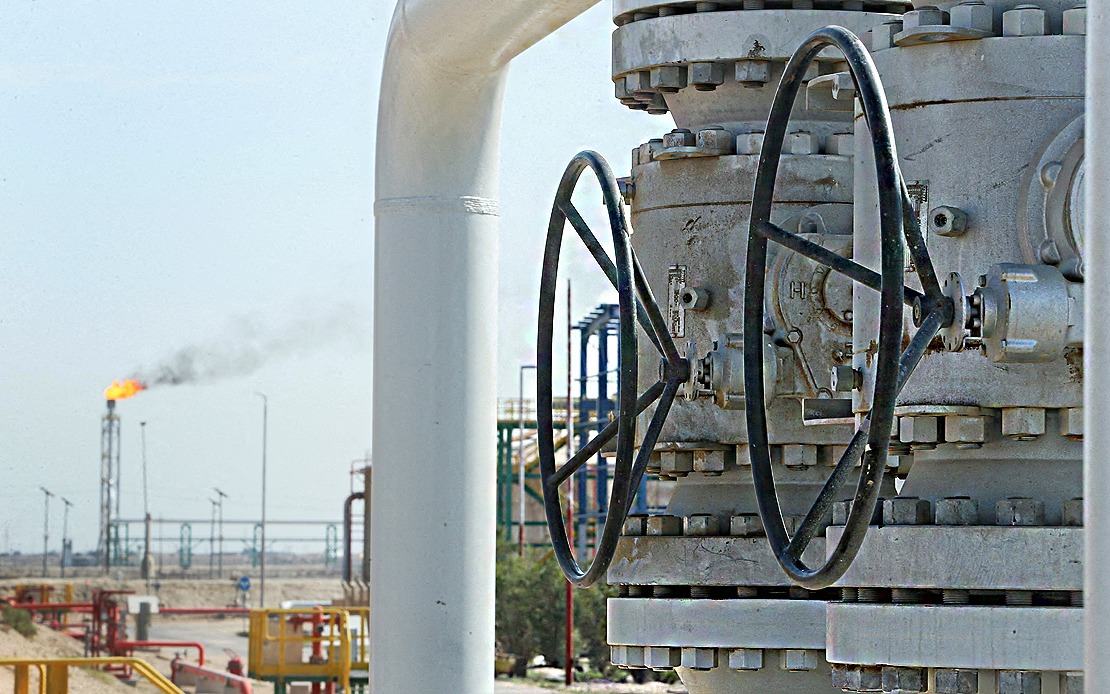
Iraq's government is moving decisively to reduce its vulnerability to disruptions in the Strait of Hormuz by developing an alternative pipeline network that would funnel crude oil directly to Mediterranean terminals in Turkey and Syria. Oil Minister Bassim Khudair announced the acceleration of these plans over the weekend, signalling Baghdad's determination to secure independent export pathways as geopolitical tensions continue to threaten traditional shipping routes through the Persian Gulf's critical waterway.
The proposed infrastructure would link Iraq's two primary oil-producing regions—Basra in the southern desert and Kirkuk in the north—to the Turkish port of Ceyhan and the Syrian Mediterranean outlet of Baniyas. Feasibility studies are already underway to evaluate the technical and economic viability of this ambitious undertaking, which represents one of the most significant infrastructure projects Baghdad has contemplated in recent years. The initiative reflects a fundamental shift in how Iraq views its energy security, moving away from historical reliance on a single maritime corridor that has proven increasingly unreliable.
The broader strategic context makes this pipeline initiative particularly urgent. The Strait of Hormuz, through which roughly one-third of global seaborne oil trade normally passes, has been effectively blocked for months due to escalating hostilities between Iran and the United States. This blockade has created substantial headwinds for Iraqi oil exports precisely when the nation can least afford disruptions. Iraq's economy remains heavily dependent on petroleum revenues, which in stable periods account for over 90 per cent of state income. This overwhelming reliance means that any interruption to export capacity translates directly into fiscal shortfalls that threaten the government's ability to function.
The human cost of export disruptions cannot be overstated in the Iraqi context. More than 10 million citizens depend entirely on monthly government transfers, including civil service employees, pensioners, and welfare beneficiaries. When oil revenues decline, these payments become difficult to sustain, creating a ripple effect throughout society. This structural vulnerability has motivated Baghdad to pursue diversification strategies with renewed urgency, as the current geopolitical situation has demonstrated that the Strait of Hormuz cannot be treated as a reliable export channel during periods of regional conflict.
Beyond the initial Mediterranean corridor, Iraqi planners are contemplating even more ambitious extensions. The feasibility study explicitly considers expanding the pipeline network to reach the Jordanian Red Sea port of Aqaba, which would provide an additional outlet and further reduce dependence on any single maritime route. Such geographic diversity would insulate Iraqi oil exports from disruptions in any single corridor and distribute infrastructure vulnerability across multiple nodes. This network thinking reflects a maturation of Iraq's strategic planning, moving beyond single-route solutions toward more resilient, interconnected systems.
Government officials in Baghdad have articulated what they describe as a comprehensive strategic vision for developing multiple export pathways. This framing is significant because it suggests a long-term commitment rather than a reactive response to immediate crisis. The ministerial language around "clear vision and strategy" indicates that pipeline development is being positioned as a cornerstone of Iraq's energy policy for the coming decade, rather than a temporary expedient.
However, the practical challenges of overland pipeline infrastructure deserve serious consideration. Exporting crude through pipelines spanning hundreds of kilometres involves substantially higher operational costs and logistical complexity compared to conventional maritime shipping. The economics become less favourable, particularly when production volumes are considered. These technical realities mean that even with successful infrastructure development, Iraqi officials will likely continue to view maritime export as the preferred option when international conditions permit it.
An equally significant consideration involves the geopolitical vulnerabilities that would persist even after pipeline construction. Iraqi and international analysts acknowledge frankly that pipelines and related energy infrastructure lying outside the Strait of Hormuz remain potentially susceptible to Iranian military action or disruption. The proposed routes traverse or pass near territories where Iranian interests are engaged, creating asymmetric risks that infrastructure planners must account for in their designs and security protocols. This sobering reality means that alternative export infrastructure, while valuable, cannot completely eliminate Iraq's exposure to regional power dynamics.
Iraq already operates an existing pipeline corridor into Turkey that carries some crude production, though this route travels through the autonomous Kurdish region, which creates its own political and administrative complexities. To provide greater flexibility and reduce its dependence on Kurdish-controlled territory, Baghdad has invested in developing a second pipeline that circumvents the Kurdistan region entirely. This alternative corridor is currently undergoing final commissioning and testing procedures, with Minister Khudair indicating that it could commence operations within days of his statement. This development, while less ambitious than the Mediterranean scheme, offers a more immediate solution to Hormuz chokepoint concerns.
For Southeast Asian energy markets and maritime powers like Malaysia, Iraq's strategic repositioning carries important implications. Any successful reduction in Iraqi oil shipments through the Strait of Hormuz could marginally ease congestion and security pressures in that critical waterway, potentially benefiting regional shipping and commerce. Conversely, the emergence of alternative pipeline routes through Syria and Turkey represents a shifting geography of Middle Eastern energy flows that will reshape transportation networks and geopolitical alignments across Asia's energy supply chains. Malaysia, as a major energy consumer and maritime nation dependent on stable Hormuz passage, has direct interest in how Iraq's export infrastructure evolves.
The initiative also signals broader patterns across the Middle East, where multiple states are pursuing infrastructure strategies designed to reduce individual vulnerability to corridor disruptions. This diversification impulse, driven by rational self-interest in an increasingly unstable region, will likely define energy infrastructure development patterns for years to come. Iraq's Mediterranean pipeline proposal represents not merely a national project but a microcosm of how resource-dependent nations are adapting their economic strategies to persistent geopolitical uncertainty.

