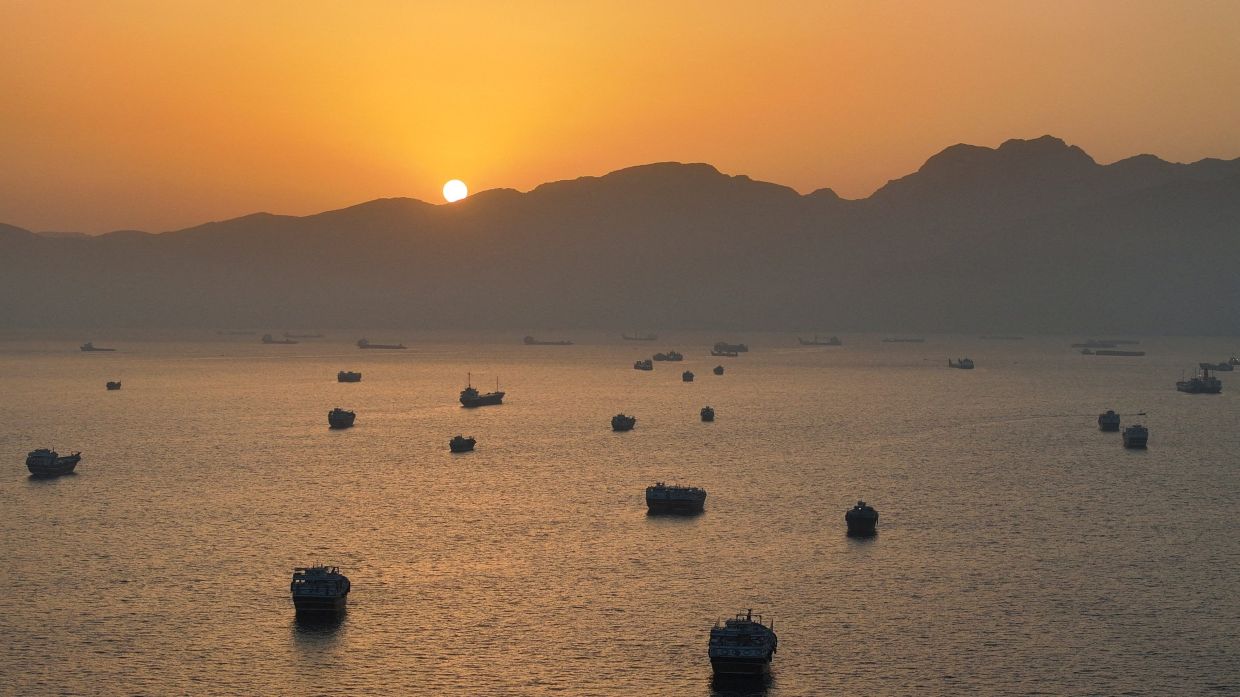
The movement of crude-laden tankers through the Strait of Hormuz is accelerating after months of costly delays, marking a significant shift in the region's shipping dynamics. On Wednesday, three major vessels departed the waterway that channels roughly one-third of the world's seaborne crude oil, their exit facilitated by diplomatic headway between Tehran and Washington that has begun to unlock substantial petroleum reserves bottled up in the Gulf since the Middle East conflict intensified.
Among those departing, South Korea's VL Breeze—a Very Large Crude Carrier managed by Hyundai Oilbank—transited the strait bound for Daesan with two million barrels of condensate sourced from Qatar and Abu Dhabi. Simultaneously, the Plata Carrier, operating under charter to India's Oil Corp, cleared the passage with two million barrels of Saudi Arabian crude, while the Prudent Warrior, a slightly smaller Suezmax vessel, headed toward Sohar in Oman carrying one million barrels of Iraqi output. These movements underscore the degree to which Asian refiners—particularly in South Korea and India—have been constrained by the inability to source crude from traditional Gulf suppliers.
The breakthrough holds particular significance for East Asian energy security. Regional refiners have depended heavily on Middle Eastern supplies, making the restoration of normal tanker flows through Hormuz critical to their operational economics and inventory management. The South Korean maritime ministry confirmed that four vessels operated by domestic shipping companies had navigated through the strait on the same day, with one heading to South Korea and the others proceeding to third-country destinations. The statistics paint a picture of pent-up demand finally finding outlet: of the twenty-six vessels that became stranded at the conflict's onset, eighteen remain bottled up within the Gulf, leaving their operators in limbo and driving up insurance and demurrage costs.
Market analysts at Kpler and Vortexa had previously estimated that approximately ninety million barrels of crude accumulated within the Persian Gulf region—a figure that underscores the magnitude of the blockage and the economic waste of idle tanker capacity and unexported inventory. The dollar value of stranded crude at current market rates represents a substantial hemorrhage for producing nations and shippers alike. Each day that vessels remain immobilized translates into opportunity cost, financing expenses, and operational inefficiency that ultimately feeds into global energy prices through constrained supply and elevated risk premiums.
The interim accord between Iran and the United States provides the political foundation underpinning this newfound mobility. By reducing tensions sufficiently to permit the resumption of commercial maritime operations, the agreement addresses one of the most disruptive factors in global energy markets—geopolitical risk concentrated in a chokepoint through which commerce worth billions of dollars flows daily. The psychological impact of such accords often precedes their tangible effects; the mere perception of reduced confrontational risk encourages vessel operators and insurers to normalise transit patterns and pricing.
Oman and the International Maritime Organization have established supplementary maritime corridors flanking the primary shipping lane to provide alternative passage routes that offer increased safety and predictability for departing vessels. The sultanate has pledged to maintain open access to the Strait of Hormuz without imposing transit tolls—a commitment that facilitates the orderly departure of accumulated traffic. These institutional arrangements, developed in consultation with the shipping industry, reflect the practical necessity of de-risking passage through contested waters and preventing future congestion.
Liquefied natural gas shipments show complementary signs of restoration. Nine empty LNG carriers have now been documented transiting Hormuz en route to Qatari loading terminals, the highest figure since the outbreak of hostilities. Among these are the Shandong Redwood and Milaha Qatar, both photographed west of the strait preparing to load cargo. Qatar's Prime Minister Sheikh Mohammed bin Abdulrahman al-Thani indicated to the Financial Times that the nation expects to resume full LNG production capacity within weeks, signalling confidence that the diplomatic opening will sustain long enough to normalise energy exports from the region.
The implications for global energy markets extend well beyond the Persian Gulf itself. Crude oil and natural gas priced on international exchanges respond to shifts in supply expectations; the movement of these vessels and the articulation of production resumption targets by Gulf producers introduce material supply additions to markets that have operated under perceived scarcity. Refined product markets in Asia—where Singapore functions as a key trading hub—stand to benefit from improved crude availability and lower import costs for regional refineries. Energy-intensive sectors across Southeast Asia, from petrochemicals to power generation, face potential margin improvement if feedstock sourcing normalises.
However, the durability of this opening remains uncertain. Geopolitical situations in the Middle East have historically proved volatile, with previous ceasefires and agreements sometimes deteriorating rapidly. Shipping companies and insurers remain cautious, and premiums for passage through contested waters are unlikely to disappear entirely until a more durable political settlement takes root. Nevertheless, the current flow of vessels through Hormuz suggests that commercial logic and economic necessity are pushing participants toward normalisation, even amid underlying regional tensions.
For Malaysian businesses and consumers, the reopening of Gulf supply channels carries concrete benefits. Malaysia's petrochemical industry, which relies on imported crude and condensates, stands to access feedstocks at more competitive pricing. Domestic utilities and industrial consumers benefit from downward pressure on regional fuel costs. The broader Southeast Asian economy, which remains dependent on affordable energy for competitiveness in global manufacturing and logistics, gains from supply restoration in one of the world's most critical petroleum-producing regions. As long as the diplomatic thaw holds, the cascade of departing tankers signals a return to more normal energy economics.