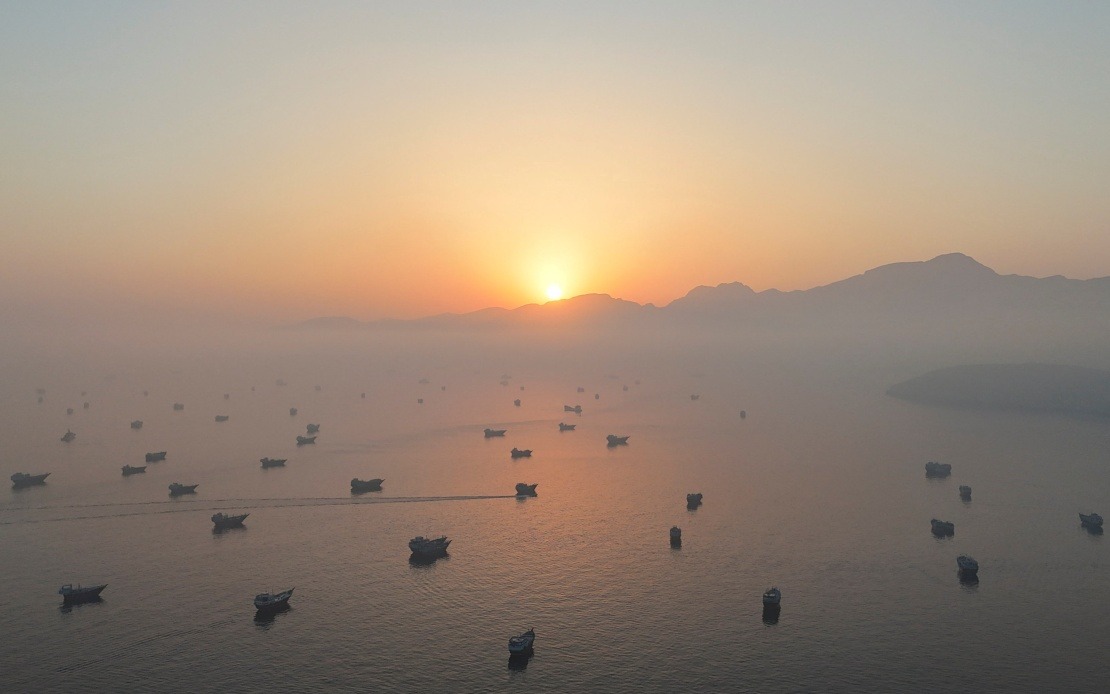
Iran's Islamic Revolutionary Guard Corps has escalated maritime tensions in the Persian Gulf by announcing a sweeping new requirement: no commercial tanker carrying oil, liquefied natural gas, or fertiliser will be permitted to transit the strategic Strait of Hormuz without explicit Iranian authorisation. The declaration follows what Tehran characterises as multiple violations by foreign vessels attempting to navigate the waterway on Sunday, marking a significant hardening of Iran's position on one of the world's most critical shipping chokepoints.
According to IRGC accounts, four vessels operating under US backing ignored repeated warnings as they sought passage through what Iranian authorities deemed an unauthorised shipping corridor on 19 July. Most significantly, these vessels are alleged to have disabled their Automatic Identification Systems, the standard navigation transponders that allow international monitoring of maritime traffic. Two of the four vessels subsequently halted their transit, while the remaining pair reversed course and departed the area, the Guard Corps reported.
This incident represents the latest in a series of escalating confrontations that has steadily ratcheted up tensions along one of the world's most economically vital waterways. The Strait of Hormuz represents a critical choke point through which roughly one-third of global seaborne oil trade passes daily, making it absolutely essential to energy supplies across Asia, Europe, and beyond. For Malaysian importers and businesses dependent on petroleum products and energy security, disruptions or restrictions here carry immediate economic consequences.
The IRGC's assertion of complete dominion over the Strait undergoes reinforcement through its insistence that Iran alone determines safe shipping corridors within the waterway. By centralising all permit authority under Iranian control and requiring explicit coordination for each transit, Tehran has effectively redefined maritime commerce in the region as requiring Iranian acquiescence. This approach fundamentally challenges the longstanding international principle of freedom of navigation through international straits and threatens to introduce substantial uncertainty into the region's energy logistics.
The timing of this declaration proves significant within the broader context of ongoing US-Iran military confrontations that have intensified considerably since early July. Beginning on 8 July, American forces launched successive strikes against Iranian targets, which Washington attributed to Iranian attacks against commercial shipping in the Strait. The US Central Command framed these operations as defensive responses intended to protect freedom of navigation and international commerce. In turn, Iranian forces have conducted retaliatory strikes against American military installations across the wider West Asian region, creating a cycle of escalation that shows little sign of abating.
These maritime incidents must be understood within the framework of deteriorating relations between Washington and Tehran, where military posturing has increasingly supplanted diplomatic channels. The pattern of accusation and counter-accusation, combined with active military strikes, creates an environment of profound uncertainty for commercial operators and regional economies alike. For Southeast Asian nations, including Malaysia, which depend heavily on stable energy imports from the Middle East, this instability represents a tangible threat to economic stability and energy affordability.
The requirement for Iranian permits effectively introduces a new control mechanism that extends Tehran's authority over international commerce. By conditioning passage on obtaining permission and maintaining coordination with Iranian authorities, the Guard Corps has created a system that gives Iran unprecedented leverage over one of global commerce's most essential arteries. This arrangement deviates markedly from international maritime norms, which ordinarily guarantee innocent passage through straits used for international navigation, and it raises serious questions about the security and predictability of future energy supplies.
For Malaysia and other regional economies, the implications prove multifaceted. Energy costs may face upward pressure if shipping insurance premiums increase due to heightened risk, or if commercial operators seek alternative, longer, and more expensive routes to circumvent the Strait entirely. The uncertainty surrounding permit issuance could delay shipments or encourage premiums that ultimately translate into higher fuel prices for consumers and businesses. Additionally, the arbitrary nature of any permit system introduces the possibility of politicised denial of passage for certain vessels or nations.
The confrontation also reflects deeper structural tensions within the Middle East, where American military presence and Iranian regional ambitions create persistent friction. Iran views its assertion of control over the Strait as a legitimate exercise of sovereignty over its territorial waters and continental shelf, whilst international maritime law advocates argue that such restrictions violate established norms permitting innocent passage through international straits. This fundamental disagreement remains unresolved and continues driving escalatory cycles.
The path forward remains uncertain. Without de-escalation and renewed diplomatic engagement, the Strait of Hormuz risks becoming increasingly unstable, with commercial shipping caught in the crossfire of geopolitical conflict. Regional stakeholders, including Malaysia and other ASEAN nations dependent on unimpeded Gulf trade, have compelling interests in encouraging resolution through negotiation rather than confrontation. The current trajectory, however, suggests that tensions will likely persist and potentially intensify absent significant shifts in the approach taken by all parties involved.

