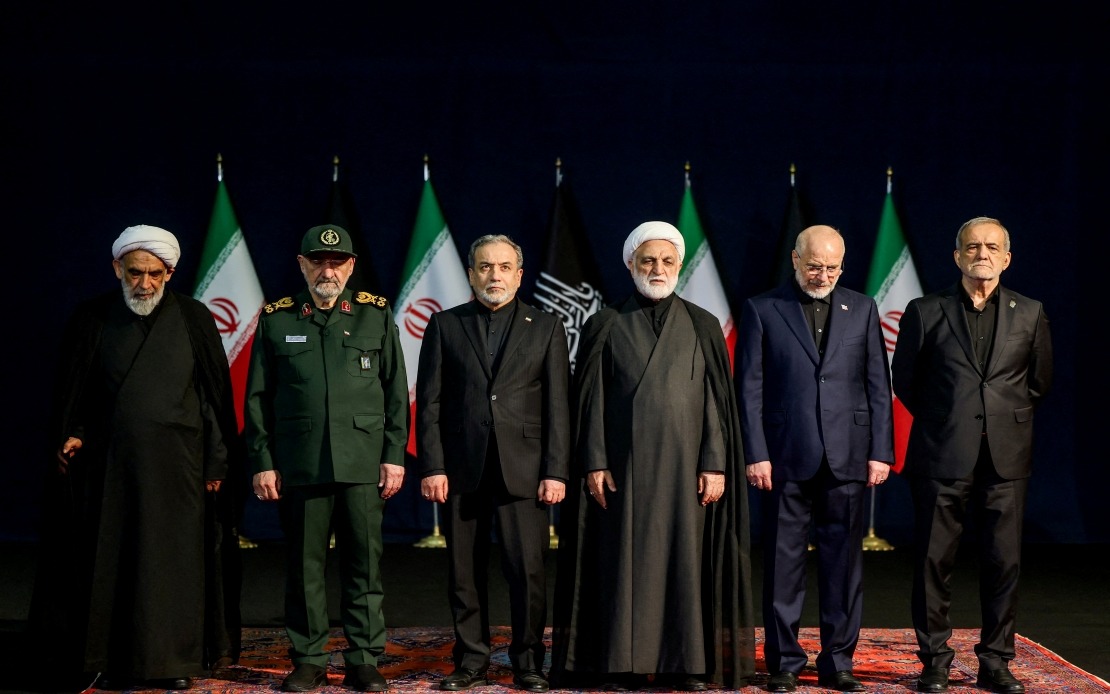
The Islamic Republic of Iran observed a solemn day of national tribute as senior officials from across Asia and the Middle East converged in Tehran on Friday to honour the country's late Supreme Leader Ayatollah Ali Khamenei. The ceremony, held at Imam Khomeini's Mosalla prayer hall in the Iranian capital, drew a remarkable gathering of political and religious figures whose attendance underscored the geopolitical significance of Khamenei's death and the transition of power within the regional powerhouse.
Iranian President Masoud Pezeshkian led the domestic contingent of mourners, joined by Parliament Speaker Mohammad Baqer Qalibaf, Judiciary Chief Gholamhossein Mohseni-Ejei, and Sadeq Amoli Larijani, the Chairman of the Expediency Discernment Council. This collective showing by Iran's highest institutional figures reflected the gravity of the moment and the need to project continuity and stability at a critical juncture in the nation's governance. The gathering extended well beyond dawn, with the tribute ceremony continuing throughout the day as scores of officials filed through to pay their respects.
The international delegation that arrived in Tehran demonstrated the extensive diplomatic network Iran has cultivated across Asia and the Middle East, despite decades of Western sanctions and geopolitical tensions. Pakistan's Prime Minister Shehbaz Sharif travelled to Tehran alongside Chief of Army Staff Field Marshal Syed Asim Munir, signalling Islamabad's commitment to its long-standing strategic partnership with Iran. This pairing of civilian and military leadership from Pakistan sent a calculated message about the stability of bilateral relations at a time when Iran faces significant uncertainty following Khamenei's passing.
The presence of Armenian Prime Minister Nikol Pashinyan and Georgian President Mikheil Kavelashvili reflected the broader regional equilibrium Iran maintains with Caucasian powers, while Iraqi President Nizar Amedi and Kurdistan Region President Nechirvan Barzani underscored Iran's deep integration into Iraqi politics and security affairs. Tajik President Emomali Rahmon's attendance reinforced Tehran's influence across Central Asia, a region increasingly contested between regional powers. These delegations collectively illustrated how Iran's strategic reach extends from the Persian Gulf to Central Asia, encompassing diverse ethno-political actors across multiple borders.
Beyond the regional Middle Eastern and Asian guests, the attendance of senior officials from China and Russia carried particular weight in contemporary geopolitical contexts. Both nations have deepened their alignment with Iran in recent years, particularly as Western pressure has mounted. The visible presence of Chinese and Russian representatives at such a significant state ceremony for Iran represented a powerful symbolic affirmation of these relationships, suggesting that Iran's international isolation remains incomplete and that partnerships with major global powers continue to provide Tehran with leverage and legitimacy.
The broader composition of attendees included not only heads of state and government ministers but also religious scholars, tribal leaders, and other cultural figures. This deliberately inclusive gathering served multiple purposes: it demonstrated the breadth of support for Iran's Islamic system, honoured Khamenei's role as a unifying figure across various segments of Iranian and allied societies, and provided a platform for displaying the durability of Iran's institutional structures and diplomatic networks despite the loss of its supreme leader.
Khamenei, who had led Iran since 1989, was killed on February 28 in what Iranian authorities characterised as a joint United States and Israeli military strike against Tehran. His death marked a watershed moment for the Islamic Republic, raising immediate questions about succession, continuity of policy, and potential shifts in Iran's approach to regional conflicts and international relations. The rapid identification and selection of his son, Mojtaba Khamenei, as the new Supreme Leader in March provided one measure of institutional continuity, though observers have noted differences in approach between the late leader and his successor.
The funeral proceedings were scheduled to extend through July 9, with an elaborate sequence of rituals and public observances planned across multiple Iranian cities. Processions were organised in Tehran, Qom, and Mashhad, Iran's three most significant urban centres from religious and political perspectives, while commemorative rites were also to be conducted in Iraq, underscoring Iran's influence over neighbouring Shia-majority populations and territories. Iranian authorities announced significant public restrictions during this period, including airspace closures in Tehran and Mashhad on designated dates and a nationwide day of mourning declared for Thursday.
For Southeast Asian observers and policymakers, particularly those in Malaysia, these events merit careful attention for several reasons. First, Iran's regional stability and succession processes affect oil markets and regional security architecture that have implications for maritime trade passing through the Strait of Hormuz, through which a substantial portion of global energy supplies transit. Second, Iran's deepening partnerships with China and Russia, visible in this diplomatic gathering, represent broader realignment patterns affecting geopolitical competition in Asia. Third, the demonstrated strength of Iran's regional diplomatic network suggests that despite international sanctions, Tehran retains significant soft power and strategic partnerships that shape Middle Eastern and Central Asian politics.
The transition of power in Iran occurs against a backdrop of ongoing tensions with Western powers, unresolved nuclear negotiations, and continued regional conflicts involving proxy forces and allied militias. The swift succession planning and the impressive gathering of international mourners suggested that despite internal uncertainties, Iran's institutional framework and international standing remained sufficiently robust to manage the transition without immediate state collapse or dramatic policy reversals. How the new Supreme Leader navigates these complex challenges in coming months will have reverberations well beyond Iran's borders, affecting energy security, regional stability, and the broader configuration of power in Asia.

