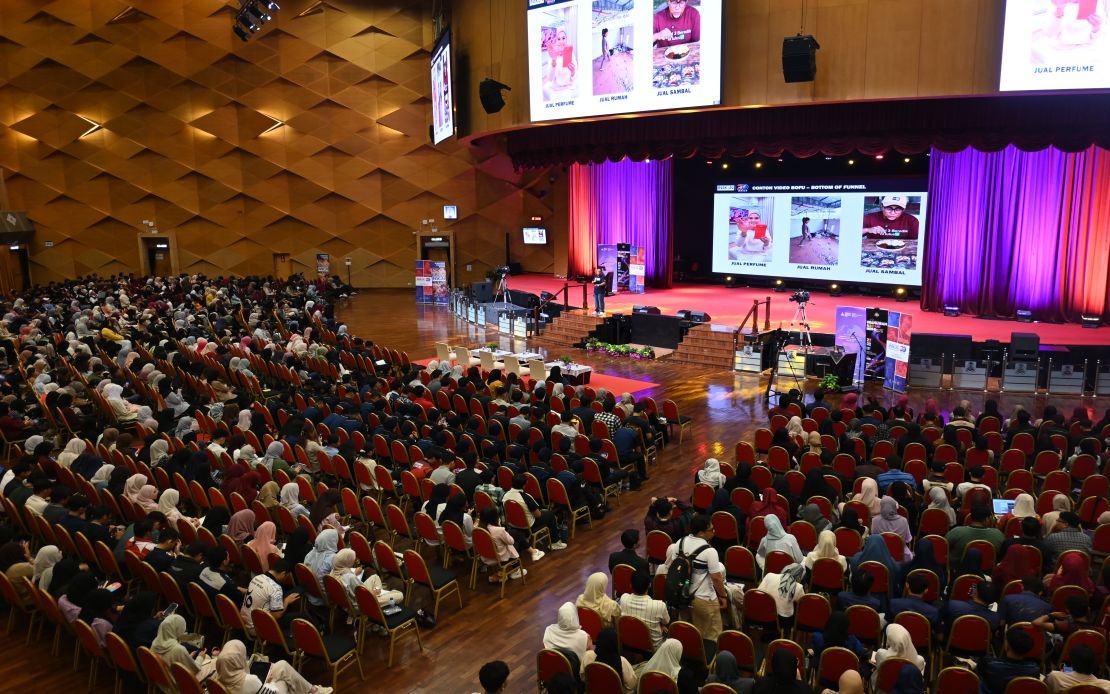
The National Entrepreneurship Institute (INSKEN) and Universiti Teknologi MARA (UiTM) have orchestrated what is now officially recognised as Malaysia's largest student-attended entrepreneurship seminar, drawing 6,877 participants across physical and online channels at the Dewan Agung Tuanku Canselor in Shah Alam. The achievement underscores a significant shift in how Malaysia's younger generation perceives business ownership and self-employment as a legitimate and attractive career trajectory in an economy increasingly defined by innovation and individual enterprise.
The Usahawan MADANI Mega (SUM MEGA) 2026 event, staged in June and organised jointly with the Malaysian Academy of SME and Entrepreneurship Development (MASMED), delivered a comprehensive immersion into entrepreneurial fundamentals through structured knowledge-sharing forums, hands-on capacity-building workshops, and carefully curated networking opportunities. By bringing together UiTM students from campuses nationwide, the initiative created a rare moment of concentrated focus on enterprise development within Malaysia's higher education ecosystem, signalling institutional commitment to embedding entrepreneurial thinking across academic disciplines.
Datuk Mohamad Alamin, deputy minister for Entrepreneur and Cooperatives Development, framed the record-breaking attendance as evidence of genuine grassroots interest in entrepreneurship among young Malaysians. He emphasised that this enthusiasm arrives at a crucial moment for the nation, as policymakers and business leaders recognise that entrepreneurship extends far beyond individual wealth creation. Rather, it functions as a fundamental engine of macroeconomic growth, particularly as Malaysia navigates increasing regional and global competition for investment and talent.
The deputy minister elaborated on the MADANI government's strategic positioning of entrepreneurship within the Ministry of Entrepreneur and Cooperatives Development (KUSKOP) framework. Rather than treating business development as a peripheral concern, the administration has woven entrepreneurship support into multiple layers of economic policy, encompassing capacity-building programmes that develop technical and managerial skills, financing mechanisms that reduce capital access barriers, market connectivity initiatives that link startups with buyers, digitalisation support that enables businesses to operate efficiently in online environments, and ongoing advisory services that guide entrepreneurs through critical growth phases.
The seminar's practical pedagogy centred on the MOFA approach, a structured methodology addressing the four cornerstone dimensions of viable business operations. Marketing competency helps entrepreneurs understand customer behaviour and build brand presence; operational excellence ensures efficient day-to-day execution and supply chain management; financial acumen enables sound investment decisions and sustainable profitability; and administrative capability creates the systems and governance structures that allow enterprises to scale. This integrated framework acknowledges that entrepreneurial success rarely hinges on a single factor but rather emerges from competence across interconnected business domains.
Datak Mustaffa Kamil Ayub, chairman of INSKEN's Board of Trustees and a UiTM board member, reframed the seminar's significance beyond attendance metrics. He contended that the overwhelming response signals a cultural evolution within Malaysia, where entrepreneurship is increasingly understood not as a risky outlier career but as a mainstream mindset compatible with economic citizenship. This perceptual shift carries profound implications for how universities structure curricula, how government allocates entrepreneurship resources, and how young Malaysians approach career planning.
The timing of SUM MEGA 2026 reflects alignment with Malaysia's broader institutional frameworks. The seminar explicitly positions itself as a building block within the National Entrepreneurship Policy 2030, a long-term strategic document that articulates how entrepreneurship should contribute to Malaysia's economic transformation. By channelling university students into a comprehensive entrepreneurship experience before they enter the workforce, policymakers attempt to ensure that the next generation of business operators embeds national entrepreneurship priorities into their decision-making from inception.
INSKEN's constellation of complementary programmes—including the INSKEN Masterclass intensive training sessions, BANGKIT mentorship initiatives, and PROTÉGÉ sponsorship schemes—reveals a recognition that a single event, however well-attended, cannot sustain entrepreneurial development. Instead, the institute has architected a progression pathway where SUM MEGA serves as an entry point and awareness-raising platform, while ongoing programmes provide deeper skill development and longer-term guidance. This multi-touch approach acknowledges that entrepreneurship is not a one-time decision but an evolving journey requiring sustained institutional support.
The collaborative architecture underpinning SUM MEGA 2026 merits particular attention for Malaysian and Southeast Asian readers. The event brought together government agencies, higher education institutions, industry participants, financial institutions, enterprise development bodies, and the broader business community into a coordinated effort. This multi-stakeholder approach contrasts with fragmented entrepreneurship support in some regional economies and suggests that Malaysia has begun institutionalising ecosystem-wide collaboration. When government policy, university infrastructure, private sector expertise, and financing capabilities align around a single objective, the resulting synergies amplify impact far beyond what any single institution could achieve independently.
For university students and recent graduates considering entrepreneurial paths, the proliferation of such initiatives signals expanding institutional support. Rather than navigating business ownership in isolation, emerging entrepreneurs can access training, mentorship, financing advice, and peer networks with minimal friction. This democratisation of entrepreneurship knowledge and connection represents a genuine structural advantage for Malaysian startups competing against counterparts in regions where such supports remain fragmented or inaccessible to ordinary young people.
The record-setting participation also carries implications for educational institutions throughout Southeast Asia observing Malaysia's entrepreneurship infrastructure development. Universities increasingly recognise that preparing graduates for economic relevance requires business exposure beyond traditional classroom instruction. The scale of SUM MEGA 2026 demonstrates that student appetite for practical entrepreneurship education substantially exceeds what conventional curricula typically provide, offering a template for other regional institutions considering expansions in enterprise-focused programming.
Looking forward, the challenge for Malaysia's entrepreneurship ecosystem involves translating initial enthusiasm into sustained business creation and growth. Record seminar attendance is a leading indicator of interest but does not automatically translate into viable enterprises. The true measure of initiatives like SUM MEGA 2026 will emerge over subsequent years as participants either establish businesses, join entrepreneurial ventures, or incorporate entrepreneurial mindsets into employment roles. INSKEN and its partner institutions must therefore maintain longitudinal engagement with participants, tracking outcomes and refining support mechanisms based on evidence of which interventions most effectively translate entrepreneurial interest into economic activity.
The Malaysia Book of Records recognition, while symbolic, reflects genuine achievement in mobilising unprecedented student engagement around entrepreneurship as a national priority. This moment of institutional alignment—where government policy, university infrastructure, student interest, and business community support converge—offers a distinctive opportunity for Malaysia to accelerate its transition toward an entrepreneurship-enabled economy. How effectively the ecosystem consolidates this momentum will significantly influence whether SUM MEGA 2026 becomes merely a notable event or a turning point in Malaysian economic development.