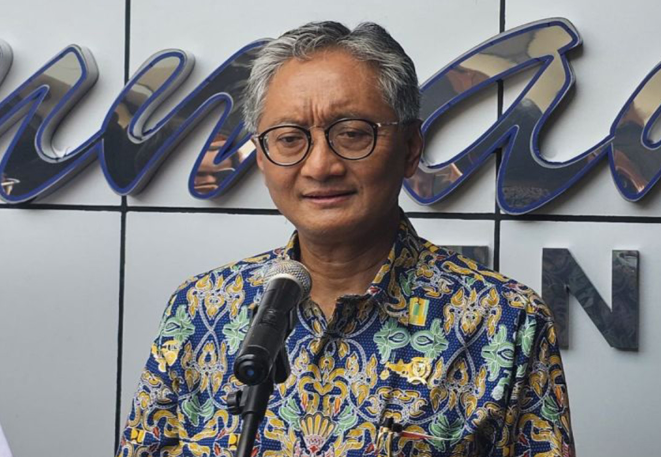
Indonesia's Public Works Ministry is being engulfed in organisational turmoil following the leaking of an internal travel document that sparked public outcry and triggered widespread staff transfers, casting a shadow over the ministry's operations and raising concerns among lawmakers about institutional stability and workforce morale.
The controversy erupted when a ministry letter circulated on social media in early July, listing eight delegates earmarked to travel to New York from July 13 to 19 for a United Nations-organised meeting scheduled for mid-July. The document, signed by secretary-general Apri Artoto on June 29, included the names of Minister Dody Hanggodo's wife Irma Hermawati and daughter Aurellia Tsabitha Meidirama among the delegation members. The inclusion of family members in what was presented as an official government delegation immediately triggered public criticism and accusations that state resources were being misappropriated for private purposes, forcing the ministry to cancel the trip entirely.
Within days of the document going viral on social media platforms, rumours intensified that Dody was systematically reassigning officials to regional postings as punishment for whoever had leaked the sensitive paperwork. Multiple posts claimed that over 100 employees had been shuffled to various positions during Dody's tenure since he assumed office in October 2024, with many transfers sending staff to locations well outside Java. When pressed by reporters on Wednesday, Dody acknowledged the staff movements but firmly rejected suggestions they represented retaliation, stating tersely that with 38,600 employees under his command, he possessed the prerogative to reassign personnel as he deemed necessary.
Apri attempted to defuse the controversy during a July 7 press briefing, explaining that Dody's family members were included in the delegation list to streamline visa application procedures through the Foreign Ministry, while assuring the public that state funds would not actually be used to cover their expenses. Despite these clarifications, the secretary-general acknowledged that the document was never intended for public circulation and pledged to identify whoever had released it. Apri went further, threatening to pursue legal action against any official found responsible for the breach, framing it as a serious violation of institutional trust and confidentiality protocols.
Dody's tenure at the ministry has been marked by continuous personnel reshuffling that extends well beyond this current controversy. Since taking charge, the 60-year-old politician—who brings engineering credentials and business connections to his Democratic Party background, particularly ties to South Kalimantan businessman Andi "Haji Isam" Syamsuddin Arsyad—has overseen multiple rounds of transfers affecting employees at all levels. The May reshuffle proved particularly significant, with seven senior officials appointed to new positions, including Apri's elevation to secretary-general, replacing Wida Nurfaida who had occupied the post for less than a year following another restructuring in July 2025. This constant churning of positions has created a pattern of instability that extends across the ministry's hierarchy.
The frequency and scale of these internal reorganisations have triggered alarm bells among legislative overseers. During a parliamentary commission meeting in June, Yasto Soepredjo Mokoagow from the House of Representatives Commission V, which oversees infrastructure matters, raised serious concerns about the cumulative effect of repeated disciplinary actions and demotions. The Indonesian Democratic Party of Struggle legislator expressed particular worry that aggressive human resources policies were breeding fear among civil servants, who now hesitate to execute their regular duties for fear of arbitrary punishment. This erosion of institutional confidence threatens to compromise the ministry's capacity to deliver essential public works programmes across the archipelago.
Dody has publicly articulated a rationale for his aggressive restructuring agenda, claiming that a "deep state" operates within the ministry's bureaucracy—an entrenched network of interests that he compares to termites silently consuming the institution's structural integrity. Under this conceptual framework, he has justified the repeated reorganisations as necessary surgery to purge corruption and mismanagement, positioning himself as a reformer committed to cleaning out institutional rot. This narrative has provided ideological cover for the constant upheaval, though critics argue it may be creating more problems than it solves.
Dody's assertion about embedded corruption has some factual grounding, as the ministry has indeed been ensnared in multiple criminal investigations. The Jakarta High Prosecutor's Office named several suspects in June in connection with a water resources project corruption case, including Dwi Purwantoro, the ministry's former water resources director general, and Yosiandi Radi Wicaksono, former acting irrigation and swamp director. When confronted with these developments, Dody promised full cooperation with law enforcement and pledged not to shield any subordinates implicated in wrongdoing, framing accountability as paramount despite the political sensitivities involved.
Yet recent revelations have complicated this narrative of decisive leadership. Social media footage has resurfaced showing Dody's interactions with subordinates in unflattering terms, including a video from April at a school construction site in East Java where he was captured berating an employee, pointing his finger while deriding the individual for making what he characterised as "dumb excuses." These images have circulated widely online, contributing to perceptions of an intimidating leadership style that may be exacerbating workplace anxiety rather than inspiring institutional reform. For Malaysian observers, the situation illustrates how personnel management crises at a cabinet ministry can spiral beyond internal matters to become significant political liabilities, affecting the ministry's public credibility and operational effectiveness at a time when infrastructure development is crucial for Indonesia's economic progress.

