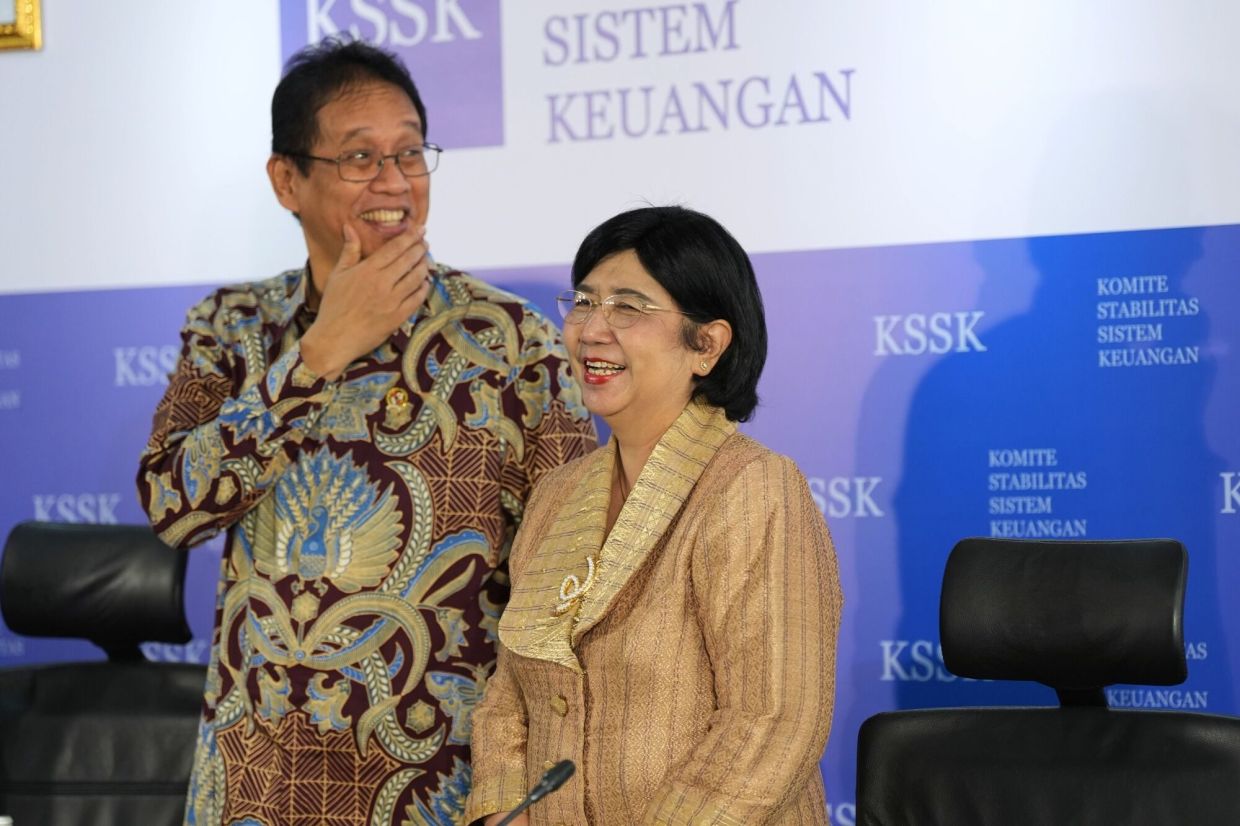
Destry Damayanti's elevation to acting governor of Bank Indonesia two weeks ago signalled a subtle but significant shift in how the central bank may engage with the government. Her first official visit of the day went to Finance Minister Purbaya Yudhi Sadewa's office before proceeding to meet President Prabowo Subianto at the presidential palace—a deliberate gesture that underscored her intention to work collaboratively with the fiscal authorities on coordinating monetary and economic policy. Within days, the two officials appeared together at a press conference, visibly at ease with one another, projecting an image of alignment and cooperation that stood in sharp contrast to the more formal and distant relationship her predecessor maintained.
The contrast with her predecessor, Perry Warjiyo, is particularly instructive for understanding the nuances of Indonesia's institutional politics. Warjiyo's meetings with the finance ministry tended to occur within formal settings at the presidential palace or regulatory committees, with very few if any one-on-one sessions recorded publicly. The single documented bilateral meeting between Warjiyo and Purbaya took place only in September 2025 at the central bank's premises, suggesting a more compartmentalised approach to the relationship between monetary and fiscal authorities. Destry's immediate pivot toward frequent, direct engagement with the finance minister suggests a willingness to adopt a more integrated approach to economic policymaking, raising questions about whether this represents an asset to coherent governance or a potential vulnerability to undue political influence.
Prabowo's nomination of Destry as the sole candidate for the permanent position reflects his attempt to thread a needle between two competing imperatives: maintaining the market confidence and technical expertise that international investors demand from a central bank leadership, while aligning monetary policy with his administration's aggressive growth targets. The president has signalled his intention to lift economic growth toward 8 percent by 2029, a goal that represents a significant acceleration from recent performance and one that will require substantial monetary accommodation. Destry, who served as Warjiyo's deputy since 2019 and brings considerable academic credentials including a master's degree in regional science from Cornell University, appears designed to satisfy both constituencies—she is a capable technocrat with proven expertise, yet she has already demonstrated receptiveness to closer coordination with the political leadership.
The economic landscape that Destry inherits is considerably more challenging than the comparatively benign conditions of recent years. The rupiah has depreciated roughly 6 percent against the dollar during 2024, making it the worst-performing currency across Asia. This weakness reflects not only global factors—particularly the elevated interest-rate environment in the United States and corresponding strength of the dollar—but also investor anxiety about the domestic policy direction under Prabowo. International rating agencies have reacted with concern; both Fitch Ratings and Moody's Ratings have placed Indonesia's sovereign credit rating on negative watch, citing policy uncertainty. Only S&P Global Ratings has maintained a stable outlook, suggesting that the credit market's confidence in Indonesia's macroeconomic management has become genuinely fractured.
The source of investor unease lies partly in the populist economic initiatives that the Prabowo administration has pursued over the preceding twelve months. Large-scale spending on universal school meal programmes and expanding state control over commodity sectors and distribution have triggered concern among financial markets about fiscal sustainability and the boundaries of government intervention in the economy. These anxieties crystallised in currency weakness and outflows, presenting Destry with immediate pressure to stabilise the rupiah while simultaneously avoiding policies that would visibly undermine the president's political agenda. This represents a genuinely difficult balancing act, one that cannot be resolved through technical competence alone.
Market participants have so far responded positively to Destry's appointment, viewing her appointment as likely to produce more consistent and investor-friendly central banking than might otherwise be expected. The rupiah extended its gains against the dollar to its strongest level in a month following her announcement, and it has outperformed most of its regional counterparts. Economists at major institutions including Citigroup have noted that they expect Bank Indonesia's communication with the government to improve, suggesting more effective coordination of monetary and fiscal policy. However, these observers have also cautiously noted that the broader institutional environment for credibility remains unstable and volatile, hinting that improved communication alone cannot offset substantive policy inconsistencies or politically-driven decision-making.
The technical challenge confronting the new governor is formidable. Bank Indonesia under Warjiyo deployed an intricate combination of policy tools to manage multiple competing objectives simultaneously. Interest rates have been increased on three separate occasions since May, moves designed to defend the rupiah and contain inflation. Simultaneously, the central bank has employed non-conventional tools to maintain adequate liquidity in the financial system and support credit flows to the private sector. This balancing act must continue, but Destry must now execute it under conditions of heightened political scrutiny and with an administration that is increasingly impatient for faster economic expansion.
Investors will scrutinise several specific questions about Destry's approach. Will Bank Indonesia maintain the willingness to raise interest rates when inflation and currency stability require such action, or will rate increases be progressively moderated in deference to the government's growth objectives? Will liquidity management decisions be guided by professional assessments of financial stability and monetary transmission, or will they gradually become subordinated to short-term political preferences? Irman Faiz, chief economist at PT Bank Danamon, has articulated the essential principle that coordination with government is legitimate and necessary, but policy subordination is not. Whether Destry can maintain this distinction in practice remains the critical open question.
Destry possesses substantial credentials for the role. Beyond her economics degree from the University of Indonesia, she studied regional science at Cornell and brings extensive private-sector experience, including a tenure as chief economist at PT Bank Mandiri and prior work at the Indonesia Deposit Insurance Corporation—an institution that was previously led by Finance Minister Purbaya himself. Her background in engaging with investors and analysts on central banking issues suggests she understands the expectations of international capital markets and recognises the reputational consequences of perceived political capture. Yet technical competence and institutional understanding cannot substitute for the political independence that central banking ultimately requires.
The deeper challenge facing Bank Indonesia extends beyond the immediate test of whether Destry can balance growth and autonomy. Fakhrul Fulvian, chief economist at PT Trimegah Sekuritas Indonesia, has argued that while preserving the stability achieved in recent years remains important, the central bank must now progress toward more ambitious objectives. These include establishing healthier liquidity conditions across the financial system, normalising the yield curve which has been distorted by policy uncertainty, strengthening monetary transmission mechanisms so that rate changes effectively influence credit conditions, and ultimately rebuilding private-sector business confidence. Achieving these goals will require not just technical expertise but also consistent messaging about institutional independence and a demonstrated commitment to rules-based rather than discretionary policymaking.
For Malaysian observers and investors, the Indonesian situation offers important lessons about the vulnerabilities of central bank independence in a region where political pressure on monetary authorities is substantial. How Destry navigates her first year in office will reverberate beyond Jakarta, potentially influencing how investors evaluate the robustness of monetary institutions across Southeast Asia. Her success or failure in maintaining professional standards while accommodating legitimate government priorities will shape regional confidence in the separation between political and monetary authority—a distinction that remains essential to long-term macroeconomic stability across the region.

