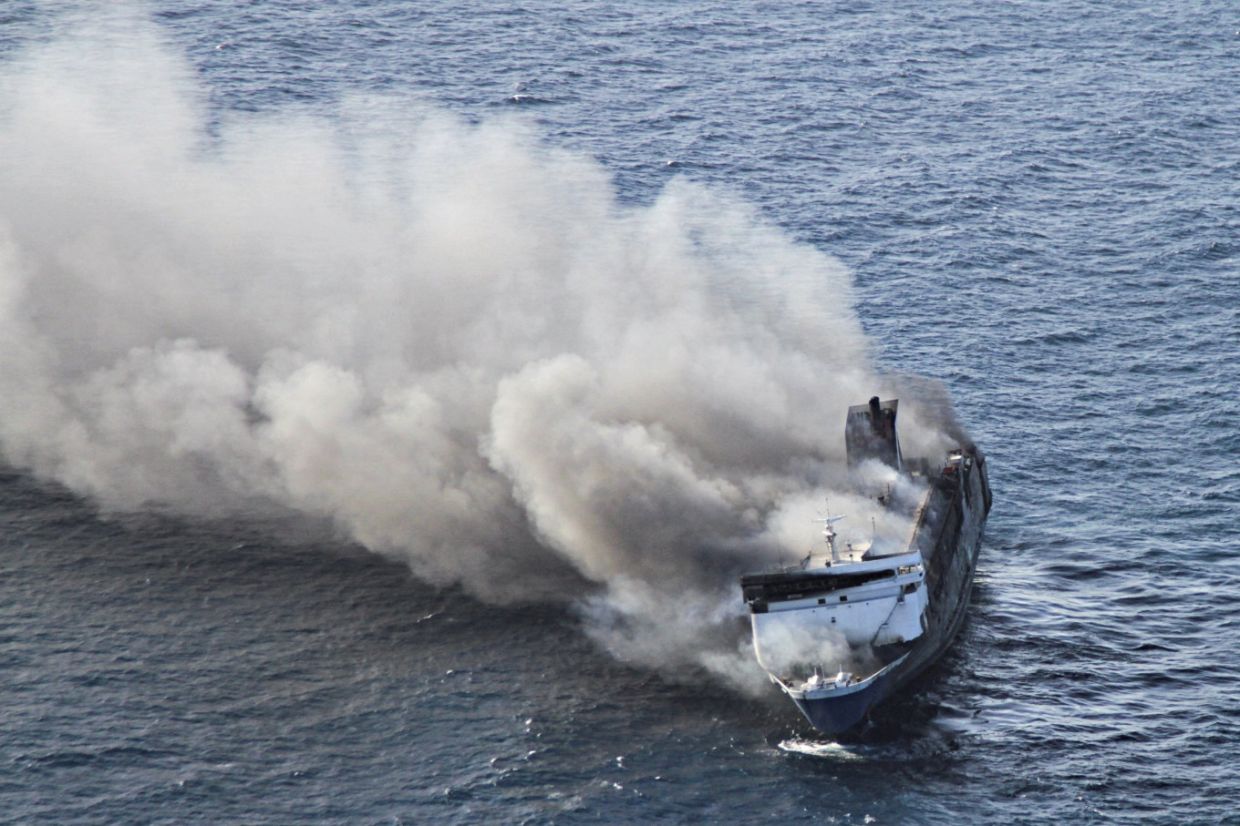
A devastating fire that swept through the KMP Mutiara Sentosa II on the morning of August 2 has thrust Indonesia's maritime safety regime into the spotlight, raising critical questions about the adequacy of national oversight mechanisms. The passenger and cargo vessel, operating the commercial route linking Surabaya in East Java with Makassar in South Sulawesi, caught ablaze around 6am, claiming at least five lives and leaving two persons unaccounted for among the 236 passengers and 39 crew members aboard. The incident has triggered widespread alarm that systemic weaknesses in Indonesia's maritime sector extend far beyond isolated technical failures, pointing instead to endemic problems in regulatory compliance, company safety culture, and government enforcement.
The 160-meter vessel operated by PT Atosim Lampung Pelayaran (ALP) became a scene of chaos as the emergency unfolded, with passengers forced into makeshift survival measures that highlight the absence of basic emergency protocols. According to Udin Karo Karo, chairman of the Makassar–Surabaya Truck Drivers Association, crew members proved unable or unwilling to guide evacuees through the crisis, leaving approximately 40 percent of the predominantly truck driver passenger manifest to save themselves. The absence of visible lifeboats and inflatable rescue rafts—critical safety equipment mandated under Indonesian maritime regulations—forced many to leap into the sea with only life jackets as protection. This breakdown in emergency response procedures suggests that safety protocols existed only on paper, never integrated into actual crew training or operational practice.
The broader implications of this incident become more troubling when viewed against the operator's history. PT ALP previously owned and operated the KMP Mutiara Sentosa I, which caught fire near Madura in May 2017, claiming five lives in an remarkably similar tragedy. That an identical company operating near-identical vessels should suffer catastrophic fires within a five-year window demands urgent investigation into whether fundamental lessons were extracted from the earlier disaster. Edi Priyanto, Deputy Chairman of the East Java Occupational Safety and Health Council, articulated this concern with precision, noting that repeated incidents from the same operator suggest institutional failure rather than mere chance. In functional safety systems, each major accident catalyzes systematic improvements—revised procedures, enhanced training protocols, upgraded equipment standards. The recurrence of comparable disasters under the same company's flag indicates that such learning either never occurred or was deliberately ignored.
The timing of this fire compounds existing anxieties about Indonesia's maritime transportation network. Only one month prior, a separate ferry carrying more than 70 passengers sank near Selayar island off South Sulawesi, resulting in four confirmed deaths and fourteen missing persons when search operations concluded. This clustering of major maritime incidents within a compressed timeframe has shifted the discussion from individual operator negligence toward systemic regulatory inadequacy. Abdul Hadi, a member of the House of Representatives Commission V responsible for transportation oversight, positioned the latest ferry fire as a watershed warning that Indonesia faces not isolated mishaps but rather a crisis of maritime governance. The repeated occurrence of major passenger vessel disasters signals a fundamental breakdown in how Indonesia certifies, inspects, and monitors the vessels entrusted with the lives of thousands of citizens daily.
Investigators must now grapple with multiple interrelated failures. Why did the fire spread so rapidly across the vessel? Were emergency containment systems properly maintained and operational? Did the crew possess adequate training to manage a catastrophic shipboard fire? Answers to these technical questions matter considerably, but they pale beside the institutional inquiry demanded by patterns of operator misconduct. Transportation Minister Dudy Purwagandhi pledged a comprehensive evaluation of PT ALP pending findings from the National Transportation Safety Committee (KNKT), indicating that government agencies recognize the need to assess this operator's fitness to continue marine transport operations. Yet evaluation and actual enforcement remain distinct propositions, and Indonesia's historical record demonstrates that regulatory assessments frequently conclude with recommendations that subsequent enforcement fails to fully implement.
Edi Priyanto articulated a sophisticated understanding of maritime safety culture that extends beyond vessel seaworthiness specifications. Effective safety management systems require far more than technically sound equipment—they demand organizational commitment to safety as a core value, consistent investment in crew training and preparedness, rigorous maintenance protocols, and mechanisms for converting accident investigations into genuine operational improvements. When ferry companies view safety certifications as administrative formalities rather than reflections of genuine readiness, and when regulators fail to enforce compliance rigorously, the result is precisely what occurred aboard the KMP Mutiara Sentosa II: human lives lost to preventable failures. The scale of the immediate tragedy—five dead, two missing—pales beside the systemic indictment it represents.
For Malaysian observers and the broader Southeast Asian region, this Indonesian crisis carries sobering implications. Malaysia's own maritime transport sector operates under comparable regulatory frameworks, and passenger ferries connecting Malaysian ports to neighboring countries must meet Indonesian safety standards when docking in Indonesian waters. A regulatory environment where operators can repeatedly violate safety protocols without facing decisive enforcement action threatens the safety not only of Indonesian citizens but also of Malaysian travelers and seafarers who conduct commerce across the region's busy maritime corridors. The incident raises questions about whether regulatory harmonization and mutual enforcement across Southeast Asia sufficiently protects passengers who transit between nations.
Abdul Hadi's forthright assertion that safety inspections must not devolve into routine administrative procedures cuts to the heart of Indonesia's institutional challenge. Certification systems become corrupted when inspectors regard their work as box-ticking exercises disconnected from genuine safety assessment. When seaworthiness certificates are issued without rigorous technical evaluation, when safety procedures exist only in manuals never translated into crew practice, when companies with documented safety failures receive continued operating licenses, the system has fundamentally betrayed its purpose. The passengers aboard the KMP Mutiara Sentosa II on August 2 were failed not by a single technical failure but by an entire architecture of governance that elevated bureaucratic process over passenger protection.
The investigation now underway must determine not merely what ignited the fire but why institutional systems designed to prevent such disasters functioned so inadequately. PT ALP's previous major incident should have triggered intensive regulatory scrutiny, mandatory safety system upgrades, and enhanced oversight of all the company's operations. Instead, the operator retained its license, continued accepting passengers, and ultimately subjected hundreds of people to the same catastrophic risks that had already proven lethal. Transportation Minister Purwagandhi's promise of comprehensive evaluation represents a necessary first step, but evaluation absent enforcement represents merely another administrative gesture. Indonesia requires demonstrable consequences for safety violations—vessel suspensions, operator license revocation, prosecutions of responsible company officials—that would create genuine deterrent effects throughout the maritime industry.
The broader question extends to how Indonesia's maritime regulator interacts with operator compliance culture. Effective regulation requires not merely the existence of rules but active verification that operators maintain compliance, with graduated enforcement responses escalating from warnings to penalties to ultimate license revocation. When companies have documented histories of major accidents and persistent safety violations, regulators must treat them with heightened scrutiny rather than presumed compliance. The KMP Mutiara Sentosa II fire represents not merely a tragedy but an institutional failure that extends across multiple government agencies and private entities. Until Indonesia's maritime authorities demonstrate willingness to enforce safety standards decisively against repeat violators, passengers will continue facing unacceptable risks aboard vessels granted permission to operate under manifestly inadequate oversight regimes.
The tragedy aboard this vessel and the pattern it reveals demand urgent action across multiple fronts. Government agencies must conduct the investigation Purwagandhi promised with genuine rigor, not merely to determine fire origin but to assess how comprehensively this operator has violated maritime safety requirements. Simultaneously, Indonesia's maritime regulator must implement enforcement mechanisms that impose meaningful consequences for documented violations—including, if warranted, permanent license revocation for operators demonstrating systematic non-compliance. The maritime industry itself requires cultural transformation where safety constitutes a core operational value rather than a compliance burden. For the families of those lost aboard the KMP Mutiara Sentosa II, immediate answers matter less than systemic changes that prevent comparable tragedies from claiming additional lives. Indonesia's maritime sector stands at an institutional crossroads, where government agencies and industry leaders must prove they possess both the commitment and the competence to prioritize passenger safety above bureaucratic convenience or commercial interest.

