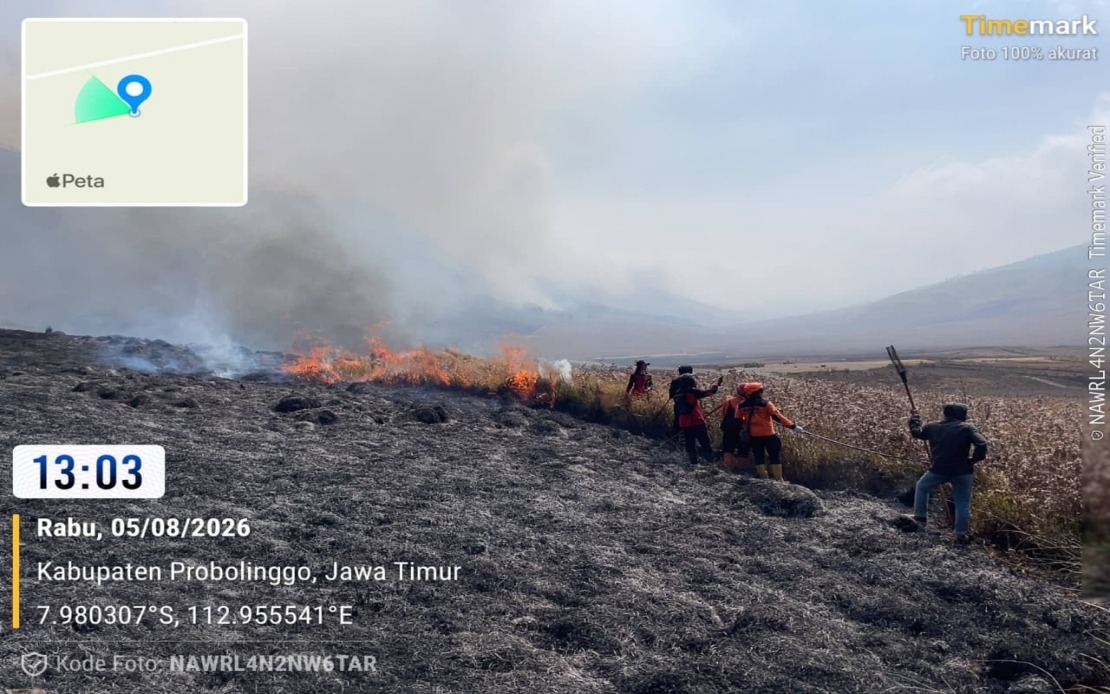
A significant wildfire at Mount Bromo in East Java has prompted Indonesia's National Disaster Management Agency (BNPB) to escalate its response by deploying two water-bombing helicopters to assist ground teams in containing the blaze. The fire, which ignited on Monday and continued to spread through Wednesday, has charred roughly 10 hectares in Probolinggo Regency while consuming an additional 50 hectares within the boundaries of Bromo Tengger Semeru National Park in the neighbouring Malang Regency. According to Abdul Muhari, head of BNPB's Disaster Data, Information and Communication Centre, the decision to deploy aerial resources reflects the escalating challenge posed by the fire's location and terrain.
Much of the wildfire had been brought under control by Wednesday afternoon, representing significant progress by emergency responders working in difficult conditions. However, several active hotspots remained stubbornly resistant to suppression efforts, particularly in steep and mountainous areas that present substantial logistical challenges for ground-based firefighting operations. The terrain's elevation and gradient have created dangerous working conditions for personnel attempting to advance on foot, making aerial support an essential complement to traditional firefighting methods. The helicopter deployment specifically targets these inaccessible zones where conventional teams cannot effectively operate or even safely position themselves.
Beyond immediate aerial intervention, BNPB is preparing to implement a Weather Modification Operation to further support containment efforts, though implementation remains contingent on suitable atmospheric conditions. This multi-layered approach demonstrates the agency's recognition that controlling such a large and geographically dispersed fire requires coordinated deployment of diverse resources and technologies. The combination of helicopter water-bombing and potential weather modification represents a comprehensive strategy tailored to the specific challenges presented by Mount Bromo's volcanic topography and variable microclimates.
Authorities have temporarily closed significant portions of the Mount Bromo tourist area, a decision prioritising both immediate firefighting operations and visitor safety. Mount Bromo is a major destination for domestic and international tourists exploring East Java's dramatic volcanic landscape, and the closure will likely impact local tourism businesses dependent on visitor traffic. The Bromo Tengger Semeru National Park Authority indicated that affected areas would remain off-limits until conditions permit safe reopening, with no specific timeline currently provided for restoration of public access.
Investigations are ongoing into the fire's origin, though preliminary findings suggest that an unattended campfire left by hikers may have triggered the blaze. If confirmed, this would align with patterns observed in several Asian nations where recreational activities in protected forest areas occasionally result in accidental fires when safety protocols are inadequately observed. The incident underscores persistent challenges in managing visitor behaviour within sensitive ecosystems, particularly during peak tourism seasons when foot traffic increases substantially.
For Malaysian readers, this incident offers instructive parallels to wildfire management challenges across Southeast Asia's forested regions. Indonesia's response demonstrates the critical importance of maintaining aerial firefighting capacity and pre-positioned resources that can be rapidly mobilised when ground conditions become prohibitively difficult. The temporary closure of a major tourist destination, while economically disruptive, reflects standard disaster management prioritisation that neighbouring Malaysia has similarly implemented during forest fire emergencies.
The scale of this Mount Bromo fire, while significant, remains moderate compared to major regional wildfire events in recent years. However, its occurrence during what should be a relatively wet season period raises questions about underlying conditions—whether unusual dryness, vegetation susceptibility, or other environmental factors contributed to rapid fire spread. These considerations carry relevance throughout Southeast Asia as climate patterns shift and traditional seasonal expectations become less reliable.
The deployment of two water-bombing helicopters, while effective, also highlights resource limitations that many regional disaster management agencies face. Such specialised aerial assets remain relatively scarce and expensive to operate, creating bottlenecks when multiple fire emergencies occur simultaneously across a large nation like Indonesia. Malaysia's experience managing its own forested regions provides valuable perspective on the logistical complexity of coordinating diverse response mechanisms across difficult terrain.
Moving forward, the Mount Bromo incident will likely prompt renewed discussions about visitor management, environmental protection protocols, and emergency response preparedness across Indonesia's national parks and protected areas. Enhanced ranger patrols, improved campfire supervision, and clearer visitor education regarding fire hazards represent preventive measures that could reduce recurrence risks. Regional cooperation on fire preparedness and resource-sharing arrangements may also emerge as prudent consideration, given the transnational nature of air pollution and environmental impacts when large fires occur.

