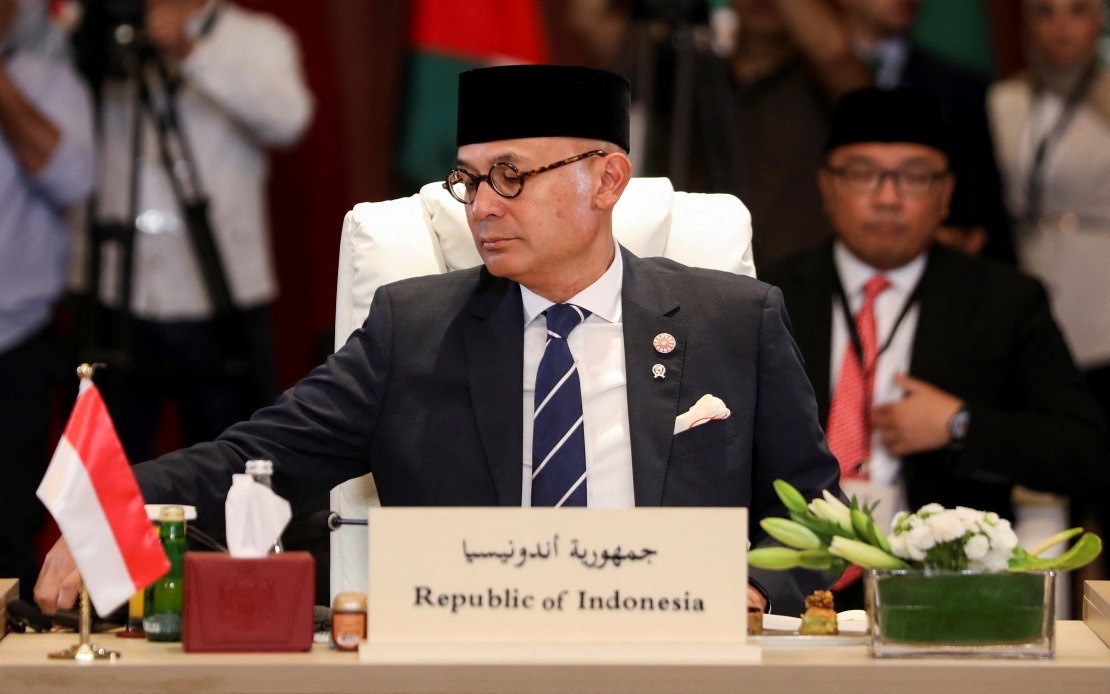
Indonesia has mounted a forceful appeal for the international community to forge a unified political strategy on Palestine, arguing that fragmented responses have repeatedly allowed Israel to exploit divisions among supporting nations. Speaking at a high-level ministerial gathering in Amman, Jordan, Deputy Foreign Minister Arrmanatha Nasir delivered a comprehensive framework for coordinated action, emphasising that the Palestinian cause transcends religious boundaries and demands a cohesive global response rooted in international law and diplomatic coordination.
The deputy foreign minister, representing Foreign Minister Sugiono at the Ministerial Meeting on Jerusalem, articulated a central thesis: that disunity in the international community has historically benefited Israeli interests and undermined Palestinian advocacy. His intervention signals Indonesia's frustration with what Jakarta views as ineffective piecemeal diplomacy and suggests the country intends to position itself as a bridge between the Islamic world and broader international opinion on the matter. By framing Palestine as a universal human rights and international law issue rather than exclusively a Muslim concern, Indonesia appears to be attempting to broaden the coalition beyond traditional allies and appeal to nations concerned with upholding international legal norms.
Indonesia's proposal encompasses five interconnected measures designed to create institutional and strategic momentum. These include establishing a common negotiating position based on unity, implementing concrete steps to enforce international law and comply with International Court of Justice rulings, and expanding the number of countries providing diplomatic recognition to Palestine. The emphasis on international legal mechanisms reflects a strategic choice to anchor the Palestinian cause within established global governance frameworks rather than relying solely on moral or religious arguments, potentially making the position more palatable to Western nations and non-aligned countries.
The remaining elements of Indonesia's proposal—strengthening protection for Al Aqsa Mosque, facilitating Gaza's reconstruction, promoting internal Palestinian political unity, and preserving the mandate of the United Nations Relief and Works Agency for Palestine Refugees in the Near East (UNRWA)—address both immediate humanitarian concerns and longer-term institution-building. The inclusion of Palestinian national unity as a priority acknowledges internal factional divisions that have historically weakened Palestinian negotiating positions, suggesting Indonesia recognises that external solidarity must be complemented by internal cohesion for any strategy to succeed.
Arrmanatha's remarks underscored the dramatically altered strategic environment in West Asia, which he attributed to Israeli settlement expansion in the West Bank, military operations across Gaza, Syria and Lebanon, and escalating US-Iran tensions. This framing presents the Palestinian issue not as a discrete bilateral problem but as a symptom of broader regional destabilisation that threatens international peace and security. For Malaysia and other Southeast Asian nations attending the meeting, this analysis carries significance because regional instability in the Middle East invariably affects Southeast Asian interests through impacts on trade routes, energy security, and international investment patterns.
The composition of the Amman gathering—bringing together representatives from Malaysia, Algeria, Saudi Arabia, Iraq, Egypt, Türkiye, Tunisia, Somalia, Pakistan, Morocco, Palestine and Qatar, alongside the League of Arab States—demonstrated substantial diplomatic mobilisation around the Palestinian question. Malaysia's participation alongside Indonesia reflects shared concern about Palestinian rights within ASEAN's Muslim-majority countries, though it also highlights how external Middle Eastern conflicts command attention and resources that might otherwise address intra-regional Southeast Asian issues. The involvement of non-Arab nations including Pakistan and Somalia illustrates how the Palestinian cause maintains salience across the wider Muslim world.
The Amman meeting's joint statement represented a detailed indictment of Israeli policies, rejecting any unilateral relocation of diplomatic missions to Jerusalem as a violation of international law and endorsing a coordinated international media strategy to publicise Israel's actions and their consequences. This emphasis on unified messaging and information coordination reflects recognition that diplomatic isolation and international opinion have become primary tools in Palestinian advocacy, particularly following the limitations of armed confrontation. The commitment to a coordinated media campaign suggests the participating nations view narrative control and public opinion as central battlegrounds in the Israeli-Palestinian dispute.
Indonesia's reaffirmation of support for Jordan's Hashemite Custodianship over Jerusalem's holy sites, including Al Haram Al Sharif, serves multiple functions. It bolsters Jordan's regional role as custodian of Islamic sacred spaces, strengthens the position of Arab nations in the coalition, and links Indonesia's position to established international understandings regarding Jerusalem's status. This approach balances Indonesia's own interests as a Muslim-majority nation with respect for the existing international legal framework and Jordan's specific historical role, rather than pursuing maximalist territorial claims.
For Malaysia and other Southeast Asian countries, Indonesia's diplomatic initiative carries implications regarding how Muslim-majority nations outside the Middle East calibrate their foreign policies. Southeast Asia's geographic distance from the Israeli-Palestinian conflict often creates the luxury of principled advocacy without the immediate security consequences that regional actors face. However, Indonesia's push for institutional coordination through international legal mechanisms and multilateral action reflects an attempt to make such advocacy more consequential by embedding it within broader international governance structures. This approach may serve as a template for how Southeast Asian nations can contribute meaningfully to Palestinian causes whilst respecting international law and avoiding unilateral actions that might provoke countervailing pressure from Western powers or their regional allies.
The challenge facing Indonesia and its coalition partners lies in translating rhetorical consensus into concrete diplomatic outcomes. Historical precedent suggests that declarations and joint statements, whilst important for signalling solidarity and maintaining coalition cohesion, often fail to alter the material behaviour of major powers or produce breakthrough movement toward Palestinian statehood. The proposal's emphasis on international legal mechanisms depends partly on whether these institutions, particularly the International Court of Justice, can deliver rulings that major powers feel compelled to enforce. Indonesia's diplomatic initiative thus represents both a genuine attempt at coordinated action and an acknowledgment that the international community currently lacks either the unity of purpose or the enforcing mechanisms necessary to fundamentally alter the status quo in Israeli-Palestinian relations.

