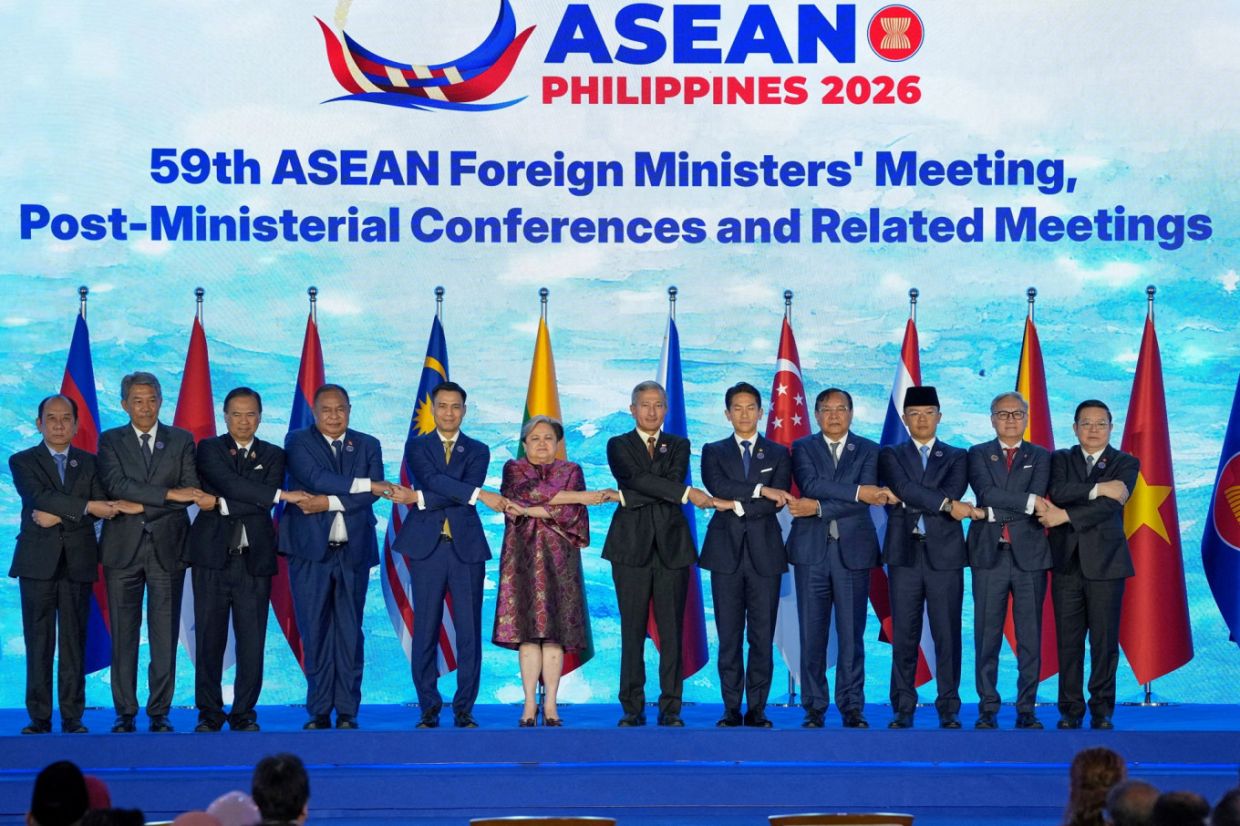
Indonesian Foreign Minister Sugiono has issued a pointed reminder to Asean that ambitious pledges must translate into measurable action, as the regional bloc gathers in Manila to address mounting geopolitical pressures that threaten its unity and strategic standing. The 59th Asean Foreign Ministers Meeting exposed persistent fractures in how the bloc handles contemporary crises, from the conflict ravaging the Middle East to unresolved maritime disputes with major powers. Sugiono's candid question—"Can Asean deliver on its promises?"—crystallized concerns that have shadowed the organisation's recent trajectory, despite May's landmark decision to welcome Timor-Leste as its eleventh member.
The Tuesday discussions among diplomats from all eleven member states revealed an organisation grappling with interconnected challenges that test its foundational commitment to regional stability and political unity. The Middle East conflict has emerged as an immediate economic threat, prompting Asean to issue a joint statement acknowledging potential fallout for member states' economies and the welfare of their citizens abroad. However, the urgency of this external shock has also exposed how individual member states prioritise bilateral interests over collective negotiating strength. Sugiono warned that the moment demands Asean demonstrate its ability to uphold its charter, yet the reality on the ground suggests internal divisions continue to limit the bloc's capacity for coordinated responses.
The economic dimensions of the Middle East crisis have begun reshaping Asean's strategic calculations in unexpected ways. Trade data reveals that the Philippines has more than doubled its solar panel imports from China during the first five months of this year compared to the same period previously, a shift driven by disruptions to energy supplies caused by tensions in the Strait of Hormuz. This pattern, likely replicated across other member states seeking alternative sources, subtly weakens Asean's negotiating leverage with Beijing on maritime issues. As countries become increasingly dependent on Chinese energy solutions, their willingness to take firm positions on the contested South China Sea—where China claims overlapping rights with several Asean members—naturally diminishes. This dynamic underscores how external shocks can inadvertently undermine the bloc's ability to maintain a unified stance on core regional disputes.
The protracted South China Sea Code of Conduct negotiations encapsulate Asean's broader struggle to convert diplomatic language into binding mechanisms. Twenty-four years have elapsed since countries began discussions on establishing rules to govern conduct in one of the world's most strategically critical waterways, a delay that reflects fundamental disagreements among member states and the influence of major powers invested in maintaining ambiguity. Sugiono's stark assertion that "a region governed by rules is stronger than one controlled by power" articulates an idealistic vision that has consistently collided with practical geopolitical realities. Smaller Asean members dependent on Chinese investment or trade face genuine constraints in supporting aggressive moves toward codifying restrictions on Beijing's activities. The financial incentives created by infrastructure investments, energy deals, and market access frequently outweigh the abstract benefits of maritime rules that would constrain the region's most influential economic actor.
Myanmar's continuing instability added another layer of complexity to Manila's deliberations, with ministers convening a dedicated session to assess implementation of the Five-Point Consensus framework. This Asean-developed roadmap has consistently disappointed expectations, primarily because the bloc lacks enforcement mechanisms and because members fundamentally disagree on how to balance engagement with the military government against pressure for democratic restoration. Philippine Foreign Secretary Theresa P. Lazaro indicated that discussions had touched on possible reforms to Asean's special envoy mechanism and a review of progress metrics, with completion targeted for November's leaders' summit. Yet such procedural adjustments address symptoms rather than the underlying contradiction: Asean cannot simultaneously demand Myanmar's compliance with democratic standards while maintaining non-interference as a founding principle. This tension has permitted the Myanmar crisis to drag on without resolution, damaging Asean's credibility as an effective regional stabiliser.
The strategic paradox confronting Asean reflects broader structural vulnerabilities in the organisation's architecture. Established on principles of consensus and non-interference, Asean was designed for an era when regional powers possessed clearer spheres of influence and when economic interdependence among members remained limited. Contemporary geopolitical competition from the United States, China, Russia, and India has fractured this consensus-based model, as major powers cultivate bilateral relationships and offer competing visions for regional alignment. Member states now calculate their interests through multiple, sometimes contradictory frameworks—the Quad, China's Belt and Road Initiative, bilateral security partnerships, and Asean mechanisms themselves. This fragmentation diminishes the bloc's collective bargaining power precisely when regional challenges demand coordinated responses.
Indonesia's leadership voice carries particular weight given its status as Asean's founding member and its economic heft as Southeast Asia's largest economy. Sugiono's emphasis on fulfilling the charter's commitment to regional peace and stability attempted to redirect focus toward the organisation's core mission, yet his framing implicitly acknowledged that member states had strayed from collective interests. By invoking May's amendment admitting Timor-Leste, he sought to remind colleagues of Asean's capacity for strategic decision-making, but also highlighted the gap between procedural achievements and substantive accomplishments on pressing issues. The expansion itself, while historically significant, represents a largely symbolic gesture that does not materially enhance Asean's ability to influence outcomes in South China Sea disputes or Middle East conflicts.
The two-day Manila gathering illustrated how external crises inevitably expose Asean's internal fault lines. The joint statement on the Middle East acknowledged economic concerns and humanitarian dimensions while carefully avoiding specific criticism of any party to the conflict—a classic Asean formulation that provides cover for member states with divergent geopolitical sympathies. Similarly, discussions of Myanmar produced agreement on process improvements rather than substantive policy shifts. These compromises preserve unity in form while obscuring continued disagreement in substance, a pattern that has defined Asean's response to major challenges for decades. Sugiono's question about delivering on promises thus carried an implicit acknowledgment: Asean excels at crafting diplomatic language but struggles to translate commitments into binding actions that constrain member state behaviour or produce measurable outcomes.
The Wednesday continuation of the Manila meetings, featuring dialogue with the United States, China, Russia, and other external partners, will test whether Asean can present a coherent regional perspective on security and economic challenges. These conversations typically reveal how individual member states align with major powers bilaterally, undermining collective Asean positions. The Philippines' current chairmanship offers an opportunity for Manila to use its position to drive internal consensus, yet even strong leadership cannot overcome structural incentive misalignments among members. Indonesia's call for delivery on promises, while rhetorically powerful, ultimately highlights the fundamental weakness constraining regional organisations: they can facilitate coordination among states with convergent interests but cannot manufacture consensus where divergent interests predominate.
For Malaysian observers and policymakers, Asean's apparent drift carries direct implications. Malaysia's own interests span South China Sea disputes, energy security, and economic partnerships with multiple major powers, creating similar tension between collective Asean positions and bilateral calculations. The bloc's evident difficulty in translating agreements into concrete mechanisms suggests that bilateral hedging strategies and plurilateral groupings may prove more effective for advancing Malaysian interests than reliance on Asean consensus. As Indonesia insists that the organisation must deliver on its promises, the uncomfortable reality is that without fundamental reform to Asean's decision-making structures and enforcement capabilities, such calls will likely continue to echo unheeded.

