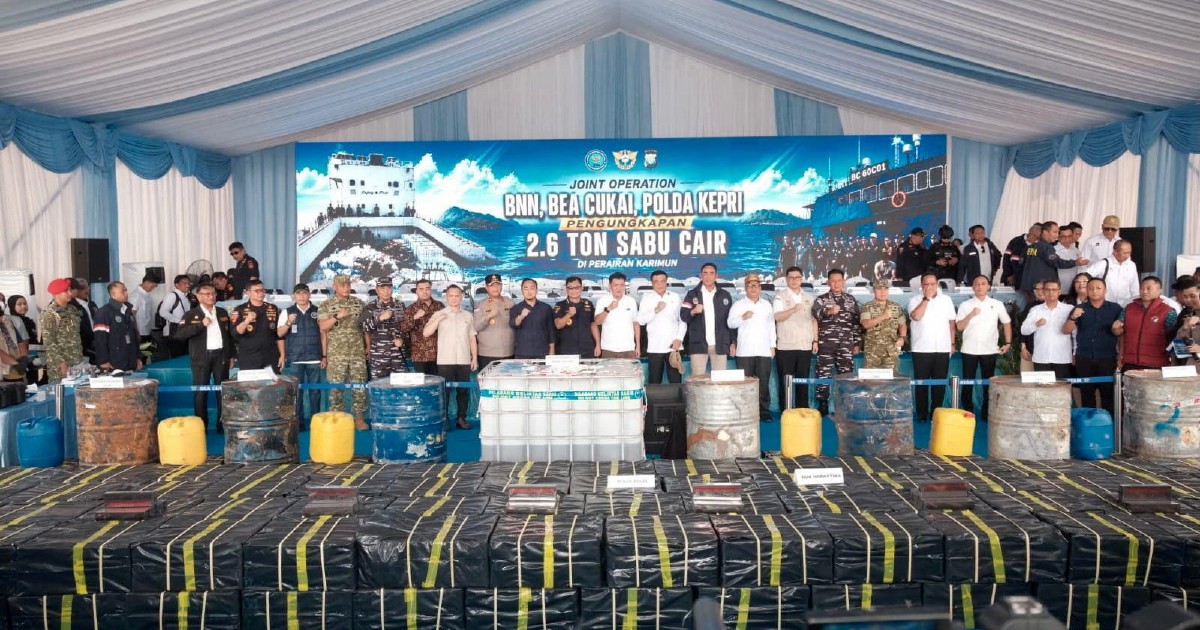
Indonesian law enforcement has apprehended 10 Myanmar nationals in connection with the discovery of 2.6 metric tonnes of liquid methamphetamine aboard a commercial vessel flying a Tanzanian flag, authorities announced during a Friday briefing in Jakarta. The bust represents a substantial victory against transnational drug smuggling operations that continue to plague Southeast Asia, a region struggling with the proliferation of illicit narcotics destined for markets across the continent and beyond.
The seizure underscores the persistent vulnerability of maritime routes traversing Indonesian waters to illicit trafficking. Criminal syndicates frequently exploit international shipping lanes and flag-of-convenience vessels—including those registered to distant nations like Tanzania—to obscure the origins and destinations of contraband. The use of a Tanzanian-flagged ship points to a deliberate attempt by traffickers to create legal ambiguity and complicate enforcement efforts by authorities in the region.
Methamphetamine, particularly in its liquid form, remains one of Southeast Asia's most lucrative and destructive narcotics. The drug commands substantial profit margins along international supply chains, making it an attractive commodity for organised criminal networks. Liquid methamphetamine can be more easily concealed and transported than crystalline forms, and it can be reconstituted at its final destination, adding another layer of operational sophistication to trafficking endeavours.
The arrest of 10 Myanmar nationals reflects broader patterns in regional drug trafficking, where individuals from Myanmar have become increasingly visible in law enforcement operations across Southeast Asia. Myanmar's geographic position, porous borders, and ongoing political instability have made it a significant production and transit hub for methamphetamine destined for markets throughout the region, from Thailand to the Philippines and beyond. The country's placement in the Golden Triangle, alongside Laos and Thailand, has long positioned it as a critical node in Asia's illicit drug supply chain.
Indonesia, as the archipelago's largest economy and a major maritime hub, has intensified its counter-narcotics operations in recent years. The Indonesian National Police and related agencies have expanded their capabilities for interdicting contraband at sea, reflecting Jakarta's recognition that ocean-based trafficking represents a critical vulnerability. These efforts align with broader regional initiatives, including ASEAN's increasingly coordinated responses to drug trafficking and other transnational crimes.
The scale of this particular seizure—2.6 metric tonnes—demonstrates the volume at which these operations function. Street-level enforcement captures only modest quantities; major busts like this one reveal the true magnitude of trafficking infrastructure. A seizure of this magnitude, if successfully distributed, would have devastated communities throughout Indonesia and potentially beyond, fuelling addiction, criminal violence, and public health crises.
The involvement of a Tanzanian-flagged vessel raises questions about international maritime regulatory frameworks and how criminal networks exploit them. Flag-of-convenience registries, particularly those from nations with limited maritime oversight capacity, can obscure vessel ownership and operator accountability. This case illustrates how global shipping logistics can become entangled with transnational criminal enterprise, requiring enhanced coordination between maritime authorities and law enforcement agencies.
The apprehension and impending prosecution of the 10 suspects will likely provide Indonesian authorities and international partners with valuable intelligence regarding trafficking routes, operational procedures, and the broader networks involved. Such cases often reveal connections to larger criminal organisations, potential corruption vectors, and vulnerabilities in border security and port operations that can inform future enforcement strategy.
For Malaysia and other Southeast Asian nations, this bust carries important implications. Methamphetamine seizures in Indonesian waters often represent drugs in transit toward other regional destinations, including Malaysia. The Malaysian authorities' own drug enforcement efforts occur within this broader regional context of heavy trafficking flows. Enhanced maritime cooperation between Indonesia and its neighbours remains essential for disrupting these supply chains before contraband reaches domestic markets.
The bust also highlights the continued capacity of Myanmar-based production and trafficking networks to sustain massive international operations despite years of enforcement efforts. As long as production hubs remain active and demand persists across Asia, traffickers will adapt their methods, routes, and cover mechanisms. The use of legitimate maritime infrastructure for smuggling purposes presents an ongoing challenge that demands sustained international coordination and intelligence sharing.
Indonesian authorities' announcement of this seizure reflects both a genuine enforcement success and strategic communication aimed at demonstrating commitment to counter-narcotics work. Such high-profile busts serve notice to criminal organisations while also addressing public and international expectations regarding government efforts against drug trafficking. The operation represents one significant victory in an ongoing battle against organised crime networks operating across Southeast Asia's maritime domain.

