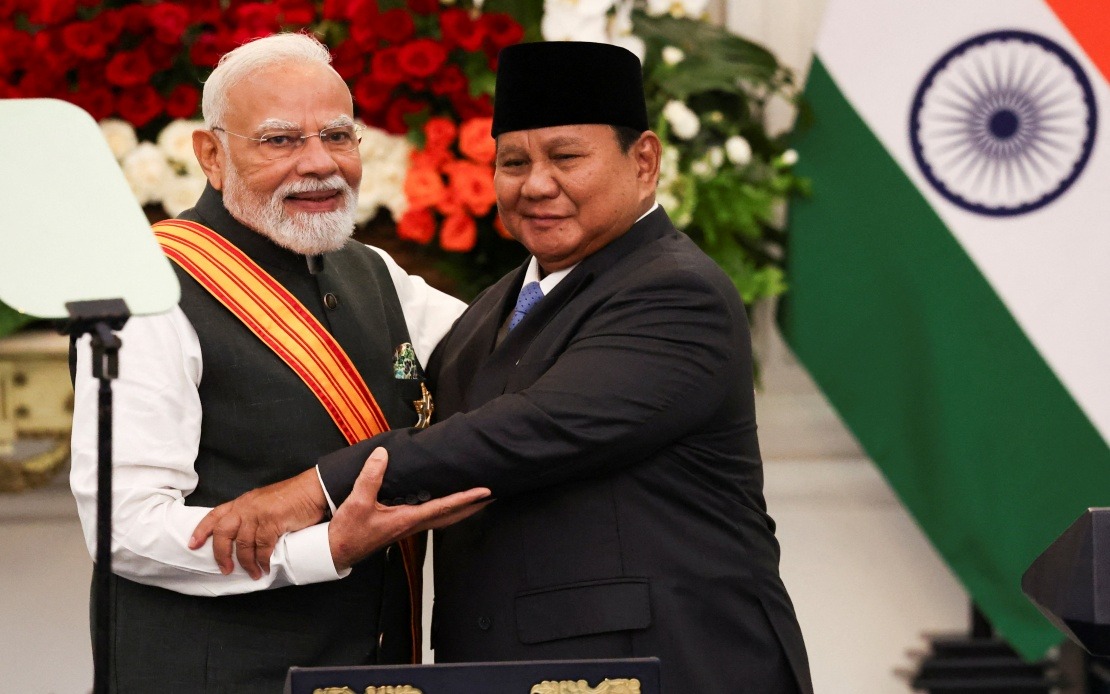
Indonesian President Prabowo Subianto conferred the country's highest state honour on Indian Prime Minister Narendra Modi on Tuesday, marking a significant diplomatic milestone in the relationship between Southeast Asia's largest economy and South Asia's dominant power. The award ceremony took place at the Merdeka Palace in Jakarta during Modi's state visit at Prabowo's invitation, underscoring the deepening engagement between the two nations across multiple dimensions of cooperation and strategic alignment.
Prabowo articulated the rationale for the honour in remarks delivered alongside Modi following their bilateral meeting, emphasising that the award recognised Modi's personal leadership and his substantive contributions to elevating Indonesia-India relations to the level of a Comprehensive Strategic Partnership. The Indonesian president highlighted Modi's consistent dedication to expanding cooperative frameworks between Jakarta and New Delhi, positioning the award as recognition not merely of diplomatic courtesy but of tangible outcomes that have benefited Indonesia's development trajectory.
The state visit itself carries considerable symbolic weight, as it represents a reciprocal engagement following Prabowo's own visit to India earlier in the year. This rhythm of high-level bilateral exchanges demonstrates the mutual commitment both countries have expressed to institutionalising their partnership and ensuring that strategic alignment translates into sustained, mutually beneficial collaboration across trade, defence, energy, and technology sectors that matter to both regional economies.
Prabowo contextualised Modi's recognition by drawing a historical parallel with India's first Prime Minister, Jawaharlal Nehru, who previously received Indonesia's highest honour in acknowledgement of his instrumental role in strengthening ties between the two countries and his pioneering contributions to the Non-Aligned Movement. This comparison carries weight beyond ceremonial gesture; it positions Modi's visit within a continuum of India-Indonesia statecraft spanning decades and suggests that New Delhi's current regional engagement is viewed by Jakarta as consistent with historical patterns of cooperation dating to the early post-independence era.
The Indonesian president characterised Modi's state visit as a historic watershed moment in bilateral relations, framing it as concrete evidence of both governments' determination to advance their Comprehensive Strategic Partnership through substantive, reciprocally advantageous initiatives. This language moves beyond the ritualistic reassurances typical of diplomatic statements, instead suggesting that Jakarta views this particular moment as an inflection point where partnership deepens qualitatively rather than merely expands quantitatively.
A notable aspect of Prabowo's remarks was his explicit appreciation for India's support regarding Indonesia's aspiration for permanent membership within BRICS, the influential bloc of emerging economies. This dimension reveals how bilateral partnership intersects with Indonesia's broader strategic positioning within global institutions and power structures. India's backing for Indonesian BRICS membership carries practical significance for Jakarta's influence on the world stage and demonstrates how bilateral relationships serve as vehicles for advancing positions within multilateral forums that shape global economic and political architecture.
Prabowo repeatedly emphasised the deep historical and cultural foundations underpinning Indonesia-India relations, describing India as a longstanding close friend whose ties with Indonesia extend far beyond contemporary diplomatic interests. He stressed that shared cultural and historical heritage provides ballast for the partnership, suggesting that cooperation rests on foundations that transcend transactional calculations and instead reflects civilisational connections spanning centuries. This framing reflects how both nations understand their engagement as rooted in Indic cultural influences that historically permeated maritime Southeast Asia.
For Malaysian and Southeast Asian observers, this bilateral elevation carries broader regional implications. Indonesia's strategic deepening with India signals Jakarta's confidence in pursuing partnerships with major powers while maintaining its central role in regional affairs. As the largest economy in ASEAN and an increasingly influential voice in regional diplomacy, Indonesia's commitment to India partnership shapes the broader geopolitical environment in which Malaysia and other Southeast Asian states operate. The emphasis on Comprehensive Strategic Partnership suggests that India is establishing itself as a reliable stakeholder in regional stability and prosperity.
The timing of Modi's visit also merits consideration within the context of evolving great power competition in Asia. India's engagement with Indonesia reflects New Delhi's Indo-Pacific strategy and its determination to strengthen partnerships with major Southeast Asian economies. For Malaysia, which maintains its own relationships with both India and Indonesia, these deepening bilateral ties underscore the importance of navigating a region where major powers increasingly compete for influence and where traditional regional leaders must carefully calibrate their own external partnerships.
The Comprehensive Strategic Partnership framework that both leaders repeatedly referenced represents a commitment extending beyond traditional diplomatic protocols into substantive collaboration across multiple sectors including defence, maritime security, economic integration, and people-to-people exchange. This institutional scaffolding suggests that India-Indonesia engagement is designed to withstand political transitions and changing administrations, creating durable structures for cooperation that enhance bilateral ties regardless of personnel changes in either capital.
For Indonesia, securing India's backing on the BRICS membership question while simultaneously elevating Modi through the nation's highest honour creates diplomatic reciprocity that strengthens Jakarta's hand in multilateral negotiations. This exchange of support demonstrates how bilateral ceremonies and honours serve practical functions in advancing national interests within global forums, particularly for countries seeking expanded influence among emerging market economies.

