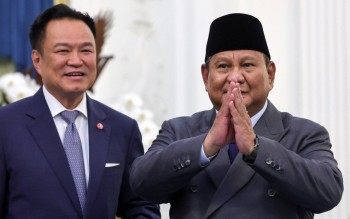
Indonesia and Thailand are moving to substantially deepen their economic relationship, with both nations committing to achieve US$20 billion in bilateral trade by 2030 under a newly adopted strategic roadmap. The ambitious target was endorsed during the second Leaders' Consultation between President Prabowo Subianto and Thai Prime Minister Anutin Charnvirakul at Jakarta's Merdeka Palace on Monday, signalling a deliberate effort to harness the combined economic potential of Southeast Asia's two largest economies by purchasing power parity. The roadmap, formally titled the Indonesia-Thailand Strategic Partnership Roadmap 2026-2030, establishes a comprehensive framework intended to guide bilateral cooperation across trade, investment, and broader strategic domains, building upon the two nations' elevation to Strategic Partnership status during Prabowo's visit to Bangkok in the previous year.
The establishment of the Indonesia-Thailand Joint Trade Commission represents a watershed moment in the bilateral relationship, functioning as the first institutional mechanism of its kind in the countries' histories dedicated specifically to identifying commercial opportunities and systematically dismantling trade barriers. Speaking at the joint press conference, Prabowo emphasised that this formal structure would enable consistent dialogue between trade officials and business representatives, moving beyond ad-hoc engagement to create sustained momentum for economic integration. The commission is expected to operate at the commerce minister level, offering both governments and the private sector a dedicated platform to address specific impediments to cross-border commerce and jointly develop initiatives that benefit companies in both nations.
Thailand's Prime Minister characterised Indonesia as his country's fourth-largest trading partner within ASEAN, yet argued that the magnitude of both economies' populations and productive capacities suggested substantially greater trade potential remains untapped. Anutin's framing reflects a common observation among regional economists that intra-ASEAN trade, despite decades of integration frameworks, remains below what bilateral economic complementarities might suggest. By invoking the scale differential, Anutin was effectively challenging both governments to move beyond incremental improvements and pursue transformative policies that would substantially reduce trade friction and unlock deeper commercial integration.
Food security emerged as a priority pillar within the strategic roadmap, with both nations recognising mutual vulnerabilities and complementary assets that could be leveraged collaboratively. Prabowo outlined that cooperation would encompass agricultural technology transfer, logistics infrastructure, food processing capabilities, and supply chain resilience—framing food security not merely as agricultural commerce but as a comprehensive systems challenge requiring coordinated investment and policy alignment. Thailand, which functions as a major rice supplier to Indonesia and the broader region, committed to maintaining reliable supplies of premium-quality rice whilst simultaneously seeking enhanced market access for Thai agricultural products, meat, dairy, and machinery across Indonesian borders. This represents a bargain of sorts: Thailand leverages its agricultural production capacity and established reputation for quality whilst Indonesia reciprocates through preferential treatment of Thai agricultural inputs.
A particularly striking dimension of the cooperation framework involves urea fertiliser, with Thailand currently importing approximately 60,000 tonnes annually from Indonesia but signalling intent to increase volumes to several hundred thousand tonnes annually. This expansion would represent a substantial multiplication of existing trade flows and reflects Thailand's recognition of Indonesia's capacity as a significant fertiliser producer, a sector where Indonesia holds considerable competitive advantages rooted in its natural resource endowments and chemical manufacturing base. The potential expansion underscores how bilateral trade can extend beyond finished consumer goods into industrial inputs that support broader agricultural productivity across the region.
Energy cooperation constitutes another cornerstone of the strategic arrangement, with both governments agreeing to establish the Indonesia-Thailand Energy Forum as an institutional framework for strengthening energy security and accelerating transitions toward sustainable energy systems. Given Indonesia's substantial hydrocarbon reserves, geothermal potential, and renewable energy ambitions, coupled with Thailand's energy consumption requirements and growing commitment to decarbonisation, the forum provides a logical platform for alignment on energy policy, investment facilitation, and technology collaboration. The forum's emphasis on both government and business participation signals recognition that energy transitions require coordinated action across state actors and commercial entities, from utilities to renewable developers.
Digital economy cooperation represents a modern dimension of the bilateral agenda, with particular attention to promoting local currency transactions in bilateral trade and investment activities. This initiative addresses long-standing inefficiencies whereby regional trade typically relies on US dollars as the transactional medium, imposing unnecessary currency conversion costs on businesses and limiting the development of local financial market infrastructure. By encouraging Indonesian rupiah and Thai baht transactions, both nations aim to reduce transaction costs, improve capital flow efficiency, and gradually develop deeper financial market integration that could eventually facilitate more sophisticated cross-border investment and financial products.
The halal industry cooperation framework reflects both pragmatic economics and broader regional positioning. Indonesia, as the world's largest Muslim-majority nation and a major halal certifier, and Thailand, as a significant halal product producer and exporter, possess complementary strengths in developing regional and global halal value chains. Anutin specifically referenced the mutual recognition agreement on halal certification, set to expire in November, underscoring the need for proactive renewal before institutional discontinuity disrupts certification processes and market access. The willingness to cooperate on halal standards and certification demonstrates how bilateral partnerships can extend into regulatory and standards domains where harmonisation generates mutual benefits.
Education cooperation, formalised through a newly signed memorandum of understanding, addresses human capital development as a foundation for sustained economic integration. When skilled labour can move more freely across borders and when educational curricula become better aligned across countries, labour markets function more efficiently and talent flows toward areas of highest productivity. The education agreement thus represents an investment in the institutional underpinnings required to support deeper economic integration, recognising that commerce ultimately depends upon human capability and cross-national understanding.
Anutin's arrival in Jakarta on Monday marked the first official visit by a Thai prime minister to Indonesia in 15 years, an interval that reflects the somewhat uneven nature of bilateral engagement despite geographic proximity and economic complementarity. That Anutin's visit represented his first official journey to Indonesia since assuming office as Thailand's 32nd Prime Minister in September 2025 suggests deliberate prioritisation of the Indonesian relationship within his government's regional strategy. This elevation in diplomatic engagement, coupled with the substantive agenda articulated through the strategic roadmap, signals that both capitals view bilateral deepening as integral to their respective national and regional strategies.
For Malaysian and Southeast Asian observers, the Indonesia-Thailand partnership deepening carries broader implications for regional architecture and competitive positioning. As ASEAN's two most populous nations and largest economies consolidate their bilateral relationship through institutional frameworks and ambitious trade targets, they establish models and precedents that could influence how other dyadic partnerships develop within the region. Additionally, the emphasis on local currency transactions, digital economy integration, and food security cooperation reflects adaptive responses to contemporary challenges—from currency volatility to supply chain vulnerabilities—that resonate across Southeast Asia and potentially offer lessons applicable to broader regional initiatives.
The signed agreements on tourism and organic waste processing, whilst appearing peripheral, signal the comprehensiveness of the integration agenda. Tourism cooperation between TransNusa and Thailand's Tourism Authority, alongside the organic waste processing initiative involving Bio-Axel and Pro Konsilium, demonstrate that bilateral deepening encompasses not merely headline sectors but also emerging opportunities and environmental sustainability concerns. This granular approach to bilateral cooperation, where government-level strategic frameworks translate into specific business partnerships and projects, suggests the roadmap possesses practical implementation mechanisms rather than remaining aspirational rhetoric.
The US$20 billion bilateral trade target by 2030 represents an ambitious yet potentially achievable objective given both nations' economic scales and existing complementarities. Current bilateral trade volumes, whilst substantial, suggest room for growth through policy reforms, infrastructure investment, and business facilitation. Success would require sustained political commitment from both governments, proactive engagement by business communities in identifying and developing opportunities, and demonstrated willingness to address specific sectoral barriers as they emerge. The establishment of institutional mechanisms such as the Joint Trade Commission provides the necessary infrastructure for such sustained engagement, transforming what might otherwise be episodic diplomatic encounters into systematic, ongoing cooperation aimed at realising tangible economic benefits for both populations.

