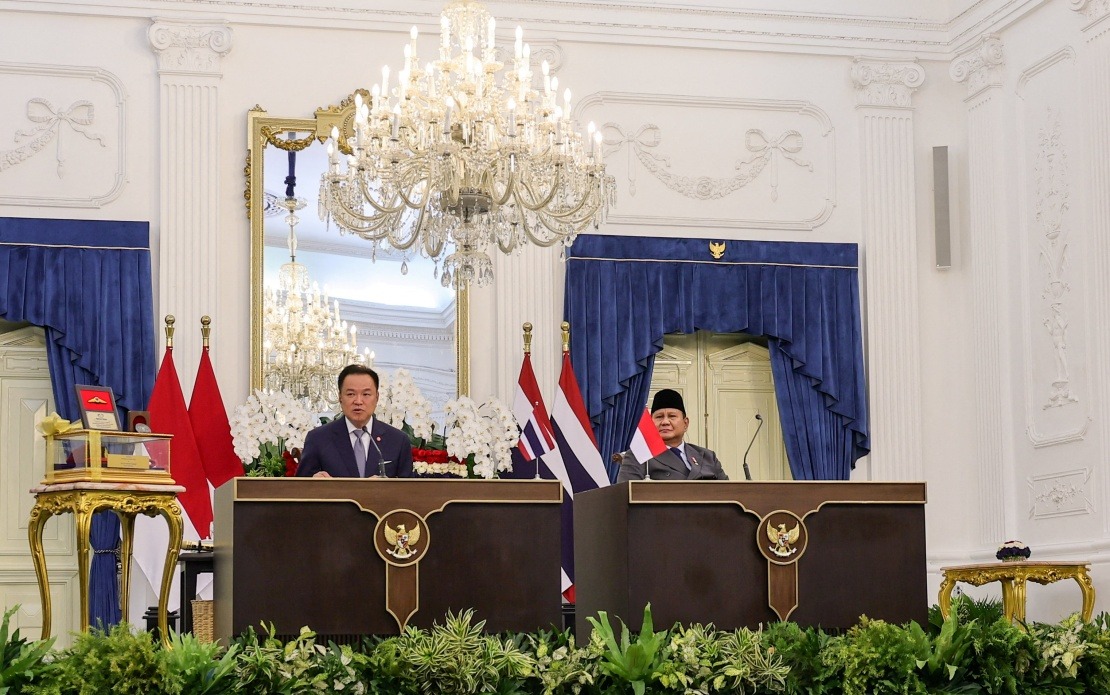
The second high-level leaders' consultation between Indonesia and Thailand on Monday signals a significant reinforcement of bilateral ties and their shared commitment to addressing the Myanmar crisis through Southeast Asia's premier multilateral forum. During meetings at Jakarta's Merdeka Palace, Indonesian President Prabowo Subianto and Thai Prime Minister Anutin Charnvirakul outlined an ambitious agenda spanning regional peace architecture and concrete security collaboration, reflecting the two nations' strategic importance within ASEAN and their mutual interest in stabilising the broader region.
At the heart of their discussions lay Myanmar's deteriorating security situation, which has prompted Jakarta and Bangkok to reaffirm their backing for ASEAN's Five-Point Consensus—the regional bloc's flagship roadmap for resolving the political standoff that has engulfed the country since the 2021 military coup. Both leaders stressed that advancing this framework depends on fostering inclusive dialogue among Myanmar's fractious political actors, achieving concrete progress on violence reduction, and ensuring humanitarian corridors remain open for displaced persons and aid delivery. President Prabowo emphasised that ASEAN unity and centrality remain foundational to any credible peace process, a position that reflects the regional organisation's emphasis on non-interference and consensus-driven diplomacy, even as Myanmar's crisis tests those principles.
Thailand's role as a key facilitator in ASEAN's Myanmar engagement cannot be overstated, particularly given Bangkok's geographic proximity to the conflict zone and its historical ties to Burmese stakeholders. Prime Minister Anutin's visit, his first official trip to Indonesia since assuming office in September 2025, marks a symbolic milestone as the first Thai prime ministerial visit to Jakarta in 15 years, underscoring a deliberate effort to resurrect high-level engagement between two major ASEAN economies. The timing and emphasis on bilateral consultation suggest both governments recognise that individual nation-states must strengthen their own coordination mechanisms before attempting to broker regional consensus on Myanmar.
Beyond Myanmar's political morass, the bilateral talks revealed a deepening alliance focused on transnational security threats that pose increasingly tangible dangers to ordinary citizens across Southeast Asia. Indonesia and Thailand have agreed to substantially elevate their joint counteroffensive against online scam networks, which have emerged as one of the region's most sophisticated and damaging criminal enterprises. These syndicates, often operating from third countries but targeting victims throughout Southeast Asia, have extracted hundreds of millions of dollars while leaving psychological and financial wreckage in their wake. The scale of the problem has reached critical proportions: Thailand has already facilitated the repatriation of nearly 1,000 Indonesian nationals victimised by such operations, a figure that represents merely the tip of a far larger iceberg of deception and financial fraud.
The defence and security cooperation framework that Prabowo and Anutin endorsed encompasses several operational mechanisms designed to dismantle these criminal networks at their source. Enhanced intelligence sharing between Jakarta and Bangkok will enable both nations to identify transnational crime nodes and financing flows more effectively, whilst joint investigations and financial tracking protocols will follow money trails across borders and into cryptocurrency exchanges and underground banking systems where scammers launder proceeds. This represents a significant evolution beyond traditional law enforcement cooperation, recognising that modern organised crime requires sophisticated, real-time data integration and investigative coordination. Law enforcement agencies in both countries will establish formal liaison structures to ensure that operations targeting the same criminal organisations proceed in synchronised fashion rather than operating in parallel silos.
Particular attention has been devoted to establishing a Transnational Referral Mechanism, a institutional innovation that addresses a critical gap in existing victim protection frameworks. Previously, Indonesians and Thai nationals rescued from scam operations faced bureaucratic obstacles and safety risks during repatriation processes, with inadequate protocols for identifying vulnerable persons, assessing their needs, and ensuring dignified return to their home countries. The TRM framework will systematise victim identification, coordinate protective measures, and streamline repatriation procedures, ensuring that rescued individuals receive appropriate psychosocial support and are not re-traumatised by the return process. This human-centred approach acknowledges that successful counterterrorism requires not only dismantling criminal infrastructure but also supporting those shattered by exploitation.
Thailand's defence minister proposals indicate that bilateral military cooperation will expand substantially beyond intelligence matters into hardware and joint operational capabilities. The proposed supply of 36 amphibious wheeled armoured vehicles to Indonesia demonstrates Thai interest in strengthening Indonesia's defence infrastructure whilst generating defence industry opportunities for Thai manufacturers. This development reflects a broader trend across ASEAN whereby regional military powers increasingly pursue defence industrial cooperation, building indigenous capacity for procurement whilst reducing dependence on distant suppliers. Regular joint military training exercises will deepen interoperability and establish shared operational doctrine, particularly important given both nations' maritime responsibilities and coastal defence requirements.
The expansion of maritime security cooperation holds particular significance for Malaysian observers and policymakers. Indonesia and Thailand together control critical chokepoints and shipping lanes integral to Southeast Asian commerce, whilst facing shared threats from piracy, illegal fishing, and maritime smuggling operations. Enhanced coordination on naval patrols, information sharing on suspicious vessel movements, and joint task force arrangements improve overall maritime domain awareness across a region through which trillions of dollars in annual trade flows. For Malaysia, operating between these two larger regional powers, improved Indonesia-Thailand maritime cooperation creates both opportunities and challenges—strengthening overall security architecture whilst potentially shifting patrol patterns and enforcement priorities.
Human trafficking and drug trafficking, longstanding scourges of transnational Southeast Asian crime, received explicit attention in the bilateral framework. These criminal enterprises exploit vulnerable populations—often from impoverished rural areas—whilst enriching organised crime networks that operate across multiple jurisdictions. Thailand's particular emphasis on combating online scam operations alongside human and drug trafficking acknowledges the operational linkages between these seemingly distinct criminal enterprises; scam syndicates often employ trafficked labour to conduct fraud operations, whilst drug networks utilise the same smuggling corridors and corruption networks that facilitate human trafficking. By addressing these crimes within an integrated security framework rather than through compartmentalised law enforcement specialisations, Indonesia and Thailand signal a more sophisticated understanding of modern organised crime's networked nature.
Wildlife trafficking, mentioned explicitly by Prime Minister Anutin, represents an emerging priority area reflecting international environmental concerns and ASEAN's commitment to biodiversity protection. The region's tropical forests and coastal ecosystems support some of the world's most endangered species, yet criminal networks systematically poach, smuggle, and trade protected animals and plants worth billions annually. Indonesia and Thailand jointly control significant wildlife habitats and migration corridors; coordinated enforcement operations, intelligence sharing on trafficking routes, and capacity building for ranger training and forensic investigation of smuggled fauna represent meaningful contributions to global conservation efforts whilst addressing profitable criminal enterprises that operate across borders.
The geopolitical context surrounding this bilateral deepening merits consideration by Malaysian strategic observers. Indonesia under President Prabowo has signalled renewed emphasis on regional engagement and security cooperation, whilst Thailand under Prime Minister Anutin similarly prioritises ASEAN cohesion and bilateral relationships with key regional partners. This twin emphasis on both Myanmar peace efforts and expanded security cooperation suggests that both governments view regional stability as a prerequisite for economic development and prosperity. The 15-year gap in Thai prime ministerial visits to Indonesia had symbolised cooling bilateral relations; its closure through Anutin's inaugural visit represents a deliberate reset that regional economies require for navigating the complexities of post-pandemic recovery and geopolitical uncertainty.
For Malaysia, these developments in Indonesia-Thailand cooperation carry implications for broader ASEAN architecture and burden-sharing arrangements. As Myanmar's crisis persists and transnational crimes proliferate, successful bilateral security cooperation between major regional actors strengthens ASEAN's collective resilience and demonstrates that regional problems can be tackled through multilateral frameworks rooted in bilateral partnership. However, Malaysia must ensure that its own interests in maritime security, humanitarian assistance, and counter-trafficking efforts receive adequate attention within regional mechanisms increasingly driven by the economic and security weight of larger neighbours.

