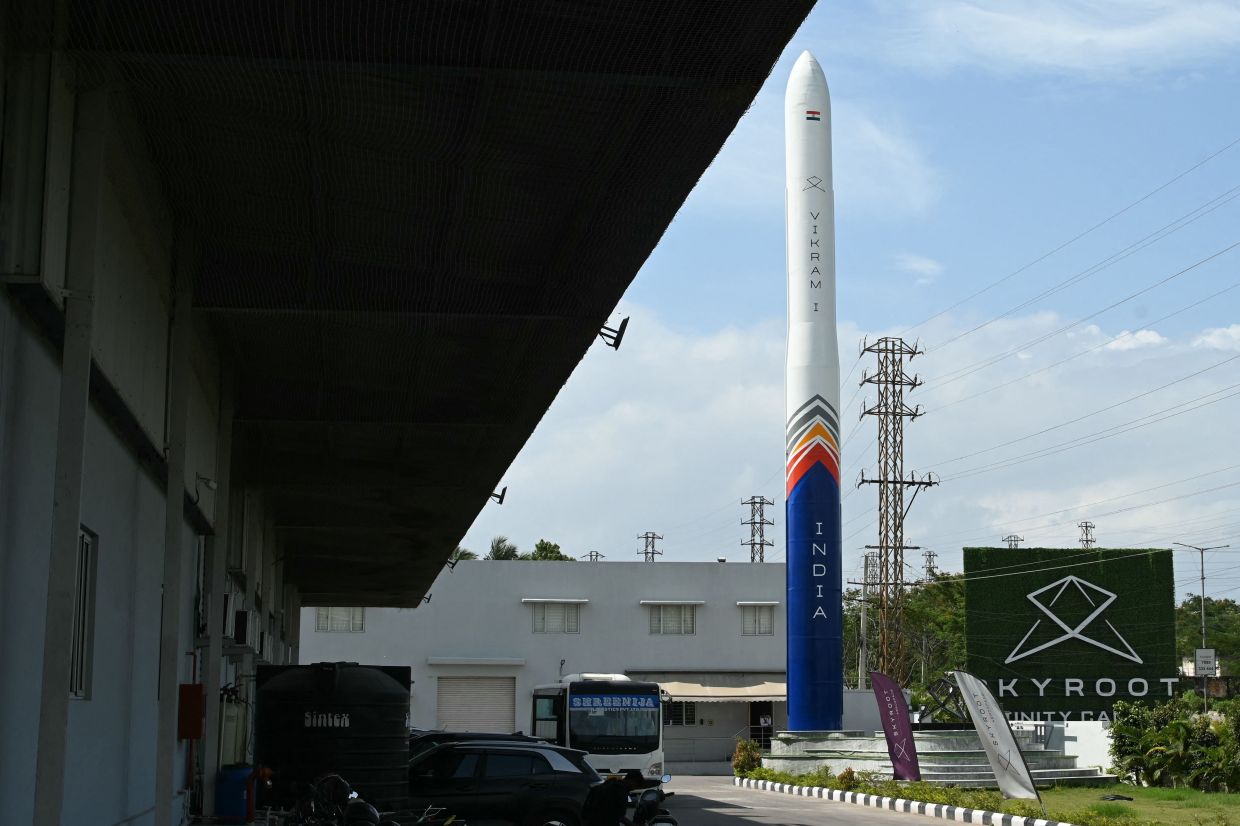
India stands on the cusp of a defining moment for its aerospace ambitions. Within weeks, Skyroot Aerospace will attempt to launch the Vikram-1, the nation's first privately developed orbital-class rocket, marking a watershed in the country's transition from government-controlled space exploration to a vibrant commercial sector. The planned liftoff, scheduled between July 12 and August 4 from the Sriharikota spaceport on the southeast coast in Andhra Pradesh, represents the culmination of years of regulatory reforms and policy shifts that have unlocked India's space potential for private enterprise.
The transformation has been dramatic. When India's government opened the space sector to private investment in 2020, few anticipated the velocity of growth that would follow. Today, the Indian space economy is valued at US$8.4 billion and has attracted more than 400 space startups hungry to capture market share in satellite launches, propulsion systems, and Earth observation capabilities. This entrepreneurial explosion reflects deeper changes in how New Delhi views space—no longer the exclusive preserve of the Indian Space Research Organisation, but rather a strategic economic sector essential to national competitiveness and technological advancement.
India's credentials as a spacefaring nation are formidable. The country became the first Asian nation to place a spacecraft in Mars orbit back in 2014, a achievement that showcased Indian engineering prowess on the interplanetary stage. The lunar programme, Chandrayaan—Sanskrit for "Mooncraft"—has been equally impressive, culminating in 2023 when India successfully landed an unmanned rover on the Moon, making it the fourth nation globally to accomplish this feat after Russia, the United States, and China. These accomplishments established India as a serious player in deep-space exploration, yet they also masked a potential vulnerability: the heavy reliance on ISRO's infrastructure and launch capabilities had constrained the growth of a competitive private ecosystem.
The Department of Space has articulated an expansive vision for India's role in the global space landscape. The government envisions ambitious programmes spanning deep-space exploration, space science, human spaceflight, and orbital infrastructure development. These aspirations are backed by concrete investment projections and infrastructure expansion. New Delhi is enlarging the Sriharikota launchpad and constructing a second spaceport at Kulasekarapattinam in Tamil Nadu's southern tip, moves designed to relieve congestion and enable the rapid cadence of commercial launches that the growing sector demands. Official projections are bullish: the space industry is forecast to expand to $44 billion by 2033 and reach $100 billion by 2040, targets that assume sustained policy support and private sector dynamism.
India has long cultivated a reputation for cost-efficient space missions, a competitive advantage traceable to its engineering talent and relatively lower operational expenses compared to Western space agencies. ISRO has leveraged this advantage aggressively in the commercial satellite launch market. The organisation has deployed more than 430 foreign satellites, generating revenues exceeding $600 million, while simultaneously launching over 144 of its own satellites for domestic and scientific purposes. This dual mission—serving both national interests and international customers—has positioned ISRO as a reliable launch provider, though the emergence of private competitors like Skyroot threatens to erode its monopoly on orbital access.
Skyroot Aerospace exemplifies the new breed of Indian space entrepreneurs. The company's Vikram-1 rocket is engineered to carry small satellites into low-Earth orbit, addressing a market niche that larger government launchers have underserved. Beyond Skyroot, a constellation of specialised firms is carving out distinct roles within the emerging ecosystem. Pixxel is developing observation satellites for agricultural monitoring and environmental applications, sectors where Earth-imaging data commands premium valuations. Bellatrix Aerospace is advancing satellite propulsion technologies, while Agnikul Cosmos is manufacturing small satellite launch vehicles powered by 3D-printed rocket engines—a manufacturing innovation that could revolutionise production economics and speed development cycles.
India's international partnerships in space remain expansive and strategically important. Collaborations span NASA, the European Space Agency, and bilateral arrangements with France, Germany, Italy, Japan, and Saudi Arabia. Russia continues supporting India's human spaceflight preparations, a relationship rooted in Cold War-era technical cooperation that persists despite geopolitical volatility. These partnerships offer Indian firms access to technology, expertise, and market opportunities that would be unattainable in isolation. Conversely, India's established reputation for cost efficiency and its large pool of engineering talent make it an attractive partner for international space agencies and commercial ventures.
However, the expansion of India's space sector cannot be disentangled from the country's military and defence imperatives. The civil space industry and defence establishment are deeply intertwined, with government and private companies supplying both sectors with critical technologies including launch rockets, propulsion systems, satellites, avionics, and guidance systems. ISRO maintains close coordination with the Defence Research and Development Organisation and has supported the BrahMos missile programme, a joint India-Russia venture producing advanced cruise missiles. Companies manufacturing avionics and guidance systems for ISRO are simultaneously benefiting from surging military demand as New Delhi invests heavily in missile systems and military drones to address evolving security challenges along its land and maritime borders.
This civil-military overlap carries strategic implications for India's space aspirations and regional dynamics. As India develops indigenous launch capabilities and satellite technologies, defence applications inevitably follow, enhancing military systems and operational capabilities. The emergence of private firms in this ecosystem adds complexity, as commercial space companies increasingly operate in domains with direct national security applications. For neighbouring countries and regional observers, India's expanding space sector represents both opportunity and concern—opportunity for commercial collaboration and technological advancement, but also concern about the military applications that space technologies enable.
Skyroot's forthcoming launch will test whether India's regulatory framework and infrastructure can support sustained commercial operations. Success would validate the government's 2020 liberalisation decision and attract further private investment. Failure would raise questions about execution capabilities and dampen investor enthusiasm. The broader significance extends beyond commercial metrics. A thriving private space sector would diversify India's launch options, reduce costs, and accelerate the pace of technological innovation. It would also position Indian firms to compete in global markets for satellite services and launch capacity, areas where established players from the United States, Europe, and China currently dominate.
The coming weeks will reveal whether India's space ambitions can translate into competitive commercial realities. Skyroot's Vikram-1 represents a critical test case, but the ultimate measure of success will be whether private companies can repeatedly and reliably reach orbit, capture market share, and generate sustainable returns. The infrastructure is being constructed, the policy environment has shifted, and the entrepreneurial energy is evident. What remains to be demonstrated is execution at scale. For Malaysia and other Southeast Asian countries monitoring regional developments, India's space sector evolution carries implications for commercial launch options, satellite services availability, and the balance of technological capabilities across the Indian Ocean region.

