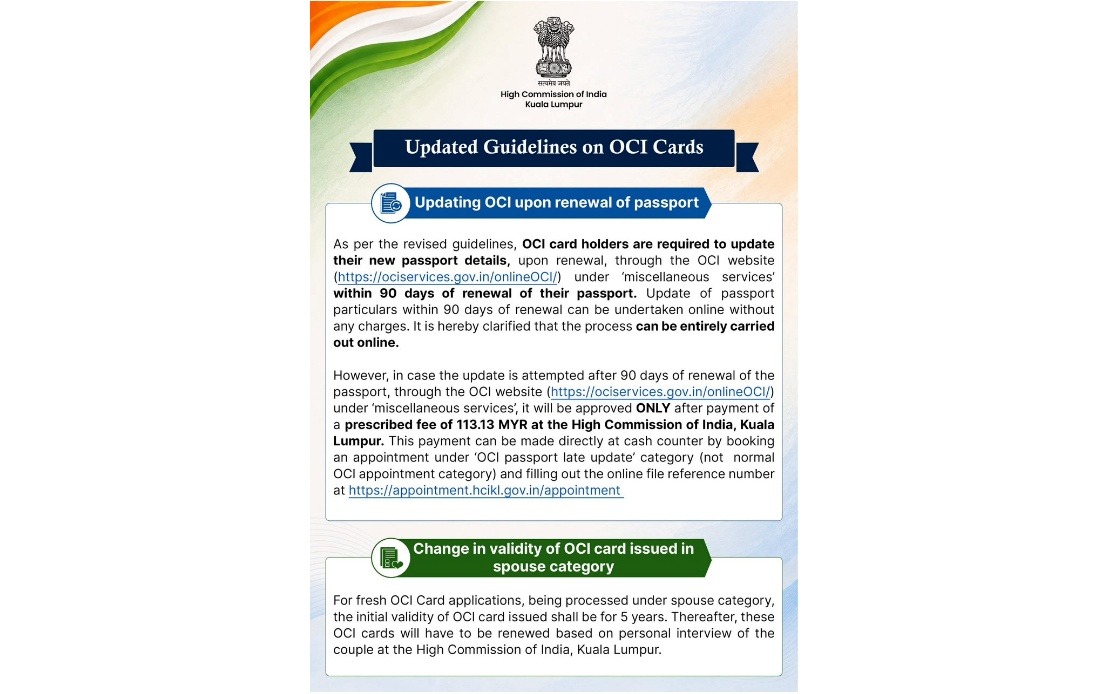
The High Commission of India in Kuala Lumpur has introduced more stringent requirements for Overseas Citizen of India (OCI) cardholders, establishing a mandatory 90-day window for updating passport information following renewal. These revised guidelines, announced through the mission's official social media channels, represent a tightening of administrative procedures that will affect the substantial population of Indian diaspora members residing in Malaysia who maintain OCI status.
The new framework prioritises speed and compliance by offering a cost-free pathway for those who act promptly. Cardholders who complete their passport update within the 90-day period can process the change entirely online through the OCI portal's miscellaneous services section without incurring any charges. This digital-first approach aligns with India's broader push towards streamlined consular services and reduces the burden on physical mission infrastructure, which has faced capacity pressures across Southeast Asian postings in recent years.
For those who miss this initial window, the revised policy introduces a penalty mechanism. Updates submitted after the 90-day deadline will require payment of a prescribed fee of RM113.13, payable at the High Commission's cash counter in Kuala Lumpur. This financial disincentive is designed to encourage timely compliance and discourage administrative backlog. Applicants seeking late updates must book appointments under a specific "OCI passport late update" category rather than the standard OCI appointment slot, ensuring the mission can efficiently manage and track delayed submissions while maintaining documentation integrity.
The procedural requirements for late payments underscore the bureaucratic precision now expected. Applicants must provide their online file reference number when making the RM113.13 payment, creating a digital trail that links the transaction to the original application. This verification mechanism reduces processing errors and prevents duplicate applications—a persistent challenge in consular administration where applicants sometimes resubmit through multiple channels. The emphasis on reference numbers and appointment categories reflects lessons learned from previous administrative irregularities in OCI processing across Indian missions globally.
Simultaneously, the High Commission announced a significant restructuring of the OCI spouse category, introducing temporal limitations that fundamentally alter the benefit structure for this cohort. Newly processed applications under the spouse classification will now receive an initial validity period of five years, substantially shorter than the lifetime validity previously extended to most OCI cardholders. This change signals India's strategy to maintain closer administrative oversight of spousal-based OCI grants, which have occasionally attracted regulatory scrutiny regarding document verification and the authenticity of marital relationships.
The five-year validity requirement introduces a critical consequence: renewal of spouse-category OCI cards now mandates a personal interview of both partners at the High Commission in Kuala Lumpur. This requirement represents a significant departure from the administrative convenience that previously characterised OCI renewals. Couples must coordinate schedules, travel to the mission, and present themselves for in-person assessment—a process that adds time, cost, and logistical complexity. The interview requirement likely aims to verify the continued validity of the marriage and ensure that the spousal relationship remains genuine, addressing concerns about fraudulent applications or marriages contracted primarily for immigration benefits.
For Malaysian residents of mixed Indian-Malaysian heritage or those married to Malaysian citizens, this development carries immediate practical implications. Couples who obtained OCI cards under the spouse category will need to plan renewal timelines carefully, factoring in appointment availability and potential travel schedules. The requirement to appear jointly also means that both partners must maintain current travel documents and coordinate their movements across borders, which may prove problematic for those with extensive international professional commitments or health limitations.
The underlying policy direction reflects broader patterns in how democracies manage diaspora citizenship. India's OCI scheme, introduced in 2005, has evolved from a largely ceremonial status into a more actively administered category with tangible benefits and responsibilities. By introducing validity periods and interview requirements, India is reasserting substantive control over its diaspora population rather than treating OCI as a passive, permanent designation. This shift mirrors similar trends in citizenship and immigration policies across major democracies, where governments increasingly demand periodic verification of status and continued eligibility.
The accessibility of updated guidelines through the official OCI portal and the High Commission's appointment website means that affected cardholders have clear reference materials to navigate these changes. However, the complexity of the new framework—distinguishing between standard updates and late updates, understanding fee structures, and recognising spousal interview obligations—suggests that many applicants may require clarification. The mission's consular staff will likely face increased inquiries as individuals verify their specific obligations based on when they renewed their passports and under which OCI category they were originally approved.
For the broader Malaysian Indian community, these revised guidelines represent a moderately increased compliance burden. Approximately 32,000 OCI cardholders are registered in Malaysia, according to data from the High Commission. The 90-day update requirement effectively transforms what was previously an optional administrative formality into a mandatory process with financial penalties for non-compliance. Individuals who frequently renew their passports—whether for professional reasons, travel frequency, or document expiry cycles—will need to add OCI portal updates to their renewal checklists.
The spouse category modifications carry longer-term demographic significance. By limiting initial validity to five years and requiring in-person renewal interviews, India has essentially created a tiered citizenship system where spousal OCI status receives less generous treatment than other categories. This approach may prompt some couples to explore alternative residence or citizenship pathways, potentially affecting India's retention of diaspora ties through the OCI mechanism. For bilateral India-Malaysia relations, the policy signals India's preference for more rigorous documentation and verification standards across its mission network.
The implementation of these guidelines occurred without prior consultation with community organisations or diaspora representatives in Malaysia, suggesting they were formulated centrally by India's Ministry of External Affairs without seeking local stakeholder input. This top-down approach, while administratively efficient, may have missed opportunities to identify implementation challenges or receive feedback from those most affected. Community groups representing Indian diaspora interests in Malaysia may now advocate for transition periods or grandfather clauses for existing cardholders, particularly those in the spouse category approaching renewal dates.
Moving forward, OCI cardholders in Malaysia should review their passport renewal dates and OCI validity status immediately, particularly those who renewed passports recently or hold spouse-category cards. The High Commission's technical infrastructure for online updates will be critical; any portal downtime or digital access issues could leave applicants scrambling to process updates before deadlines or facing unnecessary late fees. For migration consultants, legal advisors, and community organisations supporting Indian diaspora in Malaysia, communicating these requirements clearly and accurately has become an essential service as the OCI framework becomes progressively more administrative and less automatically beneficial.

