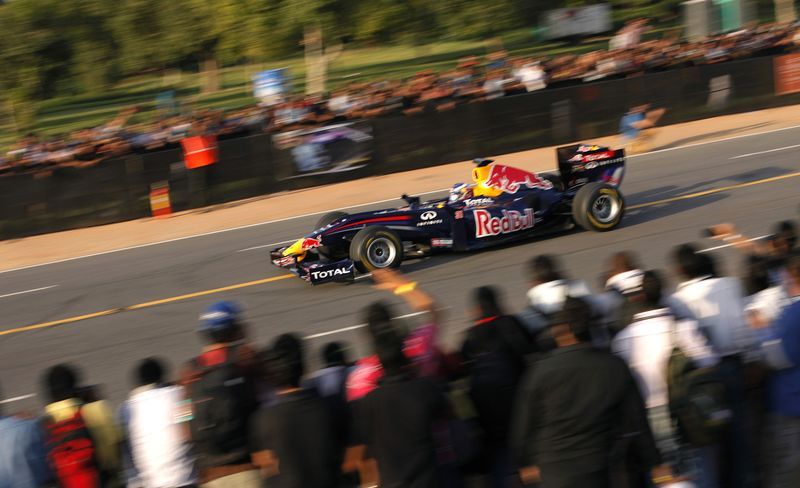
India's government has launched a formal initiative to clear the path for Formula One's return to the Buddh International Circuit on the outskirts of New Delhi within the next four years, seeking to resurrect a prestigious international motorsport event that vanished from the country's sporting calendar over a decade ago. Sports Minister Mansukh Mandaviya has convened key stakeholders, among them the Adani Group—positioned to take operational control of the venue—and officials from India's motorsports federation, to chart a course toward hosting the championship race in 2028.
The original Indian Grand Prix represented a significant moment in the country's sporting development when it debuted at the Buddh International Circuit in 2011, signalling India's arrival as a destination capable of staging world-class motorsport infrastructure. However, the promise was short-lived. After just three editions, the race was discontinued in 2013 following bitter disputes over tax treatment and regulatory requirements that created an unwieldy operating environment for promoters. The collapse left India without a Formula One presence despite its position as the world's most populous nation and a growing centre of economic influence.
The structural challenge facing organisers centres on India's complex tax regime and the bureaucratic obstacles that complicated the event's finances during its initial run. Multiple government agencies maintained overlapping jurisdiction, creating confusion about liability and compliance obligations that ultimately rendered the proposition unviable for promoters. These systemic issues have not disappeared in the intervening years, making resolution fundamental to any credible revival strategy. The government appears to have learned from that experience, designing a dedicated task force specifically to diagnose and address these pain points rather than hoping they would resolve themselves.
Mansukh Mandaviya's task force will bring together representatives from India's tax authorities alongside senior officials from the policy establishment to develop coordinated responses to the obstacles that once derailed the event. The government's apex policy think tank has been assigned responsibility for coordinating across ministries to streamline approval processes and reduce bureaucratic friction. This represents a more sophisticated governmental approach than simply inviting promoters to work within the existing framework—instead, New Delhi is pledging to reshape the framework itself.
The Adani Group's involvement carries particular weight given the conglomerate's substantial financial resources and demonstrated capacity to manage complex infrastructure projects across India's economy. Karan Adani, managing director of Adani Ports & Special Economic Zone Limited, has publicly signalled his personal commitment to restoring Formula One to the country, language suggesting the group views the venture as strategically important beyond immediate financial returns. By taking over ownership of the Buddh circuit facility, Adani would assume both the operational burden and the potential long-term benefit of hosting an event that commands global television audiences and enhances a nation's international profile.
Formula One's appetite for an Indian return appears genuine, though cautious. Chief executive Stefano Domenicali acknowledged the sport's "big interest" in re-establishing a presence in India during recent discussions with the broadcaster FanCode, yet his comments emphasised the magnitude of preparatory work required before any commitment could be finalised. Domenicali's circumspect tone reflects the sport's institutional memory of the previous difficulties; Formula One will not commit resources to a venture until confident that the underlying conditions have fundamentally improved.
The timeline extending to 2028 provides realistic scope for resolving India's regulatory architecture without rushing into arrangements that replicate past failures. This phased approach contrasts with the urgency that sometimes characterises sports diplomacy, where political leaders seek quick victories. Instead, New Delhi's architects appear focused on building sustainable foundations, recognising that a Formula One event succeeds only when promoters, government, the sanctioning body, and local stakeholders operate within a coherent legal and financial framework.
For Malaysia and the broader Southeast Asian region, India's pursuit of Formula One carries implications beyond motorsport. It signals India's determination to compete for major international sporting events and to project itself as an investment destination capable of managing complex, high-stakes ventures. If New Delhi succeeds in attracting Formula One, it will enhance the region's overall standing as a centre of global sporting activity, complementing existing events across Southeast Asia. Conversely, failure would reinforce perceptions that India's regulatory environment remains inhospitable to premium international enterprises.
The revival effort also underscores how government policy and institutional reform can unlock opportunities that would otherwise remain inaccessible. The Buddh circuit itself remains a world-class facility—the infrastructure deficit was never the constraint—yet the venue sat underutilised because of factors entirely within government's control. By deliberately tackling taxation and regulatory opacity, India's administration is attempting to demonstrate that it can move decisively when national interests align with policy objectives.
The outcome of Mansukh Mandaviya's task force will reveal whether Indian governance structures can accommodate the demands of contemporary international sport. Formula One represents perhaps the highest standard of event sophistication, requiring seamless coordination between multiple agencies, transparent fiscal treatment, and clear regulatory pathways. If India can deliver those conditions, Formula One's return would serve as a powerful signal to other premium international ventures that the country has matured as a host destination.

