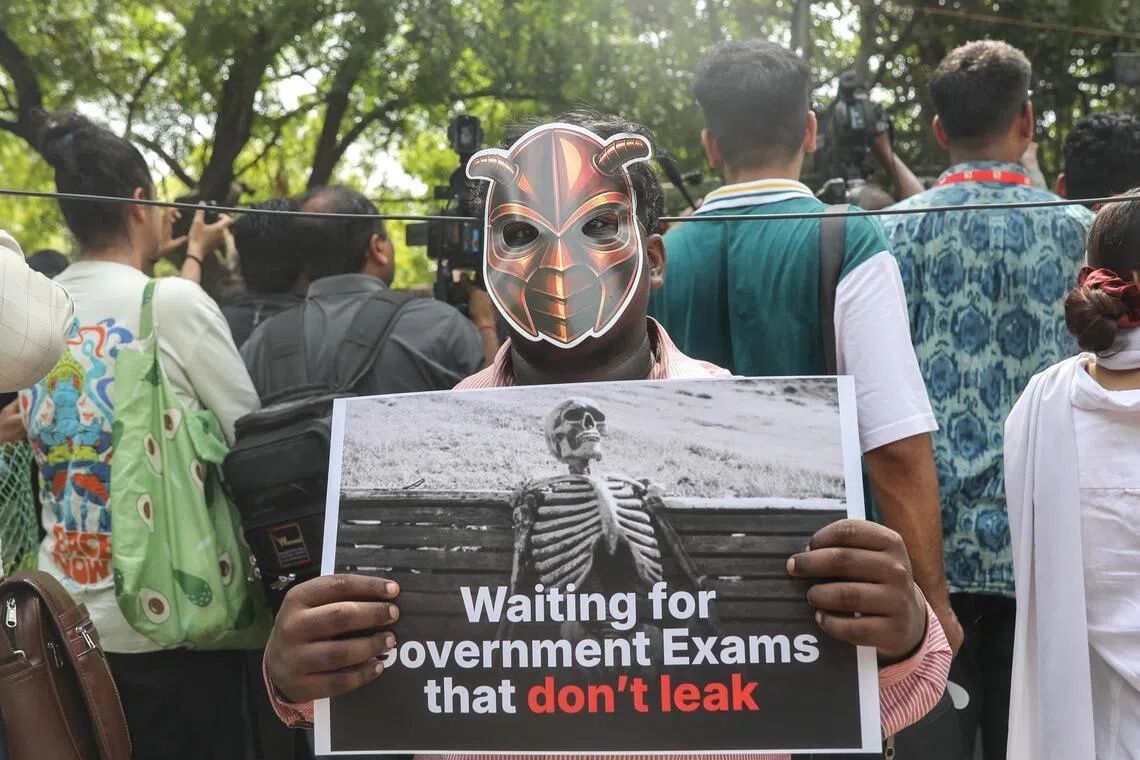
India's medical education system faces a critical moment as authorities attempt to restore credibility to one of the world's most competitive entrance examinations. On Sunday, 2.2 million aspiring medical students will sit for a retake of the National Eligibility cum Entrance Test (NEET), the primary gateway into India's medical colleges, following the extraordinary decision to scrap May's examination after widespread evidence of question paper leakage. The unprecedented crisis reflects deep structural vulnerabilities in India's examination infrastructure and has exposed the sophisticated criminal networks operating within the country's education sector.
The original test collapsed following revelations that examination papers had been leaked to candidates before the scheduled test date, triggering immediate demands for accountability from students, parents, and civil society organisations across the country. The breach was not an isolated incident of carelessness but rather the culmination of a coordinated operation involving insiders and criminal elements seeking to profit from exam fraud. Indian authorities moved swiftly to identify and arrest the alleged mastermind of the operation, a chemistry lecturer whose role in orchestrating the leak exposed how individuals within the education system itself were compromised to facilitate cheating on a massive scale.
The fallout from the examination fraud extended beyond angry parents and disappointed candidates. Indian media reports documented tragic suicides among teenagers devastated by the cancelled test and the uncertainty surrounding their educational futures, underscoring the immense psychological pressure that India's ultra-competitive entrance examination system places on millions of young people annually. These deaths galvanised broader social movements, with students organising coordinated protests demanding the resignation of Education Minister Dharmendra Pradhan. The public anger manifested in unexpected cultural phenomena, including the rise of a satirical political movement called the "Cockroach People's Party," which accumulated millions of social media followers within weeks of its May launch by channelling widespread frustration with the government's management of the education sector.
The problems were not confined to the medical entrance examination. Simultaneously, India's education system was rocked by a separate controversy involving the online marking system used for high school examinations taken by nearly two million students. Numerous allegations emerged that the automated grading system had produced incorrect results or assigned marks to the wrong candidates, compounding public anxiety about the reliability of India's examination infrastructure more broadly. Together, these parallel crises created a perfect storm of institutional failure that undermined confidence in the entire national examination apparatus.
For this retest, Indian authorities have implemented unprecedented security measures designed to prevent any recurrence of the fraud that compromised the previous examination. The government has deployed more than 200,000 officials, including police personnel, to oversee the administration of the test across thousands of examination centres nationwide. Beyond personnel, the security framework incorporates advanced technological solutions intended to create multiple layers of protection against potential cheating. These include biometric authentication systems to verify candidate identities, artificial intelligence-enabled camera surveillance to monitor examination halls in real time, and GPS tracking of question papers throughout the distribution and collection process.
The National Testing Agency has publicly committed to ensuring that Sunday's retake will be conducted with heightened transparency and procedural integrity. Officials have emphasised the comprehensive nature of the "multi-layered security framework" implemented to prevent paper leaks and other forms of examination fraud. However, such assurances must be viewed against the backdrop of the May examination, which presumably also operated under security protocols that ultimately proved inadequate to prevent one of India's largest examination frauds.
Communications infrastructure has become part of the security apparatus, reflecting authorities' assessment that modern digital networks played a crucial enabling role in the May fraud. Indian officials have restricted access to the Telegram messaging application, recognising that cheating rackets exploited encrypted messaging platforms to rapidly disseminate leaked examination questions to candidates who had paid substantial sums for access to this illicit information. The restriction represents a significant intervention in digital freedoms, though authorities justified it as a necessary emergency measure. Notably, Telegram's founder Pavel Durov publicly disputed the effectiveness of such bans, arguing that messaging traffic associated with examination fraud would simply migrate to alternative applications rather than being eliminated entirely. Durov's critique highlighted a fundamental challenge: the problem was not merely the technological medium through which leaks were shared but the insiders within the examination system itself who had been persuaded or coerced into providing the original materials.
The stakes involved in the NEET examination extend far beyond the immediate careers of the 2.2 million candidates sitting for Sunday's test. The examination determines access to just over 100,000 undergraduate medical seats distributed across India's medical colleges annually. This extraordinarily intense competition for limited positions has generated a vast coaching industry worth billions of rupees, attracting millions of students seeking every possible advantage in their preparation. Within this high-pressure ecosystem, organised criminal networks have identified lucrative opportunities to profit from examination fraud, creating supply chains for leaked papers and related services. The May scandal revealed that these networks operate with considerable sophistication, involving connections to insiders and the capacity to distribute materials to large numbers of candidates before examination dates.
The NEET examination occupies a particularly significant role within India's medical education system and South Asian regional context. As the primary mechanism for selecting medical students in the world's most populous country, the integrity of this test has implications extending far beyond India's borders, affecting the quality and composition of the physician workforce across South Asia. For Malaysian and regional readers, the Indian examination fraud carries particular relevance given the significant numbers of Indian students who pursue medical education in Malaysia and elsewhere in Southeast Asia, often after failing to secure positions in India's limited medical college seats. The breakdown in examination integrity in India may well redirect even more ambitious medical students toward regional alternatives.
Authorities have scheduled the retest to commence at 2pm local time, allowing sufficient hours for the administration of the lengthy examination. The timing and logistics of the retake will be monitored closely by Indian media and international observers assessing whether the security apparatus can successfully deliver a credible examination experience. Success will depend not merely on technological systems and personnel deployment but on fundamental institutional reforms addressing the systemic vulnerabilities that allowed insiders to compromise the previous examination.
The retest represents more than a simple administrative reset. It is a test of India's capacity to maintain institutional credibility during a period of acute public distrust in its education governance. The outcome will reverberate through millions of families whose children's medical careers hang in the balance and through the broader social contract between citizens and the state regarding the fairness and reliability of public institutions. For a country where entrance examinations serve as primary mechanisms for social mobility and determining access to elite professional pathways, the successful restoration of examination integrity is not merely an educational concern but a political and social imperative.
%22%2F%3E%3C%2Fpattern%3E%3C%2Fdefs%3E%3Crect%20width%3D%22100%25%22%20height%3D%22100%25%22%20fill%3D%22url(%23ph2rpzpg)%22%2F%3E%3Crect%20width%3D%22100%25%22%20height%3D%22100%25%22%20fill%3D%22url(%23ph2rpzpp)%22%2F%3E%3Ctext%20x%3D%2250%25%22%20y%3D%2250%25%22%20text-anchor%3D%22middle%22%20dominant-baseline%3D%22central%22%20fill%3D%22rgba(255%2C255%2C255%2C0.95)%22%20font-family%3D%22Georgia%2C%20'Times%20New%20Roman'%2C%20serif%22%20font-weight%3D%22700%22%20font-size%3D%22320%22%20letter-spacing%3D%22-0.02em%22%3E24%3C%2Ftext%3E%3C%2Fsvg%3E)