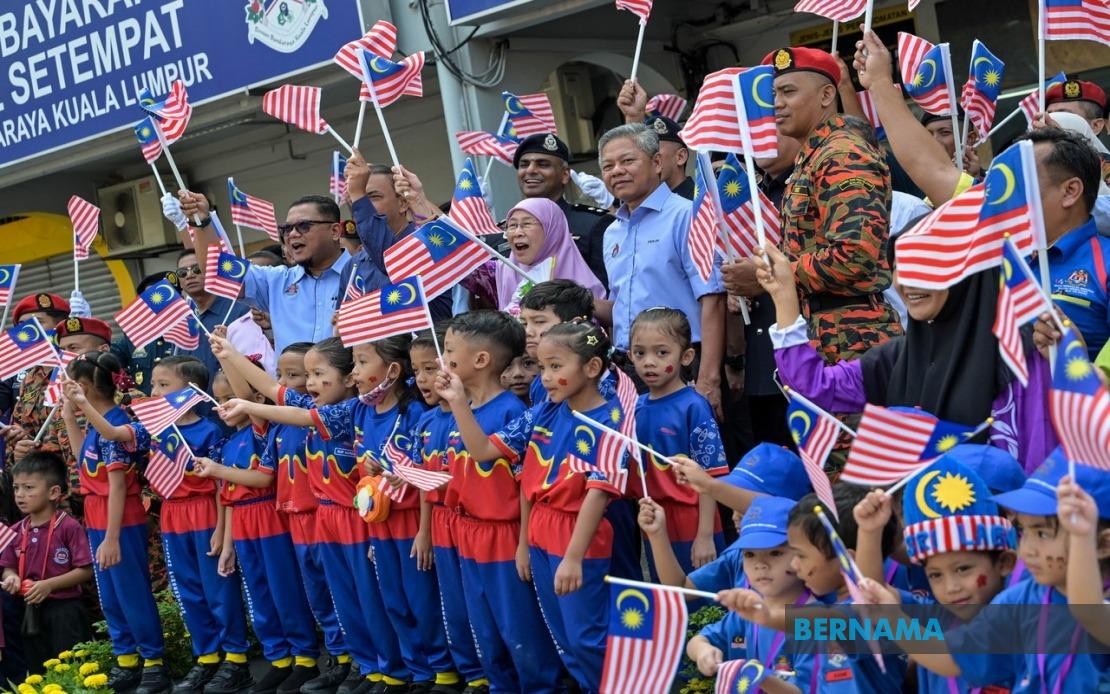
Datuk Seri Dr Wan Azizah Wan Ismail, the Prime Minister's wife and Member of Parliament for Bandar Tun Razak, has called for a deeper national appreciation of independence, framing it not merely as a moment for celebration but as an ongoing shared commitment to preserving Malaysia's stability and social cohesion. Speaking at the Semarak Merdeka Programme in Kuala Lumpur on August 12, she stressed that understanding what independence truly represents forms the foundation upon which current and future generations must build their collective future.
The Prime Minister's wife made clear that independence transcends the visible trappings—the patriotic chants of "Merdeka" and the waving of the Jalur Gemilang flag—that characterise National Day festivities. Instead, she positioned independence as embodying the freedom hard-won by previous generations, whose sacrifices and struggles transformed Malaysia into a sovereign nation. This reframing is significant for Malaysian society, as it redirects attention from superficial nationalism towards the substantive values that independence was meant to protect and advance.
Dr Wan Azizah explicitly called for leveraging the annual independence celebration as a meaningful occasion for reflection and collective action. She envisioned the commemoration serving as a platform where citizens could genuinely appreciate the concept of freedom, acknowledge the contributions of those who fought for nationhood, and recommit themselves to the continuing project of nation-building. Her emphasis on transformation—turning the celebration into something purposeful rather than merely ceremonial—reveals an understanding that national cohesion requires active, conscious participation rather than passive remembrance.
The theme chosen for this year's National Day, "Malaysia Madani: Jiwa Merdeka," provided the context for her remarks, with Dr Wan Azizah noting its alignment with broader governmental objectives of enhancing citizens' quality of life, ensuring equitable opportunities across all demographics, and reinforcing national unity. This thematic focus suggests an official strategy to link independence commemoration directly to tangible improvements in citizen welfare and social integration, positioning both as interdependent objectives.
Drawing on detailed census data, Dr Wan Azizah highlighted her own constituency as a microcosm of Malaysian diversity and harmony. Bandar Tun Razak's approximately 191,000 residents comprise 60 per cent Malays, 24 per cent Chinese, and 8 per cent Indians, according to Malaysian Population and Housing Census figures. Her description of this composition as reflecting a "dynamic and harmonious community" served to demonstrate that Malaysia's multiethnic character, when properly managed and respected, represents strength rather than fragmentation—a message particularly resonant given ongoing discussions about social cohesion in the region.
Beyond her remarks on national symbolism, Dr Wan Azizah translated her message into concrete welfare action, visiting families in the Seri Pulau Pinang and Desa Tun Razak People's Housing Projects (PPR) to distribute assistance from the Social Security Organisation (PERKESO) and the Federal Territories Islamic Religious Council (MAIWP). This juxtaposition of high-level political messaging with grassroots welfare delivery suggests an integrated approach where independence is framed not as abstract principle but as enabling improved material conditions for vulnerable citizens.
One beneficiary, K. Moganavalli, aged 39, received support following her husband Edwin Anthony Dass's sudden death on August 2. Left as sole household provider for three young children, Moganavalli received a one-off Funeral Management Benefit of RM3,000 from PERKESO along with monthly Survivor's Pension payments of RM1,118.33, supplemented by Kotak Prihatin assistance. Her case illustrates how social security mechanisms function as expressions of national commitment to citizen welfare, translating the concept of independence into practical support for those facing sudden vulnerability.
Another recipient, Khalijah Binti Nazir, aged 64, exemplifies different welfare challenges within Malaysian society. As a single mother who sacrificed employment to care for two children, one with hearing impairment, Khalijah depends on a combination of support mechanisms: RM800 monthly Baitulmal assistance, RM300 monthly through Boost eWallet, and RM150 via Sumbangan Asas Rahmah (SARA), with an additional RM100 monthly in SARA assistance directed to her son. The layered nature of her support suggests Malaysia's welfare architecture attempts to address multiple dimensions of household vulnerability simultaneously.
These welfare distributions carry political significance beyond individual assistance. They demonstrate how National Day commemoration can be operationalised as occasion for reviewing and reinforcing social safety nets, effectively telling vulnerable citizens that independence's promise includes protection during hardship. For Malaysian policymakers, the strategic linkage of national celebration to welfare delivery offers template for embedding social responsibility within patriotic messaging.
From a Southeast Asian perspective, Dr Wan Azizah's emphasis on independence as "shared responsibility" reflects broader regional concerns about maintaining social stability amid demographic diversity and economic pressures. Her framing suggests that sustaining independence requires not merely institutional strength but continuous renewal of social contract between state and citizens, particularly those most vulnerable to economic disruption. This philosophical positioning aligns with regional trends towards emphasising inclusive development and social protection as foundations of political legitimacy.
The integration of Dr Wan Azizah's remarks on independence's deeper meaning with immediate welfare action suggests an understanding that national cohesion depends on translating principles into lived experience. Citizens experiencing concrete support during vulnerability are arguably more likely to internalise independence not as historical achievement to commemorate but as ongoing commitment to mutual care and collective progress. This pragmatic approach to nation-building represents a significant inflection in how Malaysia frames its relationship with independence as the nation approaches its seventh decade of nationhood.

