Deep in the Czech countryside, roughly 90 kilometres east of Prague, stands a house unlike any other in the village of Bukovka. The three-storey residence of Miloslav Urbanec, a 51-year-old music promoter known locally as "Curby", has become an unexpected monument to the passion that has consumed much of his adult life: Argentine football. The exterior walls painted in the distinctive sky-blue and white of the nation's football colours serve as the first clue to visitors about what lies within and around this extraordinary dwelling.
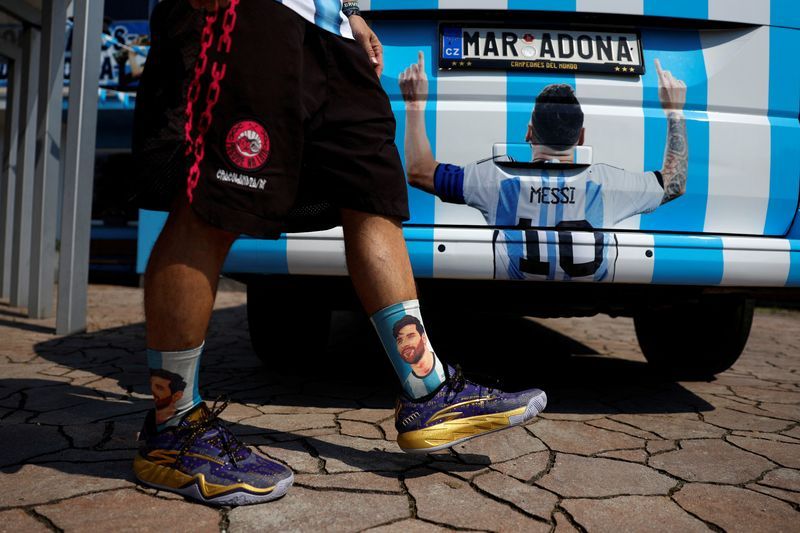
The transformation of Urbanec's property into a shrine dedicated to Argentine sporting glory extends far beyond a simple colour scheme. A towering sun emblem, the centrepiece of the Argentine flag, dominates one exterior wall, while a larger-than-life portrait of Lionel Messi covers the rear facade of the house. These visual declarations pale in comparison to the life-size statue of Diego Maradona that stands guard in the courtyard, a permanent testament to the man whose legacy first ignited Urbanec's burning admiration for all things Argentine football more than four decades ago.
The origin of this devotion traces back to Urbanec's childhood, when as a four-year-old he sat alongside his father to watch Argentina's triumphant 1978 World Cup campaign. The long hair of players like Mario Kempes captured his imagination in those formative years, but it was the eventual championship victory that transformed a child's casual interest into a lifelong obsession that would shape his identity and priorities. From that moment forward, everything about Argentina's football culture—from the national team to Boca Juniors, one of South America's most storied clubs and the team that gave the world Diego Maradona—became central to how Urbanec understood and engaged with the world around him.
The domestic sphere provides further evidence of this consuming passion. Behind the main house lies a full-size all-weather football pitch, a facility that serves as both practical sporting venue and thematic centrepiece for Urbanec's Argentine football museum. The pitch is surrounded by placards featuring the likenesses of Boca Juniors stars, creating an immersive environment where the boundary between hobby and lifestyle has effectively dissolved. Even Urbanec's mode of transport reflects his allegiances: his van sports the same sky-blue and white livery, complete with imagery of Maradona holding aloft the World Cup trophy and Messi in his prime, accompanied by the declaration "In Messi we trust" and a personalised number plate reading "MARADONA".
Perhaps the most striking manifestation of Urbanec's commitment came seven years before the interview when he named his second son Lionel, a deliberate homage to the Barcelona and Paris Saint-Germain legend. At the time of the naming, Urbanec claims he recognised with certainty that Messi represented something rare and extraordinary in football—a player whose gifts transcended the ordinary. The decision to bestow this name upon his own child underscores how completely Urbanec has integrated Argentine football into his family identity and personal legacy.
What makes Urbanec's fandom particularly noteworthy is its geographic displacement. Far from Buenos Aires or even Europe's major football capitals, this Czech enthusiast has constructed an entirely self-sufficient ecosystem of Argentine football culture in rural Bohemia. His neighbours in Bukovka have become inadvertent participants in his passion project, their village now bearing the unmistakable imprint of one man's extraordinary devotion. This phenomenon speaks to the truly global reach of Argentine football culture and the magnetic pull that the country's particular style and history exerts upon football lovers across continents.
At the time of the interview in late June, Urbanec remained buoyant about Argentina's prospects in the tournament ahead. He expressed absolute confidence in what he termed "La Seleccion"—the Select—describing the squad as nothing short of "absolutely amazing". His conviction that Argentina would secure another championship victory bordered on religious certainty, a faith born from decades of following the team through triumphs and disappointments alike. He envisioned the forthcoming victory as not merely a sporting achievement but a celebration that would ripple outward from his corner of Czech countryside to encompass the entire world.
Crucially, Urbanec's assessment of Argentine football extended beyond mere results to encompass aesthetic and philosophical dimensions. He characterised the team's approach to the game as the embodiment of beautiful football—a particular vision of how the sport should be played that transcends simple accumulation of goals and victories. This perspective positions Argentine football within a broader cultural and artistic framework, elevating it beyond the realm of mere sport into something approaching an expression of national character and identity. For Urbanec, supporting Argentina means endorsing not just a winning team but a particular vision of how football should be conducted.
The practical challenge of maintaining such devotion across thousands of kilometres introduces questions about the nature of modern fandom. Urbanec's comprehensive engagement with Argentine football culture—through the house, the vehicle, the family naming decisions, and his articulated philosophy—demonstrates how contemporary supporters can construct meaningful connections to distant teams and nations. The availability of global media coverage, combined with the internet and satellite broadcasting, has allowed individuals like Urbanec to maintain deep, intimate relationships with foreign football cultures in ways that would have been impossible in previous generations.
At the time of writing, Argentina faced Cape Verde in a round of 32 match scheduled for July 3, a fixture that would test Urbanec's predictions about the team's championship credentials. Regardless of the outcome of individual matches, however, the existence of this Czech fan and his meticulously constructed Argentine football sanctuary illustrates a larger truth about sport in the contemporary world: passionate fandom knows neither national borders nor geographic limits. In the unlikely landscape of rural Czech countryside, Lionel Messi's image gazes out from a mural, watched over by the stone figure of Diego Maradona, a testament to football's remarkable capacity to inspire devotion that transcends nationality and reason.

