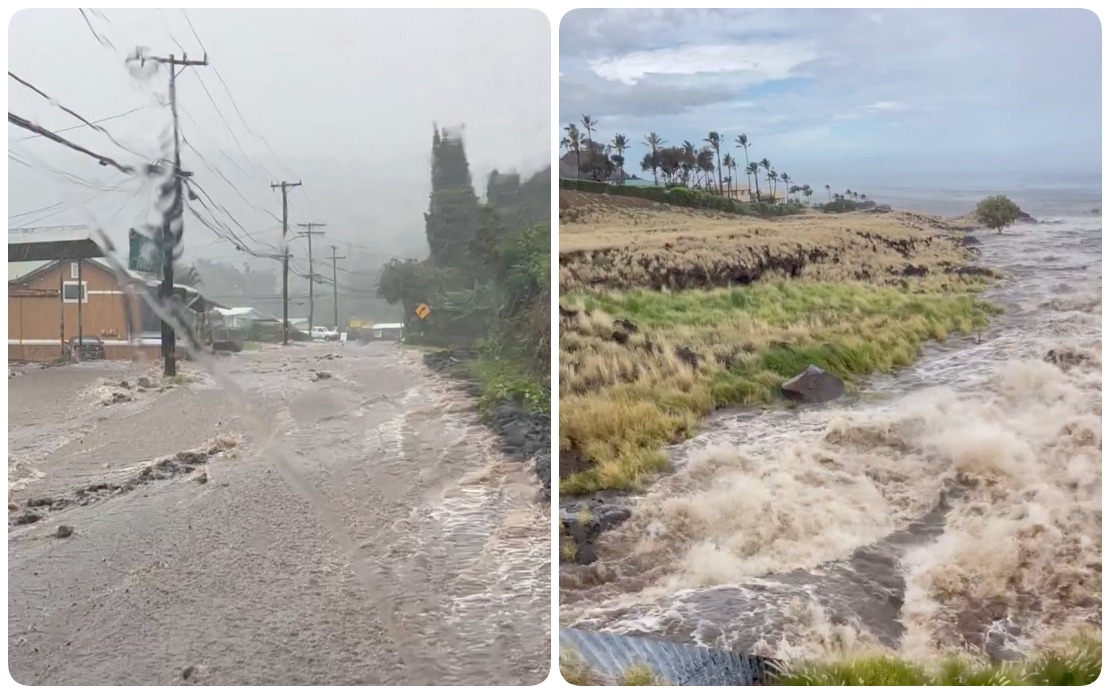
Hurricane Lala descended upon the Hawaiian Islands on Saturday, August 15, delivering a powerful assault of destructive winds and torrential precipitation that left the archipelago grappling with significant infrastructure damage and widespread service disruptions. As the storm tracked just south of Hawaii Island, its outer bands brought dangerous conditions across the entire island chain, with the most severe impacts concentrated on Hawaii Island itself, where residents endured the brunt of the system's intensity.
Hawaii Governor Josh Green reported that wind conditions were reaching their peak on Hawaii Island even as the storm traversed the waters nearby. The precipitation rates proved particularly alarming in certain localities, with some measurement stations recording accumulations exceeding 13 inches of rainfall—amounts capable of triggering flash flooding in susceptible areas. The situation was simultaneously deteriorating across the neighboring regions, including Maui County, Oahu, and Kauai, suggesting that the threat extended far beyond the primary impact zone and would challenge emergency responders across multiple jurisdictions simultaneously.
The immediate physical toll manifested across multiple infrastructure categories. Hawaii Island bore the most severe consequences, with the Hawaii Emergency Management Agency documenting extensive flooding in low-lying and drainage-prone areas, numerous trees uprooted by the extreme winds, cascading power failures affecting residential and commercial customers, and wind speeds creating hazardous conditions that prevented safe outdoor movement. These cascading failures created a complex disaster scenario where initial damage—such as fallen trees—triggered secondary problems including downed utility lines and blocked transportation corridors.
The electrical grid sustained particularly extensive damage. Hawaiian Electric reported that 88,000 customers across Hawaii Island, Maui County, and Oahu had lost power by 7 p.m. Hawaiian Standard Time. The distribution revealed the concentrated nature of the storm's fury: Hawaii Island alone accounted for 63,270 outages representing the vast majority of affected customers, while Maui County experienced approximately 15,260 disconnections and Oahu around 9,500. These statistics reflected not merely inconvenience but genuine hardship for families, businesses, and medical facilities dependent on reliable electricity supply.
The specific mechanisms of electrical system failure spoke to the hurricane's raw power. Hawaiian Electric documented wind gusts approaching 90 miles per hour in sections of Hawaii Island, velocities sufficient to snap mature trees at their trunks and snap utility poles like matchsticks. Most remarkably, the damage extended along a 42-mile continuous stretch of transmission infrastructure on the Hamakua coast, where fallen trees and related debris brought down multiple poles and associated structures. This linear damage pattern—extending for miles along the vulnerable coastline—created restoration challenges of formidable scale, as repair crews would need to systematically progress through the entire affected corridor.
Surface transportation infrastructure suffered equally severe compromises. Hawaii's Department of Transportation documented multiple road closures spanning Hawaii Island, Maui, and Oahu, with transportation video documentation capturing images of waterlogged roadways and overflowing streams that underscored the rainfall intensity. Local police forces reported that Kahikopele Street in Mountain View remained impassable due to flooding, while Pauahi Street experienced water encroachment that threatened accessibility. The Mamalahoa Highway generated particular concern due to fallen trees and substantial debris scattered across its surface, creating hazards that could prove fatal to any driver attempting passage. Downed power lines forced closure of Plumeria Street, presenting electrocution risks to the public.
Emergency management authorities implemented protective measures to prevent casualties in the deteriorating conditions. Transportation officials issued explicit directives urging residents to either shelter in place within their current locations or relocate to designated community shelters. This guidance acknowledged the reality that venturing outdoors during the hurricane's passage created unacceptable risk, particularly for vulnerable populations including elderly residents, families with young children, and individuals with medical conditions requiring stability and environmental control.
The utility company indicated that restoration efforts would necessarily extend through the entire night and potentially into subsequent days. Hawaiian Electric stated that customers who had already experienced power loss on Hawaii Island and Maui would remain without electricity for an extended period. The dangerous environmental conditions—including continuing high winds, downed power lines presenting electrocution hazards, and reduced visibility—rendered daytime restoration work excessively risky. Crews could not safely position themselves on poles or within close proximity to damaged infrastructure until wind speeds subsided to manageable levels and visibility improved sufficiently to identify hazards.
For Malaysian and Southeast Asian observers, the Hawaiian situation offers instructive perspective on hurricane resilience and disaster response protocols. While tropical cyclones regularly affect the region, the Hawaiian incident demonstrates how even well-developed island communities with sophisticated infrastructure and emergency management systems experience severe disruption when major hurricanes make direct or near-direct approaches. The challenges facing Hawaiian Electric—managing restoration across dispersed islands with damaged transmission infrastructure—parallel complexities that would emerge in Malaysia should a major tropical cyclone strike populated coastal areas.
The broader implication concerns infrastructure vulnerability in island and coastal communities generally. The 42-mile linear damage stretch on the Hamakua coast illustrates how single weather events can compromise essential services across extensive geographic areas, overwhelming the repair capacity of even major utilities. In the Malaysian context, similar vulnerabilities exist in exposed coastal regions and island communities where transmission infrastructure traverses exposed terrain susceptible to typhoon damage. The Hawaiian experience suggests that pre-positioning spare equipment, establishing mutual aid agreements with neighboring regions, and developing rapid mobilization protocols for repair crews represent prudent preparations for communities in cyclone-prone areas.
The immediate Hawaiian situation required sustained emergency management attention as conditions gradually stabilized. Governor Green's continued monitoring and public communication maintained awareness among residents of evolving conditions and official guidance. The storm's trajectory, intensity, and the concentrated damage along specific corridors created a manageable though still significant restoration challenge for Hawaiian Electric and associated emergency services. However, the duration of power outages and the geographic extent of road closures demonstrated how even a near-miss hurricane generates substantial community disruption and underscores the importance of comprehensive disaster preparedness, rapid emergency response, and robust infrastructure designed to withstand extreme weather events.

