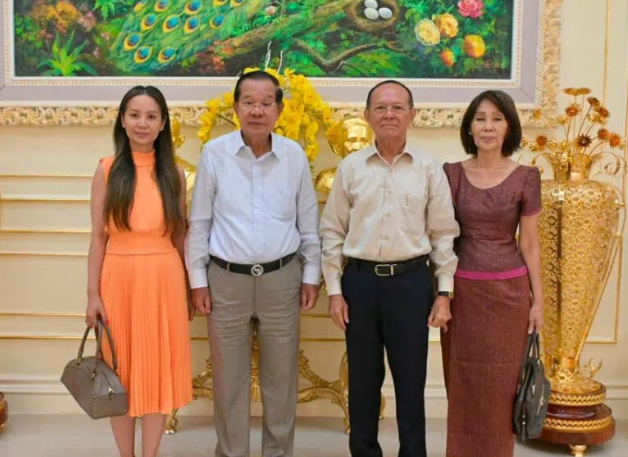
Cambodia's political landscape is experiencing a notable thaw as Senate president Hun Sen welcomed former opposition leader Kem Sokha into his home on Sunday, marking another significant contact between the long-standing rivals. The meeting, which lasted three hours from 9am until noon, included Sokha's wife and daughter, with Hun Sen subsequently highlighting the engagement through a social media post that generated considerable attention within Cambodian political circles.
The substance of their discussions remained undisclosed, though Hun Sen's public remarks centred on an unexpected element: lavish praise for Sokha's daughter, Kem Monovithya. Describing her as an "excellent human resource for the nation," Hun Sen indicated he had devoted considerable time during the meeting to conversations with Monovithya, a notable detail given her deep historical involvement with the Cambodia National Rescue Party. The compliment carries significant weight in Cambodia's political context, where public utterances from senior figures often signal broader strategic intentions.
This encounter represents an acceleration of warming ties between two figures who spent decades as principal antagonists. Hun Sen noted that Sokha had visited his residence several weeks prior to Sunday's meeting, before the former opposition leader embarked on a humanitarian mission to Cambodia-Thailand border regions affected by ongoing conflict. That initial visit demonstrated an emerging willingness to engage across political divides, a development that would have been unthinkable during the height of their confrontation when the Cambodia National Rescue Party served as the dominant opposition force.
Sokha's political rehabilitation remains incomplete, yet tangible progress marks his journey from years of legal constraint. Convicted in 2023 on a treason-related charge involving alleged conspiracy with foreign powers and sentenced to 27 years imprisonment, Sokha endured house arrest alongside severe restrictions on political activity and international travel. The Phnom Penh Appeal Court upheld this conviction on April 30, 2026, maintaining both the substantial prison term and imposing a five-year ban on overseas movement.
However, a royal pardon issued on May 25 fundamentally altered his circumstances by terminating his prison sentence and house arrest restrictions. Subsequently, a royal decree dated July 24 lifted the overseas travel prohibition that had confined him domestically. Crucially, prohibitions against political participation remain enforced, creating a liminal space where Sokha possesses personal freedom yet cannot formally engage in political activities. This distinction permits public appearances and private consultations while theoretically preventing formal party involvement or candidacy.
Sokha's public reemergence began modestly but significantly with his July 28 visit to Banteay Meanchey province, where he met families displaced by border conflict with Thailand. During this engagement, Sokha explicitly characterised himself as a private citizen rather than a political representative, emphasising his humanitarian rather than partisan motivations. He indicated raising displaced Cambodians' circumstances with international community representatives, positioning himself as an advocate for vulnerable populations rather than a political actor—a framing that navigates his remaining restrictions while permitting meaningful engagement.
The historical context of Hun Sen and Sokha's antagonism cannot be overlooked in assessing current developments. After the Cambodia National Rescue Party emerged as Cambodia's primary opposition force, achieving significant electoral gains in 2013 and consolidating support through 2017, the political establishment moved decisively against the party. The Supreme Court dissolved the Cambodia National Rescue Party in November 2017, merely two months after Sokha's arrest, effectively eliminating the organised challenge to the ruling Cambodian People's Party's dominance. This sequence effectively removed the organised institutional opposition that had threatened Hun Sen's political supremacy.
For Malaysian and Southeast Asian observers, these developments warrant close attention given broader regional implications for democratic processes and post-conflict political transitions. Cambodia's handling of opposition leadership, the mechanisms of political constraint and rehabilitation, and the private diplomacy occurring between rivals all reflect patterns relevant to other Southeast Asian democracies grappling with opposition integration and political reconciliation. The question of whether Sokha's renewed prominence signals genuine political reintegration or controlled cooptation remains unresolved, with international democratic observers maintaining cautious scrutiny.
Kem Monovithya's prominence in Hun Sen's remarks introduces another layer of complexity. As a figure deeply associated with the dissolved Cambodia National Rescue Party and heir to opposition legacy through her father, her characterisation as valuable national talent suggests Hun Sen may be signalling openness to incorporating younger opposition-connected figures into the political mainstream. Whether this constitutes a genuine olive branch toward the next generation of opposition activists or a strategic manoeuvre to neutralise potential dissent through co-option remains ambiguous.
The absence of any official announcement regarding political agreements, formal reconciliation processes, or prospective positions for either Sokha or Monovithya maintains strategic ambiguity. Both parties have adopted cautious public stances, permitting the meetings to proceed without triggering international diplomatic complications or domestic political upheaval. This calculated restraint suggests sophisticated actors managing a delicate rebalancing that acknowledges shifting political realities while avoiding confrontational declarations.
Neither the timing nor the trajectory of these developments appears accidental. Sokha's gradual reintroduction into public life, punctuated by private consultations with the nation's paramount political leader, follows a measured progression that allows adjustment to each escalation. Hun Sen's specific praise for Monovithya may represent positioning for succession discussions or recognition of evolving political demographics where younger opposition-connected figures command substantial popular respect, particularly among voters who remember the Cambodia National Rescue Party's electoral appeal.
Cambodia's political evolution continues defying simple categorisation between democratic opening and authoritarian consolidation. The current trajectory suggests neither wholesale democratic liberalisation nor permanent exclusion of opposition voices, but rather a complex accommodation where former rivals gradually reconnect within carefully managed parameters. For regional observers, these meetings illuminate how post-conflict societies navigate opposition integration and political legitimacy, processes increasingly relevant across Southeast Asia as demographics shift and new political forces demand recognition within established systems.
The substantive implications of Hun Sen and Sokha's renewed contact will emerge gradually through action rather than declaration. Whether these meetings presage genuine political opening, management of opposition through incorporation, or strategic positioning for post-Hun Sen succession scenarios remains unclear. What is certain is that Cambodia's political landscape has shifted sufficiently to permit former mortal enemies to meet privately, exchange views across three hours, and allow public commentary on emerging figures—a transformation marking significant movement from the rigid polarisation that characterised recent years.

