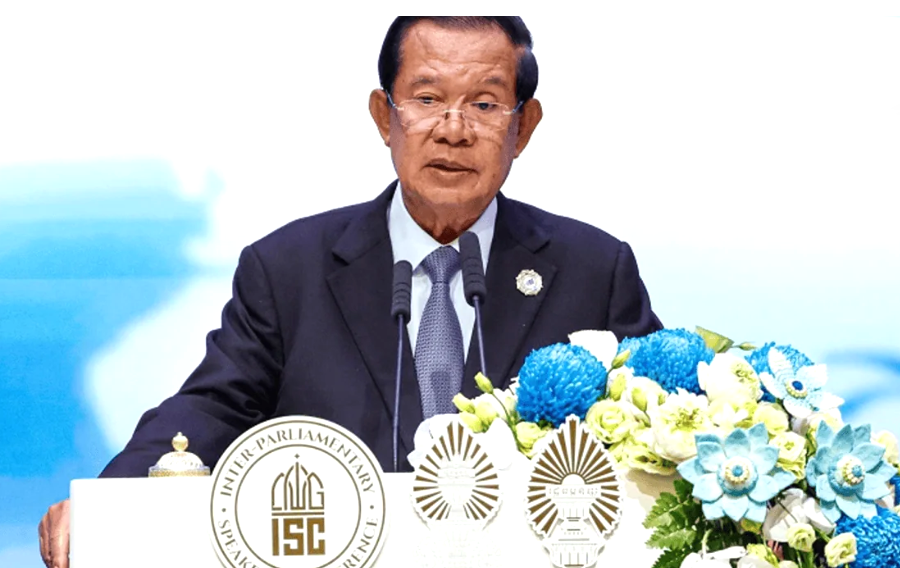
Cambodia's Senate president Hun Sen delivered a stark warning about the erosion of international order at a regional parliamentary gathering this week, alleging that Thailand has deployed the pretext of combating cross-border online scams to justify the military occupation of Cambodian land. Speaking at the 2nd Inter-Parliamentary Speakers' Conference in Phnom Penh on Thursday, Hun Sen presented his view of contemporary geopolitical confrontation as one where powerful nations selectively invoke global concerns to mask territorial aggression and strategic advantage.
The conference, which drew parliamentary leaders and delegations from Pakistan, Malaysia, Myanmar, Australia, Russia and numerous other nations, provided Hun Sen with a platform to articulate Cambodia's grievances regarding border tensions that have periodically flared along the Cambodia-Thailand frontier. His remarks reflected frustration with what he characterised as a framework wherein stronger states manipulate humanitarian and security concerns to advance narrow interests while weaker nations lack meaningful recourse through existing international mechanisms.
Hun Sen's core assertion centres on the instrumentalisation of legitimate cross-border crime as a justification for territorial incursion. He described this dynamic as a distinctly modern form of warfare, one that operates within a murky legal grey zone where jurisdictional claims become weapons. The online scam phenomenon, which has genuinely afflicted multiple Southeast Asian nations and drawn international law enforcement attention, thus becomes reframed in Hun Sen's narrative as a smokescreen for geopolitical manoeuvring rather than a genuine security imperative.
Beyond the Cambodia-Thailand specifics, Hun Sen articulated a broader framework for understanding contemporary conflict that extends well beyond traditional military confrontation. He identified multiple overlapping domains—trade wars employing customs barriers and sanctions, technology competition centred on semiconductor and cyber-infrastructure dominance, and resource protectionism around energy and rare earth minerals—as manifestations of a deeper systemic instability. Each represents, in his analysis, a weaponisation of previously neutral economic and technological spheres.
Crucially, Hun Sen highlighted what he views as the selective application of international standards by powerful actors. He contended that wealthy nations impose rigorous benchmarks regarding human rights, environmental compliance, and criminal jurisdiction upon developing countries while simultaneously ignoring structural inequalities and limited state capacity. This double standard, he suggested, creates a punitive framework disproportionately affecting vulnerable economies already burdened by historical legacies of conflict and institutional fragility.
The Cambodia-Thailand border dispute itself remains a persistent source of tension in Southeast Asia, with periodic clashes and occupation of disputed territory creating humanitarian concerns and destabilising the region. Hun Sen's invocation of alleged ceasefire violations implies that formal agreements have proven inadequate constraints on state behaviour, a deeply concerning precedent for a region where multiple overlapping territorial claims and maritime boundaries create potential flashpoints. His assertion that treaties are merely "paper" agreements underscores the depth of Cambodia's frustration with existing conflict resolution mechanisms.
Hun Sen's warning about the collapse of the international non-proliferation framework carries particular weight given regional nuclear proliferation anxieties and the arms race dynamics he identified. When states perceive that international law cannot reliably protect them from external aggression, the logic of deterrence through military capability becomes increasingly compelling. This dynamic threatens to accelerate regional militarisation and divert scarce resources from development and poverty reduction.
The Senate president's critique of what he terms the "collapse of world order" reflects a perspective increasingly articulated by smaller and medium-sized nations experiencing pressure from more powerful neighbours. For Malaysia and other ASEAN members, Hun Sen's concerns resonate with longstanding anxieties about maintaining regional stability through adherence to international law, particularly regarding maritime boundary disputes and territorial claims in contested areas like the South China Sea.
Hun Sen's characterisation of economic weaponisation—the unpredictable shifting of trade rules and the withdrawal of previously granted preferences—speaks to genuine concerns among developing economies about the reliability of international trading arrangements. The observation that "those who established the rules are now the ones destroying them" captures a fundamental frustration with the apparent fragility of rules-based systems when powerful actors find those rules inconvenient.
The implications for regional security architecture are substantial. If ASEAN member states increasingly perceive that formal agreements and international law offer insufficient protection against coercion, alternatives become more attractive—whether escalatory military buildups, realignment toward extra-regional powers, or erosion of the collective security commitments that ASEAN frameworks depend upon. Hun Sen's parliamentary platform at this international gathering signals Cambodia's determination to internationalise its grievances and challenge what it perceives as a biased application of international norms.
For Malaysia and other Southeast Asian nations, the tensions Hun Sen described underscore the critical importance of strengthening regional mechanisms for conflict resolution and maintaining commitment to international law as the foundation for coexistence. The alternative—a region where powerful states increasingly justify territorial occupation and resource appropriation through selective interpretation of security concerns—poses existential challenges to smaller nations whose security depends fundamentally on respect for borders and treaty obligations.
The gathering of parliamentary leaders from diverse geopolitical contexts provided a significant audience for Hun Sen's message that the current international system is fundamentally threatened by the selective application of rules and double standards by powerful actors. Whether this appeal resonates beyond Cambodia's immediate allies remains uncertain, but the argument itself reflects the anxieties of many developing nations about their place in an increasingly contested global order.

