Video games are not typically designed to make players feel terrible. Yet a growing movement within the gaming industry is embracing precisely this philosophy, constructing experiences intentionally calibrated to unsettle, frustrate, and ultimately humble their audiences. This counterintuitive approach reflects a deeper conviction among certain game creators that interactive entertainment possesses unique psychological power—the ability to generate genuine discomfort in ways that other media cannot replicate.
The Russian studio Ice-Pick Lodge exemplifies this philosophy through its narrative-driven games that deliberately withhold comfort and impose existential weight on every choice. Game director Alexandra Golubeva speaks to a design ethos that treats video games as a medium uniquely positioned to generate meaningful psychological friction. When players encounter in-game difficulty settings accompanied by warnings that the experience is designed to be "almost unbearable," they are being invited to confront their own tolerance for hardship. This stands in sharp contrast to the prevailing industry trend toward accessibility and comfort, where difficulty adjusters typically promise a more relaxing experience. Here, the developer does the opposite, suggesting that true engagement demands a willingness to suffer.
For Malaysian and Southeast Asian audiences increasingly immersed in digital entertainment, this philosophical shift carries particular relevance. The region has become a major gaming market, with players accustomed to titles optimised for engagement through reward loops and constant positive reinforcement. Games designed around thirty-second feedback cycles—the rapid progression common in mobile and social gaming—have trained millions to expect immediate gratification. Ice-Pick Lodge's approach deliberately ruptures this expectation, proposing instead that sustained discomfort might generate deeper reflection and personal growth.
Golubeva articulates a compelling thesis: video games might function as a counterbalance to the attention economy that dominates contemporary digital life. Platforms like TikTok fragment consciousness into microbursts of satisfaction, each designed to trigger dopamine release with minimal cognitive engagement. Against this landscape, games that demand patience, moral reckoning, and acceptance of failure offer something increasingly rare—extended periods of genuine difficulty that cannot be swiped away or skipped. The act of sitting with discomfort, of allowing oneself to fail repeatedly within a bounded fictional space, becomes a form of psychological training.
The specific mechanics employed by these games reinforce this philosophy at every level. Time-travel systems, seemingly liberating features that allow players to undo mistakes, are constrained by limited in-game resources. Run through your allocation of temporal rewinds and you face permanent consequences. Some quests are deliberately designed to destroy saved progress entirely. These design choices refuse the fantasy of consequence-free experimentation. Instead, they simulate something closer to actual lived experience: the irreversibility of certain decisions, the weight of accumulated choices, the impossibility of perfect outcomes.
Alexander Souslov, executive producer and lead game designer at Ice-Pick Lodge, frames this approach as creating space for genuine reflection on failure. Where traditional games position failure as a temporary setback to be overcome through skill acquisition and persistence, this studio's work asks players to internalise failure as personally meaningful. The narrative cannot be rewritten through mechanical mastery alone. Your avatar's suffering becomes genuinely your responsibility. This shift—from external obstacle to internal reckoning—transforms what failure means within the medium.
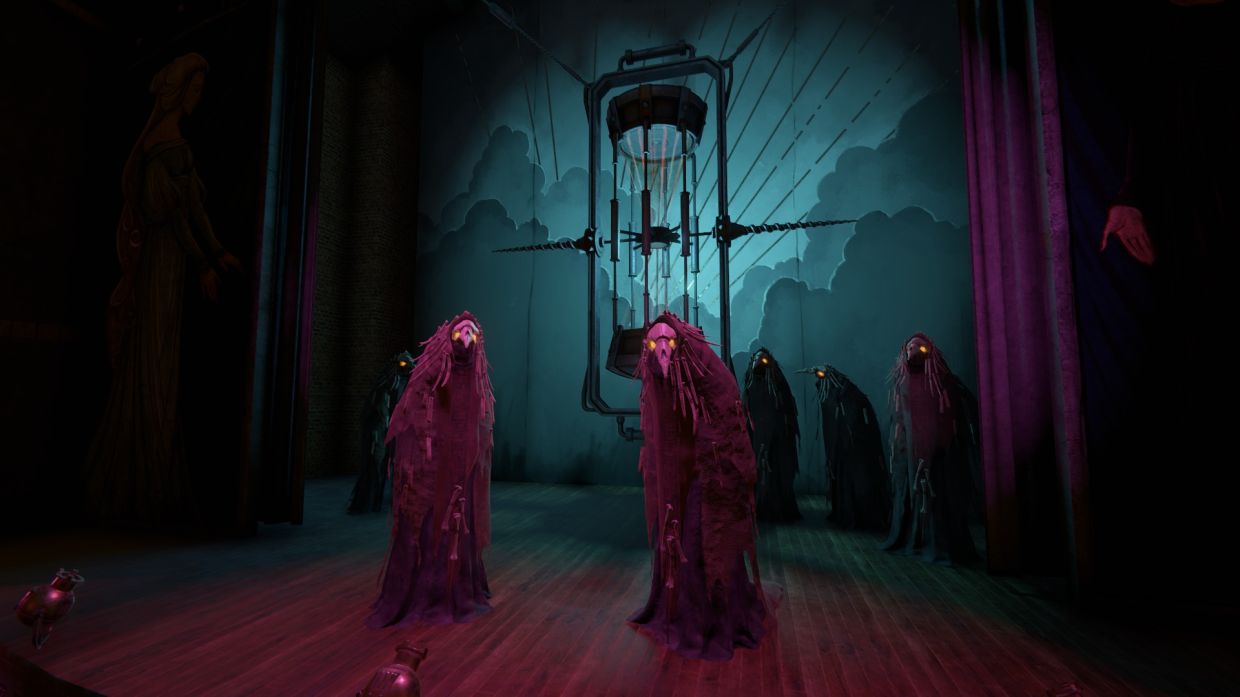
The theatrical and narrative layers amplify this effect considerably. Characters speak in dialogue that prioritises philosophical weight over naturalism. A stern judge intones that bold dreams inevitably turn to dust when opportunity passes. A theatre director suggests that meaningful art should leave audiences psychologically devastated. These are not comforting messages, nor are they presented in ways designed to please. Rather, they establish an emotional register where difficulty and discomfort are positioned as preconditions for genuine artistic experience. The games themselves adopt aesthetic choices—reused character models, stylised rather than realistic visuals—that embrace artificiality rather than pursuing immersive realism.
This aesthetic choice carries symbolic weight. By refusing photorealism, Ice-Pick Lodge's work signals that its concerns are not with simulating external reality but with exploring internal psychological terrain. The limited visual palette becomes space for imaginative investment. Players fill gaps left by sparse character models with emotional projection and interpretation. This creative participation deepens engagement precisely because the game refuses to do all the interpretive work.
Gabriel Winslow-Yost, a media critic, notes that games possess direct access to negative emotional states in ways unavailable to film, literature, or theatre. Where a film viewer observes suffering from distance, or a reader processes it through language, a game player enacts it. The failure becomes immediate, embodied, and internalised. This distinction explains why difficult video games generate a different quality of emotional response than passive media depicting similar narratives. You are not watching or reading about failure; you are experiencing it as your own agent.
The design philosophy extends to moral dimensions. Players navigate situations where correct answers do not exist. Characters pursue their own agendas and are willing to deceive the player. Attempts to save lives often backfire. Moral choices generate consequences that are not telegraphed in advance. This refusal to provide ethical clarity mirrors genuine ethical complexity. Real-world decisions rarely present themselves with obvious right answers. Games that replicate this ambiguity train players in the difficult intellectual work of living with uncertainty and the acceptance that noble intentions frequently produce harmful outcomes.
For players accustomed to games that reward "good" behaviour with clear positive feedback, this moral ambiguity initially registers as frustrating failure. Yet repeated exposure cultivates a different kind of competency—the ability to act meaningfully despite inevitable incompleteness and the acceptance that some situations genuinely cannot be solved. This resembles the psychological resilience demanded by actual adult life far more than it does traditional game design.
Alexandra Golubeva frames the experience as ultimately redemptive. Describing the arc from initial failure through subsequent attempts to manage catastrophe, she suggests that the power fantasy embedded in these games is not dominance but recovery. The fantasy is not controlling outcomes but improving them incrementally despite their inherent resistance. This inversion of the traditional power fantasy—from effortless victory to hard-won marginal improvement—represents a more sophisticated vision of human agency. The appeal lies not in defeating systems but in persisting within them despite genuine limitation.
As digital environments increasingly shape human experience globally, Southeast Asian players participating in this emerging design movement engage with questions about what games should accomplish. Can interactive media serve functions beyond entertainment—as tools for developing psychological resilience, moral reasoning, and comfort with existential uncertainty? Ice-Pick Lodge's deliberately uncomfortable approach suggests that games possess capacities the industry has largely left unexplored, waiting for players willing to embrace discomfort as a path toward deeper engagement with both fictional and actual worlds.

