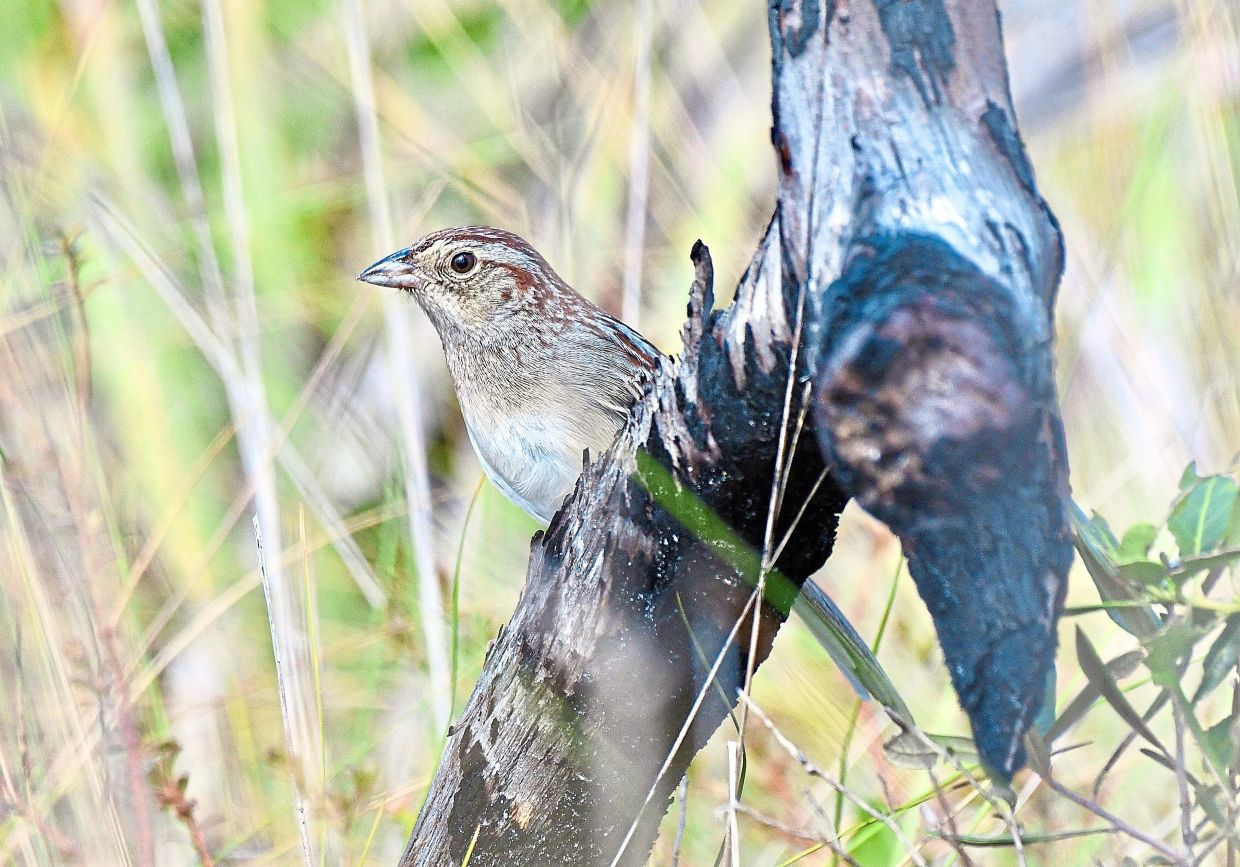
In the pine flatwoods of South Florida, small brown Bachman's sparrows perch among the branches and sing with apparent complexity that belies their unassuming appearance. Though their songs sound remarkably similar to the human ear, these birds possess a sophisticated vocal repertoire spanning up to 120 distinct song types within a single population. This acoustic diversity rivals human language in its flexibility and cultural transmission, evolving with each generation as birds decide which melodies to preserve, refine, or abandon entirely.
For decades, ornithologists have wrestled with a fundamental question: how do young sparrows navigate this abundance of options when learning to sing? A single juvenile Bachman's sparrow will master perhaps only 48 of the 120 songs available in its community, yet the mechanisms determining this selective adoption have remained elusive. Previous research emphasised social and cultural influences, focusing on how young males imitate successful adults—those who win mates or display particularly ornate plumage—during the crucial developmental window when song acquisition occurs.
A new study published in March reveals an underappreciated dimension to this puzzle: the physical landscape itself. Researchers at Florida Atlantic University discovered that environmental factors like dense vegetation, shrubs, and wind patterns directly influence song transmission through the forest. These obstacles scatter and absorb sound waves, degrading certain acoustic signals more severely than others. The hypothesis suggests that young sparrows unconsciously avoid learning songs that have been distorted by their environment, creating evolutionary pressure that gradually eliminates poorly-transmitting variants from the population's repertoire.
Behavioural ecologist Rindy Anderson, lead author of the study, explained the mechanism with striking clarity: rarer song types simply do not propagate as effectively across distance compared to their common counterparts. The research team tested this proposition experimentally, recording both rare and common sparrow songs before replaying them in various natural habitats—thickets, open plains, and other ecological zones where Bachman's sparrows forage and communicate. The results confirmed their prediction: rarer songs degraded more substantially under these field conditions than established ones, potentially explaining why some acoustic variants persist while others fade from use.
This finding aligns with established understanding of animal acoustic adaptation, a principle observed across diverse species. Low-frequency bellows produced by rainforest monkeys penetrate dense canopy better than high-pitched calls, while tropical frogs evolved shrill croaks precisely because such frequencies cut through the masking noise of rushing water. Environmental pressures have literally sculpted the voices of countless animals, yet applying this hypothesis to songbird dialects has proven surprisingly complex. Earlier research demonstrated that when other bird species heard experimentally degraded songs, they learned the undegraded versions preferentially, supporting the environmental hypothesis. Anderson emphasised that these findings illuminate a process of cultural evolution driven by habitat constraints rather than conscious choice.
Yet the full picture remains more intricate than any single factor can explain. A comprehensive analysis of 5,085 songbird species suggested that sexual selection—the preference of potential mates for certain acoustic qualities—might outweigh environmental considerations as the primary driver of song diversity. Even within Bachman's sparrows, acoustic transmission clarity may represent only one component of a much larger system determining which songs survive generational turnover. Anderson herself cautioned against overestimating the environmental effect, acknowledging that social and cultural transmission likely carry equivalent weight in shaping vocal tradition.
This research carries particular significance for understanding how animal communication systems evolve and adapt to changing environmental conditions. Southeast Asian readers face increasing habitat degradation through deforestation and urbanisation, processes that fundamentally alter the acoustic properties of natural landscapes. If songbirds in the region rely partly on environmental acoustic properties to filter learned vocalizations, habitat loss could inadvertently drive the extinction of certain song dialects even when bird populations themselves survive. The sparrow study suggests that conservation must consider not merely species survival but the preservation of ecological conditions necessary for maintaining cultural diversity within populations.
The implications extend beyond simple ornithology. Understanding how organisms learn from their environment through perceptual filtering rather than explicit instruction reveals elegant mechanisms of cultural transmission across nature. David Wheatcroft, an ornithologist at Stockholm University unaffiliated with the research, articulated both the logical appeal and genuine surprise of the findings. The expectation that undegraded songs should spread more readily possesses intuitive force—if young birds cannot hear a song clearly, they cannot learn it. Simultaneously, demonstrating this effect in uncontrolled field settings where countless unmeasured variables influence outcomes represents a remarkable achievement in ecological research methodology.
The Bachman's sparrow study thus illuminates one layer of a complex phenomenon while acknowledging its own limitations. Regional variation in bird songs has long fascinated researchers, with ornithologists documenting distinct dialects across populations separated by modest distances. The Florida research suggests that topography, vegetation density, and climate each contribute to shaping these regional acoustic identities. As environmental conditions shift due to climate change and habitat modification, bird song dialects may themselves transform in ways that reflect underlying landscape alterations rather than purely genetic or cultural drift.
Future investigations will likely examine whether this environmental filtering mechanism operates similarly across different songbird families, climates, and habitat types. Tropical species in Southeast Asia, many still inadequately studied, may reveal entirely different acoustic adaptation strategies suited to rainforest conditions dramatically unlike South Florida's pine flatwoods. The research ultimately suggests that vocal culture in birds emerges from an intricate interplay between inherited preferences, social learning, sexual selection, and environmental constraint—a dynamic system that echoes the complexity of human language itself.

