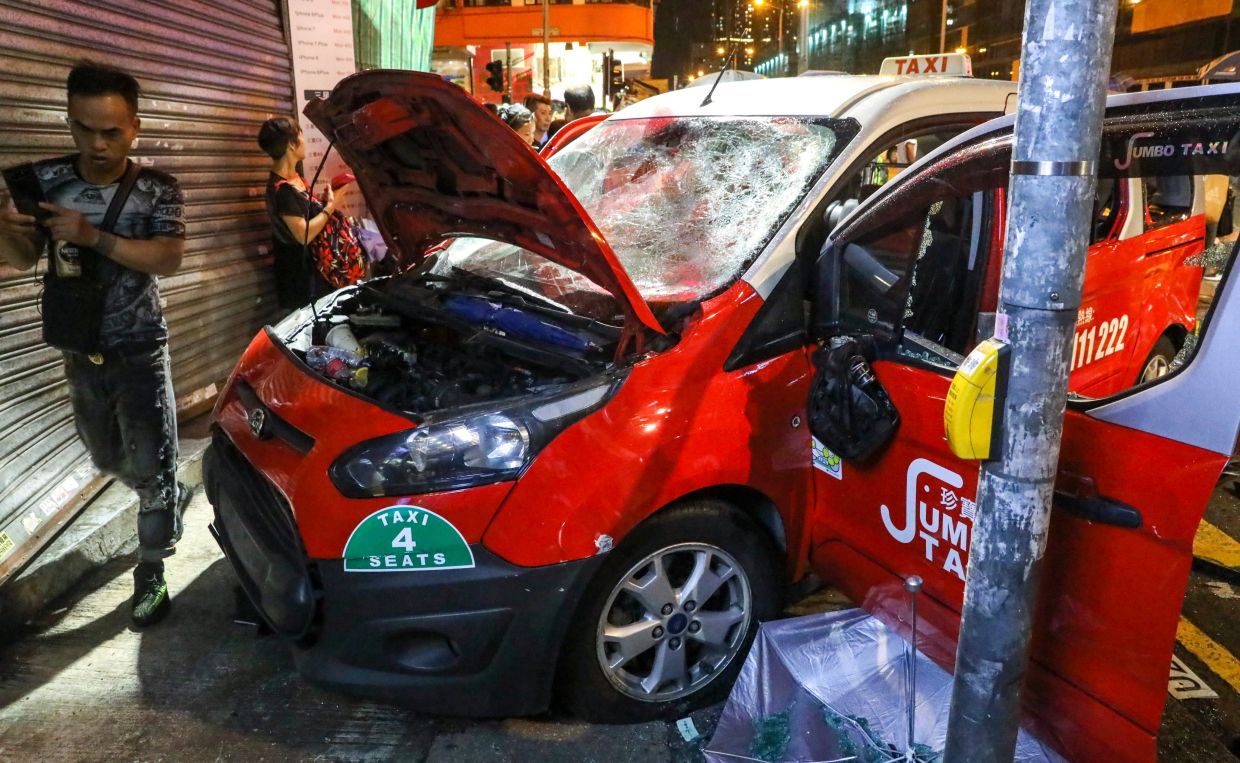
A Hong Kong kindergarten clerk is seeking HK$8.4 million in damages from a taxi driver whose vehicle struck her during a demonstration in Sham Shui Po nearly five years ago, with the case highlighting the contested narratives surrounding the 2019 protest movement and its casualties. Park Hoi-lam's legal team presented arguments this week contending that driver Henry Cheng Kwok-chuen bore full responsibility for the October 6, 2019 collision that left her with serious lower-limb injuries requiring seven operations over three months.
Counsel Susanna Leong argued that the mechanics of the accident themselves demonstrated negligence and a failure to exercise reasonable care. She emphasised that Cheng made no attempt to sound his horn or apply brakes before the taxi mounted the pavement and struck Park and another woman on Yen Chow Street. This straightforward negligence claim forms the core of the plaintiff's case, independent of the broader circumstances surrounding the protest itself. Leong specifically rejected the relevance of events that followed the collision, arguing that whatever happened to the driver afterwards bore no bearing on the question of how and why the initial impact occurred.
The defence team presented a fundamentally different framing of events, casting Cheng as an innocent victim of circumstance who became embroiled in protest violence through no fault of his own. His lawyers stressed that the cabby was subsequently attacked with metal rods and hard objects by protesters, presenting him as someone victimised by the broader disorder rather than an agent of harm. They contended that holding Cheng liable for damages would constitute injustice, particularly given that he himself suffered physical assault in the course of performing his ordinary work duties.
Park's testimony provided granular detail about the sequence of events that led to her injuries. She explained that she and companions had been travelling by bus towards Tsim Sha Tsui when blocked roads forced them to leave the vehicle at Sham Shui Po. Upon discovering that rail services had also suspended operations, the group made an ad hoc decision to walk towards Mong Kok. Park became separated from her friends when she walked faster than the group, inadvertently finding herself alone in an area that was becoming increasingly crowded. She characterised the gathering as peaceful until she heard disturbances near Cheng's taxi, at which point she attempted to flee, only to be struck by the vehicle travelling at high speed.
The trajectory of Park's injuries and recovery illustrates the long-term consequences of that October afternoon. The initial collision resulted in severe lower-limb trauma necessitating surgical intervention on seven separate occasions during the subsequent three-month hospitalisation period. Following discharge in mid-January 2020, she required ongoing outpatient therapies. Medically, she has reached a plateau; additional surgeries performed after her discharge yielded no further improvement, and her physicians have indicated that she may eventually require knee replacement surgery. The knee pain that persists prevents her from walking for extended periods without rest, restricting her ability to engage in activities most people consider routine.
These persistent disabilities have materially altered Park's capacity to perform her current work as a kindergarten clerk. Her employment near her residence in Tuen Mun is constrained by physical limitations; she cannot lift heavy objects and cannot comfort distressed young children by carrying them, duties that form part of routine childcare work. Cosmetic concerns also remain unresolved. Scarring on her legs could be addressed through reconstructive surgery, but Park lacks the financial resources for such a procedure. These ongoing restrictions exist in the context of what should be her prime working years, raising questions about her long-term earning capacity and quality of life.
The defence strategy included challenging Park's account of her current functional limitations by introducing surveillance footage obtained by a private detective agency. This covert video purportedly showed Park conducting ordinary activities such as shopping and dining after work hours, suggesting that her reported disabilities were overstated or exaggerated. Park's response to this evidence proved revealing about the gap between objective observations and lived experience. She acknowledged that the footage captured her performing normal activities but questioned whether engagement in shopping and dining alone constitutes a meaningful life or equates to genuine recovery. Her question highlighted the distinction between the ability to perform occasional tasks under optimal conditions and the capacity to sustain productivity and quality of life across the span of ordinary days.
The case has also generated controversy around the circumstances under which Park provided her police statement in March 2020. The defence sought to raise doubts about her credibility by questioning why she brought legal representation when giving that statement. Park denied that she had been involved in protest activity or that she harboured concerns about potential legal consequences for her own conduct. Her explanation—that she was simply protecting her interests—is straightforward but underscores how the 2019 protests created a legally uncertain environment where even innocent bystanders felt compelled to secure legal counsel when dealing with authorities.
The litigation encapsulates broader tensions that continue to shape Hong Kong's post-2019 landscape. While the immediate question before the court concerns whether Cheng bore responsibility for operating his vehicle negligently, the dispute also reflects competing interpretations of the protest period itself. The defence framework implicitly positions the taxi driver as a casualty of disorder, deserving sympathy rather than liability. The plaintiff's approach separates the driver's own victimisation from his duty of care in operating a motor vehicle. These framings are not easily reconciled, as they rest on different assumptions about responsibility, causation, and the proper allocation of losses when violence and accident intersect.
For Malaysian and Southeast Asian observers, the case raises questions about how societies reckon with the consequences of large-scale civil disorder. Hong Kong's legal system is attempting to address personal injury claims arising from the protest period through conventional negligence frameworks. Whether courts will hold individual actors accountable for accidents that occurred amid broader violence, or whether they will extend sympathy to those caught in the disorder regardless of their direct actions, will shape how future claimants perceive the accessibility and fairness of civil remedies. The trial before Justice Simon Leung Chun-man, expected to conclude after six days of proceedings, will provide insight into how Hong Kong's judiciary approaches causation, responsibility, and compensation in cases where accident and politics become entwined.

