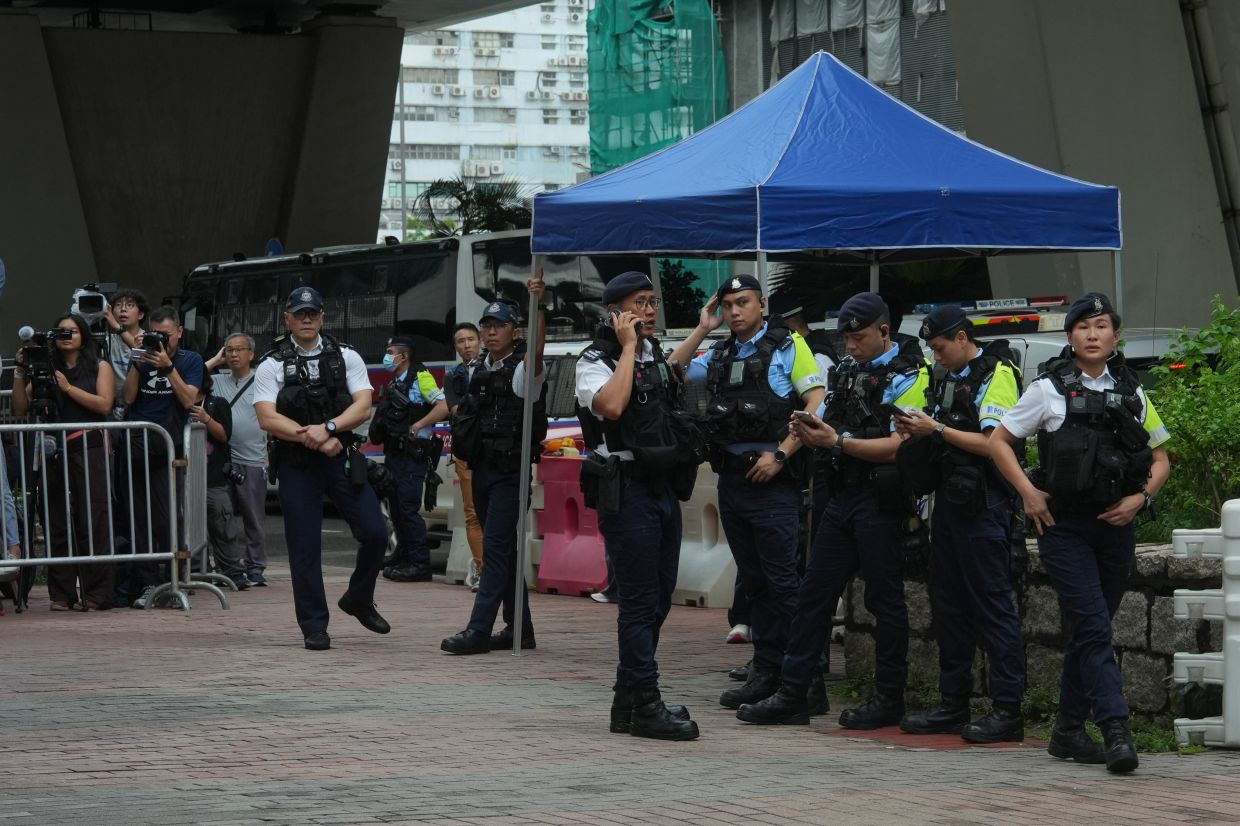
Hong Kong police have taken a woman into custody for allegedly wearing a T-shirt bearing a seditious message while standing outside West Kowloon Court, marking another escalation in the territory's enforcement of national security legislation. Police announced the detention on Monday evening, revealing that the woman had been held the previous week on multiple charges including disorderly conduct in a public place, obstruction of police officers, and acting with seditious intention. Authorities provided minimal detail about the operation itself, with a police spokesman stating only that the security measure was intended to preserve public order and safety, while declining to elaborate on operational specifics.
The timing of the arrest proved significant, occurring mere hours before three High Court judges announced guilty verdicts against two prominent figures from Hong Kong's pro-democracy movement. Lee Cheuk‑yan, the former chairman of the Hong Kong Alliance in Support of Patriotic Democratic Movements of China, and Chow Hang‑tung, the alliance's former vice-chairwoman, were convicted of inciting subversion under the national security law. Both individuals had faced charges stemming from their calls to dismantle what they characterized as mainland China's "one-party dictatorship," bringing their activism squarely into conflict with Beijing's interpretation of seditious conduct.
In the early hours of Friday morning, as dawn broke over the courthouse district, more than fifty people assembled in a queue outside the building, anticipating the judgment announcement. Some had gathered to demonstrate solidarity with the defendants; others sought to observe the proceedings directly. It was during this vigil-like gathering that plainclothes police officers reportedly identified the woman in question, focusing attention on her black T-shirt printed with Japanese characters that officers suspected carried seditious implications. Without extended dialogue, officers escorted her toward a police vehicle as camera operators recorded the exchange and journalists present at the scene received instructions to stand back.
The arrest underscores escalating sensitivities surrounding public expression in Hong Kong, where the definition of sedition has expanded considerably under the national security legislation enacted in 2020. The national security law, imposed by Beijing, criminalized subversion, secession, foreign collusion, and terrorism. Under this framework, even clothing choices and symbolic gestures face potential legal scrutiny. The incident illustrates how authorities now interpret the bounds of permissible political expression far more narrowly than before, with officials willing to target individuals based on suspected messaging encoded in their apparel.
Hours after the woman's detention, the High Court issued its verdict in the form of a comprehensive 216-page ruling. Three judges concluded that Lee, Chow, and the Hong Kong Alliance had committed subversion by advocating for systemic change to mainland China's political structure. The judges held explicitly that any attempt to undermine or overthrow the Communist Party of China's leadership meets the legal threshold for subversion under the national security law. More broadly, the ruling asserted that China's constitution does not accommodate Western-style democratic systems, effectively establishing that calls for pluralistic governance constitute seditious conduct under this interpretation.
The convictions carry profound implications for how far Hong Kong's judiciary will stretch national security legislation to suppress political activism. Lee, a former lawmaker who once represented constituents in the Legislative Council, has spent nearly five years in custody awaiting this verdict. Chow, a qualified barrister trained in the common law tradition, similarly has been held for an extended period. Their detention without trial reflects the severity with which authorities treat national security cases, as does the corresponding delay in legal resolution. A fourth defendant, Albert Ho Chun‑yan, who held the position of vice-chairman in the alliance, has been in custody for over four years and remains in detention awaiting sentencing after entering a guilty plea in January.
For Southeast Asian observers, particularly those in Malaysia where sedition laws carry significant weight, the Hong Kong case demonstrates how security legislation can expand dramatically beyond its original stated purposes. What began as national security measures have evolved into tools for criminalizing routine political expression and historical commemoration. The Hong Kong Alliance itself had organized the annual Tiananmen Square vigil, a gathering that traditionally marked the 1989 crackdown in Beijing. That the organisation has now been disbanded and its leadership imprisoned for essentially advocating democratic reform shows how comprehensively the political space has contracted in the former British colony.
The woman arrested for her T-shirt represents an ordinary citizen rather than a prominent activist, yet she faced detention on charges identical to those levelled against established political figures. This pattern suggests that authorities employ national security laws indiscriminately, targeting anyone whose conduct they interpret as challenging the political order. The presence of media coverage of her arrest indicates that such incidents occur with enough frequency to warrant reporting, though the relative brevity of coverage compared to the verdicts against Lee and Chow suggests authorities have successfully normalised such enforcement actions.
The broader trajectory in Hong Kong raises questions about the viability of dissent and civil society in the territory under the current legal regime. The national security law has fundamentally altered the risk calculus for anyone considering political participation or expression. With judges now interpreting subversion to encompass virtually any challenge to the Communist Party's monopoly on power, and with police authority to detain citizens based on suspicion of seditious intent conveyed through clothing, the boundaries of acceptable speech have contracted to minimal proportions.
For Malaysia, the Hong Kong precedent offers cautionary lessons about how security legislation, once enacted, tends toward expansive rather than restrictive interpretation. Malaysian laws including the Sedition Act carry comparable vagueness, and the Hong Kong experience demonstrates how such frameworks can evolve from protecting state security to policing political expression comprehensively. The case also highlights the importance of independent judicial oversight, as Hong Kong's courts have become instruments for enforcing rather than constraining state power over expression. As Lee, Chow and their associates face sentencing in coming weeks, the Hong Kong Alliance's effective extinction signals the success of security law enforcement in dismantling institutional challenges to the political order.

