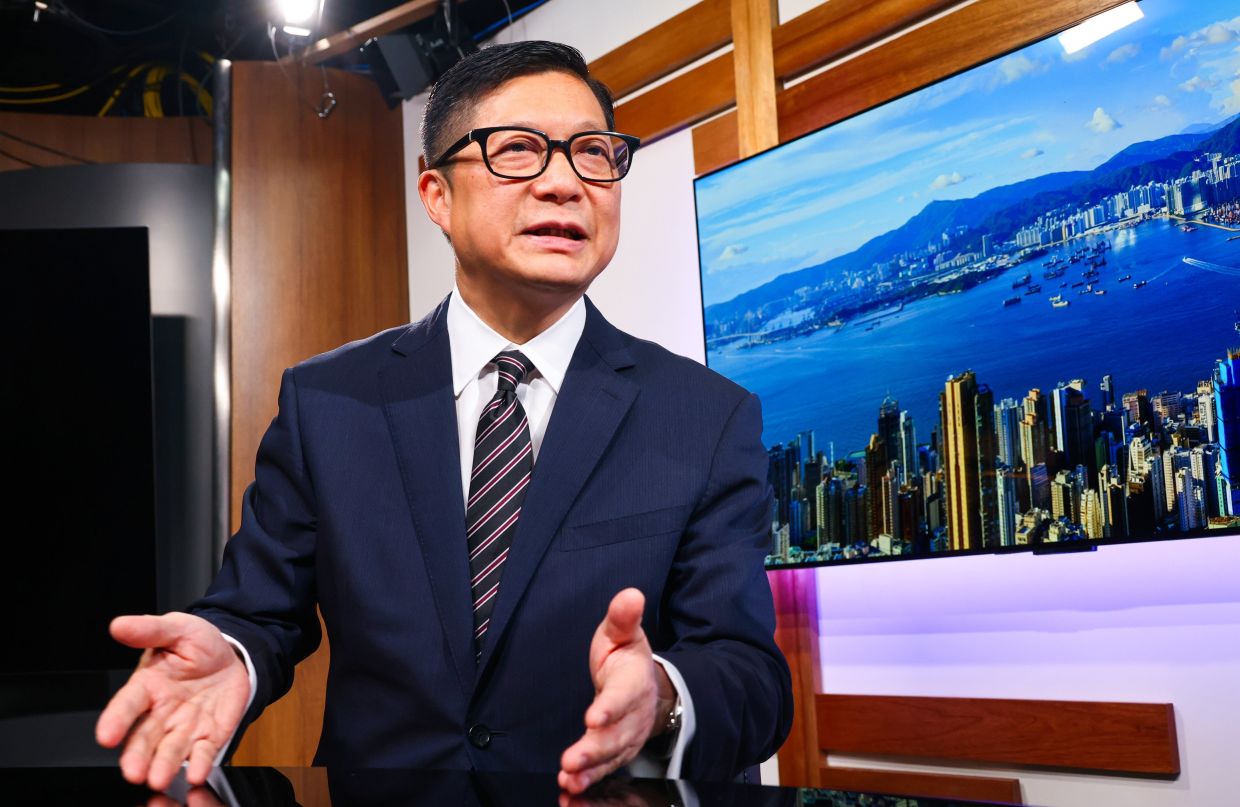
Hong Kong's Security Secretary Chris Tang Ping-keung has promised that accountability for the catastrophic Wang Fuk Court fire will know no bounds, pledging that authorities will arrest and prosecute anyone found to have committed wrongdoing regardless of whether they cooperate with the ongoing independent inquiry. Speaking in an exclusive interview, Tang stated that law enforcement already has two individuals in the prosecution pipeline for refusing to testify before the investigating committee, signalling the government's determination to pursue justice through the courts if witnesses prove uncooperative with the public inquiry process.
The deadly November fire at Wang Fuk Court represents one of the worst infernos to strike Hong Kong in recent decades, claiming 168 lives including a firefighter and forcing the displacement of approximately 5,000 residents. The blaze burned through seven of the estate's eight residential buildings over 43 hours, driven by a combination of negligent practices during renovation work that the inquiry has already exposed in considerable detail. Polyfoam boards used to cover windows, non-fire-retardant scaffolding mesh, and the removal of fireproof doors from emergency passages all contributed to the rapid and devastating spread of the flames.
On Monday, the independent committee investigating the fire made the significant decision not to seek statutory powers to compel witness testimony, a choice that alarmed survivors and their families who feared key figures might escape accountability. This development prompted Tang's emphatic reassurance that the absence of legal coercion mechanisms at the inquiry would not impede prosecutions for those with evidence of culpability. The dual-track approach—combining the independent committee's fact-finding with parallel police and anti-corruption investigations—reflects the authorities' strategy to pursue multiple avenues of accountability simultaneously.
The police and the Independent Commission Against Corruption have jointly charged seven individuals and two companies with a combined 25 offences in connection with the fire, including serious charges such as manslaughter, conspiracy to defraud, money laundering, attempting to pervert the course of public justice, and tax evasion. Among those facing prosecution are Hau Wa-kin and Gordon Ho Kin-yip, both directors of Prestige Construction and Engineering, which served as the main contractor overseeing renovations at Wang Fuk Court. Both men submitted written statements to the inquiry committee but declined to testify at hearings, placing them among the individuals already being prosecuted for their refusal to cooperate.
The inquiry's proceedings have systematically documented serious institutional failures across multiple government departments in detecting and addressing fire hazards before the tragedy occurred. These revelations have prompted questions about individual accountability within the disciplined services, particularly concerning the Fire Services Department. When asked whether officers should face consequences, Tang acknowledged room for improvement while defending firefighters' heroic efforts during the emergency response, noting that their performance should be recognised despite any systemic shortcomings identified by the investigation. His careful calibration of criticism and recognition reflects the delicate balance authorities must strike between demanding accountability and maintaining public confidence in emergency services.
District councillor Peggy Wong Pik-kiu presents a secondary strand of the accountability question, having submitted written testimony but refused to appear for cross-examination before the committee. Wong, a former consultant to the Wang Fuk Court owners' committee, faced multiple allegations from residents regarding her conduct at owners' meetings, including claims of intimidation and irregular handling of proxy votes collected for meetings. Wong's written statement denied providing benefits in exchange for proxy votes collected in 2021 and 2024, and she explicitly denied collecting votes for the general meeting at which the owners selected Prestige as their renovation contractor. Tang indicated that the government would apply the same evidentiary standard to potential prosecution of Wong as it would any other case, emphasising that concrete evidence would be the determining factor.
Tang's defence of the committee's decision to forgo statutory powers represents a departure from international practice in major disaster inquiries. He pointed to the Grenfell Tower fire in London as a cautionary example of how formal statutory inquiries can extend investigations across many years, with the final 1,700-page report in that case taking six years to complete and ultimately resulting in no prosecutions despite the 2017 tragedy that killed 72 people. The judge-led Hong Kong committee, by contrast, is targeting completion of its report within nine to ten months, a timeline that Tang characterised as delivering rapid justice through efficiency rather than legal compulsion. This comparison underscores the government's preference for speed and the combination of multiple investigative mechanisms rather than relying solely on the committee's powers.
The broader question of cross-jurisdictional cooperation in fire safety has emerged as another critical issue demanding resolution in the aftermath of the tragedy. The city signed an emergency cooperation agreement with rescue authorities in Guangdong province and Macau in 2024, yet mainland Chinese firefighters were unable to provide direct assistance during the Wang Fuk Court fire despite the existence of a formal emergency response mechanism. Tang acknowledged that current coordination between Hong Kong and neighbouring jurisdictions remains limited to flooding and landslide response, with actual firefighting operations still requiring substantial groundwork before cross-border deployment becomes feasible. The technical obstacles are considerable—ranging from incompatible electrical plug standards to different water source configurations—and will require phased coordination efforts.
Tang explained that operational procedures, firefighting tactics, and safety protocols differ significantly between Hong Kong, mainland China, and Macau, necessitating careful coordination before any joint firefighting operations can proceed. Entry safety procedures and strategic approaches to tackling fires vary across jurisdictions, and authorities must resolve these differences through discussion and planning before deployment becomes possible. The security chief indicated that initial phases would focus on simpler assistance measures such as spraying water jets from the exterior of burning buildings, with more complex operations requiring extended preparation. This measured approach suggests that full operational integration remains distant despite the formal agreement already in place.
Tang also used the occasion of his remarks to highlight two outstanding pieces of legislation his Security Bureau intends to advance before his term concludes next year. These include proposed amendments to impose stiffer penalties for sexual offences and to strengthen fire safety regulations comprehensively. The tightened fire safety provisions would ostensibly represent lessons learned from the Wang Fuk Court catastrophe, incorporating findings from the ongoing inquiry into future preventive frameworks. These legislative initiatives, alongside the prosecution of those charged and the inquiry's findings, form part of the government's multi-pronged response to the disaster, though sceptics may question whether legislative measures and inquiries can adequately address systemic failures that allowed such dangerous renovation practices to proceed unchecked.
The combination of prosecutions, the independent inquiry, and proposed legislative changes represents Hong Kong's attempt to demonstrate comprehensive accountability for the disaster. Yet the episode has exposed tensions between the desire for rapid justice and the concerns of survivors who worry that the absence of compulsory witness powers might allow key figures to evade full consequences. Tang's assurances that evidence rather than procedural cooperation will drive prosecutions may ultimately prove sufficient to satisfy legal standards, but they offer little solace to those who view the committee's rejection of statutory powers as a missed opportunity for complete transparency and compulsory accountability in Hong Kong's deadliest fire in decades.

