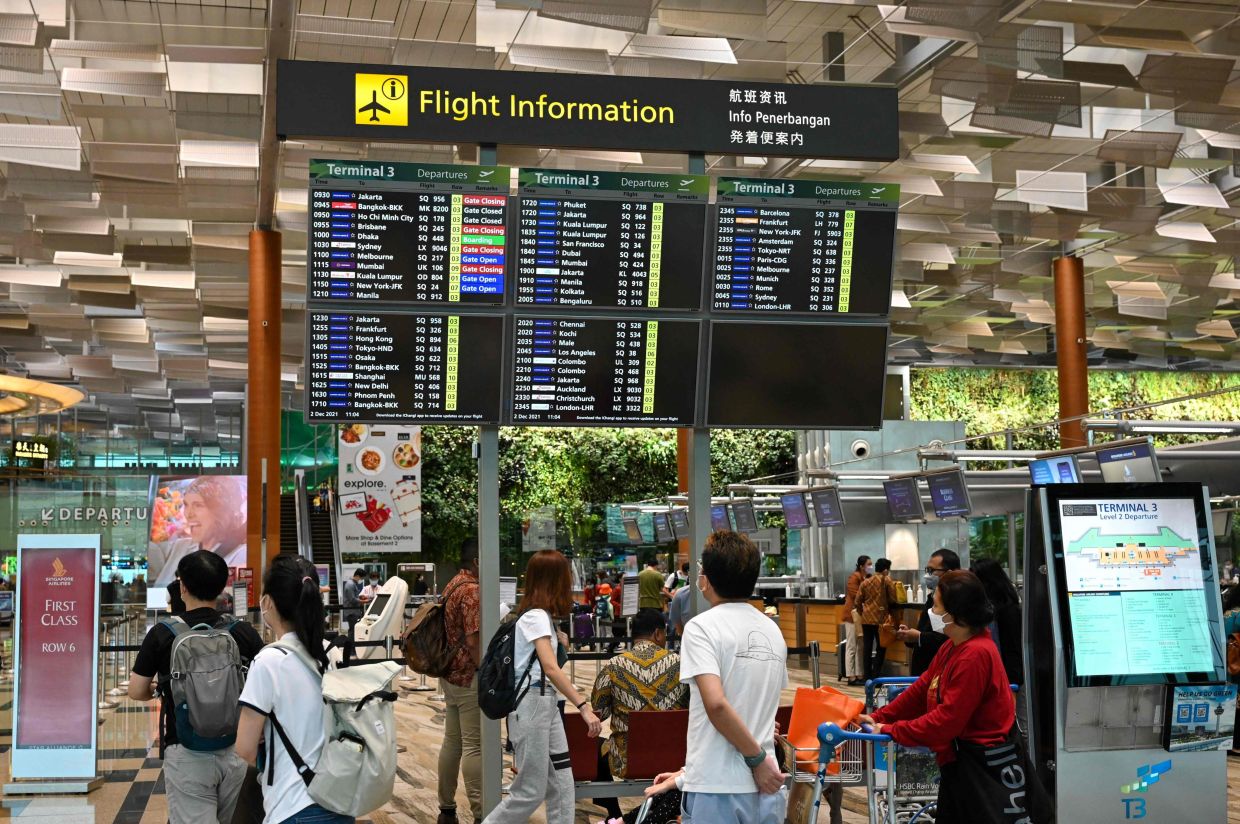
A Singapore court has handed down prison sentences against a Hong Kong mother and her adult son following a tumultuous incident at Changi Airport that saw them assault both a concerned bystander and a police officer. The 65-year-old mother, Chan Sui-kwan, received the harsher sentence of six months' imprisonment for voluntarily causing hurt with intent to obstruct a public servant, while her 42-year-old son, Chan Wing-kwan, was sentenced to just ten days in custody for voluntarily causing hurt. The convictions represent a cautionary tale about airport security dynamics and the escalation that can occur when tensions boil over in public spaces frequented by thousands of travellers daily.
The sequence of events unfolded on the afternoon of June 30, 2024, within the sprawling confines of Changi Airport's Terminal 3. According to court documents examined during the trial, the son's volatile behaviour stemmed from a misunderstanding in which he believed nearby travellers were laughing at him. This perceived slight prompted him to direct his anger physically towards his own mother, delivering a kick that would set off a chain of unfortunate events. The incident highlights how misinterpretation and emotional dysregulation in crowded airport environments can rapidly spiral into violence affecting innocent parties.
When a 69-year-old bystander noticed the mother's distress and attempted to intervene on her behalf, his good intentions met with hostility rather than gratitude. The mother rebuffed his assistance and told him to leave them alone, yet her son escalated matters significantly by aggressively confronting the older man and challenging him to physical combat. This refusal of help from a concerned stranger demonstrates how family conflicts can alienate those trying to defuse tensions, a dynamic that would have profound consequences in the minutes that followed.
The confrontation intensified when the pair relocated to another level within Terminal 3. There, the son once again attacked his mother with a kick, prompting the bystander to attempt calling emergency services for police assistance. Rather than allowing authorities to be summoned, the son launched himself at the older man with intense ferocity. The subsequent scuffle saw the son repeatedly striking the bystander with his fists, leaving the man with serious injuries including a head haematoma, knee abrasions, and bruised fingers. For air travellers and airport staff, such scenes represent precisely the kind of unpredictable violence that security systems aim to prevent.
After police arrived and investigated the initial incident, officers recorded the mother and son's passport details but returned their travel documents. This first encounter at the scene appeared to conclude without immediate arrests, allowing the pair to remain in the airport environment. However, the mother's subsequent refusal to cooperate with authorities later that afternoon fundamentally altered the trajectory of the case. When officers encountered them again in the departure hall, the mother's obstinate behaviour and disturbance triggered her arrest, though not before she physically resisted law enforcement in a shocking manner.
During the arrest procedure, the mother bit a police officer on his right forearm, penetrating through the officer's clothing to leave a visible 1-centimetre mark and bruising. This assault on a public servant, committed while the officer was performing his lawful duty, constituted the more serious charge that earned her the substantially longer prison sentence. The bite wound represents a particularly intimate form of violence that authorities take exceptionally seriously, given the health risks and the direct defiance of police authority it implies.
The legal proceedings that followed the June incident unfolded across an extended timeline. The mother was eventually brought before the court on November 18, 2024, some five months after the actual incident, while her son faced charges dating to April 24 of the previous year. This temporal gap between incident and prosecution likely reflected investigations and administrative processes typical of Singapore's justice system. Complicating matters further, both individuals failed to appear at a scheduled court hearing on July 22, prompting the issuance of arrest warrants.
They were ultimately convicted on July 29 and received their sentences the following Monday. The delayed proceedings underscore how international travel and border complications can extend legal processes. For Malaysian observers, this case demonstrates Singapore's zero-tolerance approach to airport violence and assault on law enforcement personnel, principles that are similarly prioritised across Southeast Asia's major transport hubs. The substantial prison sentence for the mother, in particular, reflects the gravity with which courts treat resistance to arrest and violence directed at public servants attempting to maintain order.
The Changi Airport incident serves as a sobering reminder of how quickly situations can deteriorate in high-stress environments like airports. Family conflicts that might be managed elsewhere become matters of serious criminal consequence when they occur in busy public spaces and involve assaults on third parties. For tourists and business travellers from Hong Kong, Malaysia, and across the region, the case underscores the importance of maintaining composure in transit environments where tempers are frequently frayed by travel fatigue, time pressures, and the inherent stresses of airport operations. The sentences handed down represent not merely punishment for specific violent acts, but also a broader statement about behavioural expectations in Singapore's tightly regulated public spaces.

