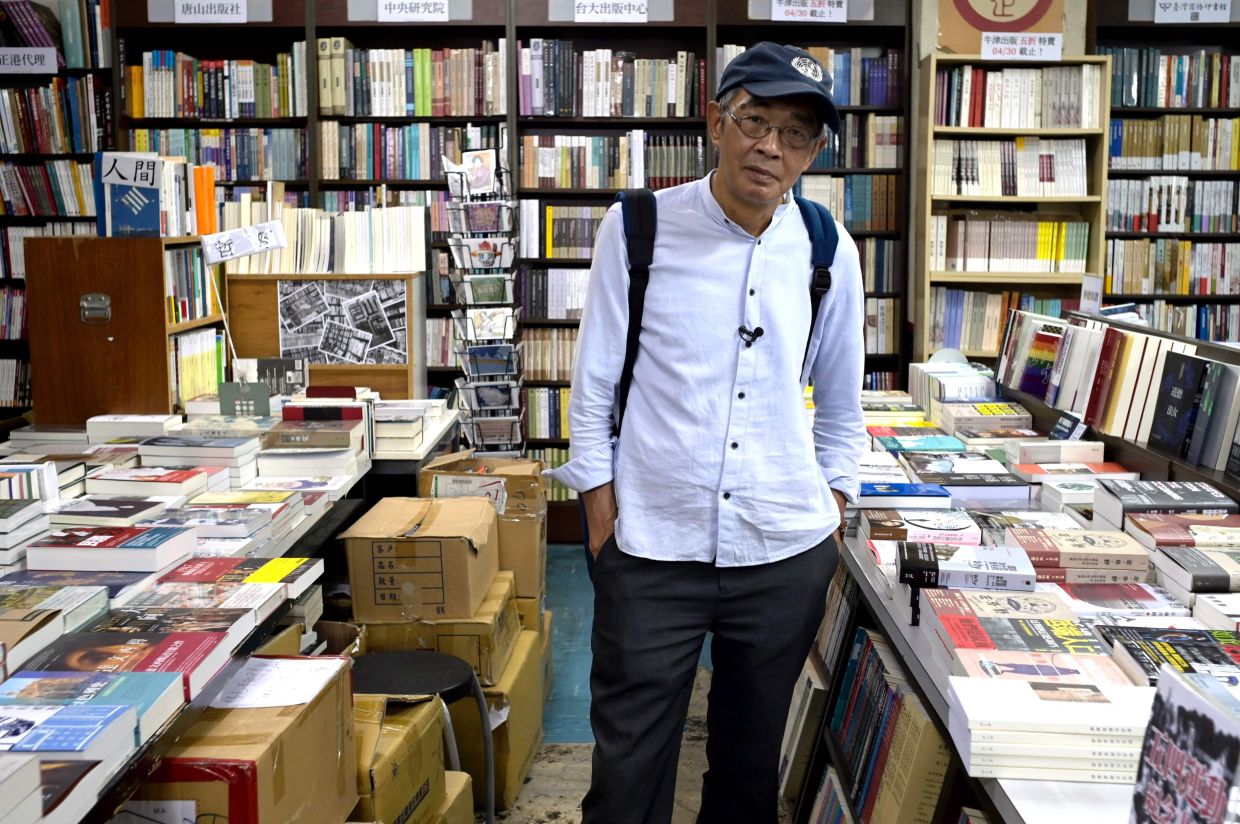
Lam Wing-kee, the Hong Kong bookseller whose dramatic account of detention by Chinese security forces made him an iconic figure in the struggle for free expression in Asia, has died in Taiwan at the age of 70. According to Taiwan's Central News Agency, Lam passed away Thursday evening at MacKay Memorial Hospital in Taipei, where he had been admitted just days earlier following a cancer relapse. His death marks the end of a life that had come to embody both the reality and the human cost of Beijing's systematic dismantling of Hong Kong's autonomous institutions and civil liberties.
Lam's prominence in international discourse about freedom stems from events that unfolded nearly a decade ago. In late 2015, he was among five people connected to Causeway Bay Books—a Hong Kong bookstore specialising in titles unavailable on mainland China, including politically sensitive works about senior Chinese leaders—who vanished without explanation. The disappearances sent shockwaves through Hong Kong's civil society and drew international attention to what many saw as evidence of Beijing's expanding security apparatus operating beyond its borders with impunity. Among those who disappeared was Gui Minhai, a publisher and part-owner of the bookstore, who had been staying in Thailand when he went missing. Gui was later sentenced in mainland China to a decade in prison on charges of illegally providing intelligence to foreign entities, underscoring the severity with which authorities treated involvement with the bookstore.
What distinguished Lam's response from silent capitulation was his decision in 2016 to break his silence. Speaking publicly at a crowded press conference in Hong Kong, he provided an extraordinarily detailed account of his ordeal that directly contradicted official Chinese narratives. He recounted being seized by authorities in Shenzhen in October 2015 after crossing the border from Hong Kong, then blindfolded for a gruelling 13-hour train journey to Ningbo in eastern China. There, he explained, he had been confined to a single room under round-the-clock surveillance by rotating teams of two officers for five months—a form of psychological pressure designed to extract cooperation. The account was particularly powerful because it came from someone willing to identify himself and provide verifiable details, lending credibility to broader allegations about how China's security apparatus operates.
Lam's willingness to testify about forced confessions broadcast on state television, and to detail the mechanics of his captivity, resonated across Asia and internationally. His story provided concrete evidence that supported the assertions of human rights organisations documenting enforced disappearances and custodial coercion in China. For many in Hong Kong and the diaspora, his account became shorthand for Beijing's contempt for the rule of law and the autonomy that Hong Kong was supposed to maintain under the "one country, two systems" framework established at the city's 1997 handover from British rule.
Fearing further legal jeopardy in Hong Kong, Lam relocated to Taiwan in 2019, a decision that reflected how precarious the situation for dissidents and activists had become in his homeland. He eventually reopened Causeway Bay Books in Taipei in 2020, attempting to continue the bookstore's mission in a jurisdiction with constitutional protections for free expression. However, his health challenges persisted. Last month, Lam informed the Central News Agency that he had temporarily shuttered the Taipei location owing to his deteriorating condition, unable to provide any timeline for resumption of operations.
The trajectory of Lam's life after 2015 mirrors the broader transformation of Hong Kong under intensifying Chinese control. The massive pro-democracy protests of 2019, which saw millions take to the streets demanding greater autonomy and democratic reforms, prompted Beijing and Hong Kong authorities to implement sweeping restrictions on civil liberties. The National Security Law imposed in 2020 criminalised dissent in ways that many observers regarded as fundamentally incompatible with Hong Kong's previous status as a relatively open society. The law's provisions have been wielded with increasing aggressiveness, including in June 2024 when police arrested two individuals who allegedly operated a bookstore suspected of selling seditious publications and receiving funding from overseas political organisations.
Taiwan's President Lai Ching-te acknowledged Lam's passing through a Facebook statement that elevated his significance beyond individual tragedy to a statement about values under threat. "The passing of Mr Lam Wing-kee is deeply saddening, but the courage he left behind would not fade," Lai wrote, adding that "Taiwan will remember that a Hong Kong bookstore worker once told us in the most ordinary yet most steadfast way how precious freedom is and reminded us that democracy requires the efforts of generation after generation to defend it." The presidential tribute underscores how Lam's experience has become central to Taiwan's self-understanding as a democratic society operating under pressure from an increasingly assertive Beijing.
The symbolic dimensions of Lam's story extend to regional geopolitics and the question of whether democratic governance can persist in East Asia. His choice to flee Hong Kong and rebuild his life in Taiwan represented a vote of confidence in Taiwan's institutions at a moment when the island faces unprecedented pressure from mainland China. Conversely, his death in exile illustrates the personal cost extracted from those who resist authoritarian expansion. The white rose left anonymously outside the Taipei bookstore on Monday—a gesture echoing symbols of mourning and remembrance used by Hong Kong's pro-democracy movement—speaks to how his life has transcended individual biography to become a touchstone for a broader struggle.
For Malaysian observers and policymakers, Lam's trajectory offers sobering lessons about the mechanics of political repression and the vulnerability of institutions supposedly protected by high-level political agreements. The deterioration of Hong Kong's autonomy despite constitutional protections written into international agreements illustrates how carefully constructed frameworks can be hollowed out through incremental legal changes and enforcement practices. Malaysia's own history of press restrictions and periodic crackdowns on dissenting voices provides uncomfortable parallels, even if the scale and coordination of Hong Kong's transformation has been more systematic.

