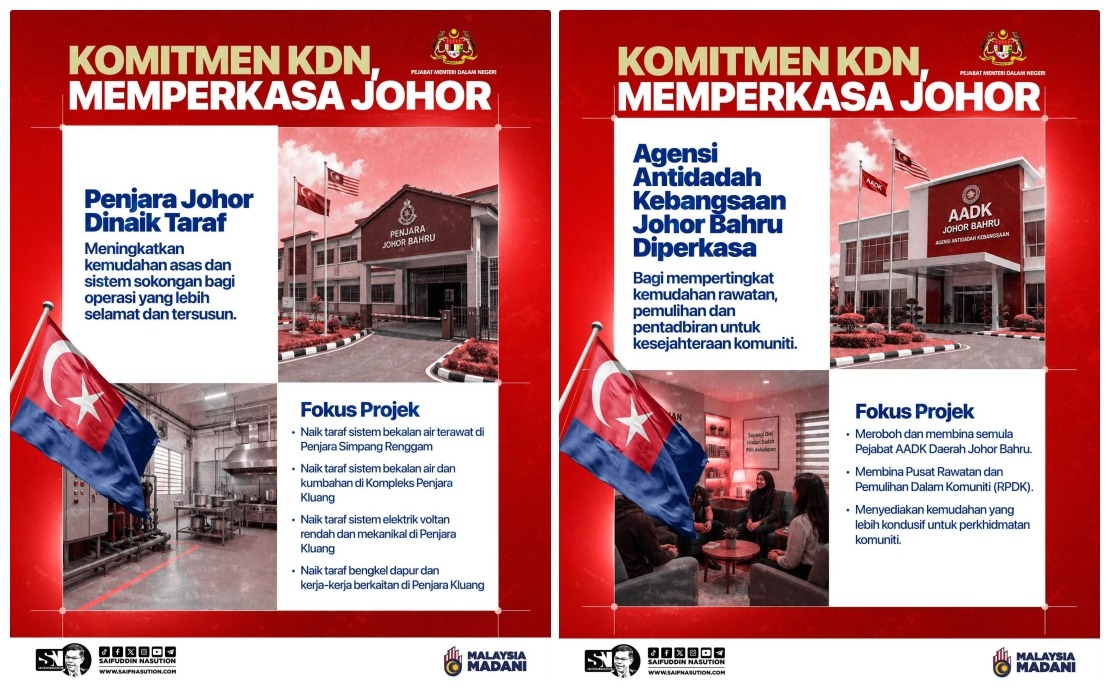
The Home Ministry is embarking on an ambitious modernisation programme for Johor, positioning the southern state as a cornerstone of the country's security and public service framework. Home Minister Datuk Seri Saifuddin Nasution Ismail unveiled the multi-agency initiative on Wednesday, framing the investment as essential to Johor's strategic importance as a key security hub and international gateway for the nation. The announcement arrives as the state gears up for its 16th state election, with approximately 2.7 million registered voters preparing to select 56 state assemblymen.
Johor's geographical and economic significance elevates its status beyond a typical state administration concern. Serving as a critical junction between Malaysia and Singapore, and functioning as a major maritime corridor, the state demands infrastructure that matches its role in national security architecture. The Home Ministry's commitment reflects recognition that ageing facilities and operational bottlenecks in border agencies could compromise both security effectiveness and the seamless flow of legitimate commerce and travel. By concentrating resources on southern Johor, the federal government signals investment in a region often perceived as peripheral to the capital-centric policy agenda.
The Royal Malaysia Police component of the development strategy includes construction of the Segamat district police headquarters, a project addressing operational limitations in that region. Simultaneously, the ministry is acquiring land earmarked for a new Pengerang district police station, indicating an expansion of police presence in areas experiencing growth or emerging security challenges. These capital works represent more than routine facility management; they signal the government's intent to enhance police response capabilities and community policing infrastructure in districts that have historically operated from older or cramped premises. Complementing these structural projects, the ministry plans comprehensive repair and maintenance work on police quarters and lift systems across facilities, acknowledging deferred maintenance backlogs.
Immigration and border control modernisation features prominently in the announcement, reflecting heightened focus on the security of international entry points. Upgrades to immigration facilities at the Sultan Iskandar Building and the Sultan Abu Bakar Complex target operational efficiency at two critical processing centres. These installations handle substantial passenger and cargo flows, and their efficiency directly affects Malaysia's reputation as a well-organised, business-friendly destination. Enhanced systems at these complexes promise faster processing, improved record management, and strengthened integrity checks—all crucial for a country competing for regional trade and tourism leadership.
The Home Ministry's portfolio encompasses agencies beyond the police force, demonstrating the comprehensive nature of the initiative. The National Registration Department's planned Batu Pahat office construction addresses administrative infrastructure needs, while upgrades to basic systems at Kluang Prison and Simpang Renggam Prison tackle longstanding challenges in the correctional system. Malaysian prisons have faced periodic scrutiny over overcrowding and inadequate facilities, so targeted upgrades signal willingness to improve conditions for both inmates and staff. The National Anti-Drugs Agency component includes office and treatment facility redevelopment, recognising that drug rehabilitation infrastructure requires contemporary design to support evidence-based treatment approaches.
Maritime security represents another dimension of the strategy, with planned improvements to the Abu Bakar Maritime Base including jetty upgrades and building refurbishment. Malaysia's maritime domain awareness and enforcement capabilities carry increasing importance given regional tensions and the volume of maritime traffic transiting local waters. The Malaysian Maritime Enforcement Agency's operational effectiveness depends partly on functional infrastructure and serviceable vessels, making the base improvement relevant to broader strategic concerns about sovereignty protection and regional stability.
The timing of this announcement warrants scrutiny, arriving immediately before a state election when public attention focuses on governance and resource allocation. Saifuddin Nasution's statement emphasises that every allocation should deliver direct public benefit and strengthen agency preparedness, framing development as technocratic rather than politically motivated. However, major infrastructure commitments announced during electoral campaigns inevitably carry political salience, as voters consider which governments deliver tangible improvements to their localities. The Home Ministry's visible engagement in Johor development may influence voter perceptions about federal commitment to the state.
From a wider Southeast Asian perspective, Johor's strengthened security infrastructure supports Malaysia's role in regional security cooperation. The Strait of Malacca and approaches to Malaysian territorial waters carry global significance for shipping and maritime commerce. Enhanced border processing and maritime enforcement capabilities contribute to the region's stability and counter-transnational crime efforts. Neighbouring Singapore and Thailand, both engaged in similar modernisation initiatives, would view Malaysia's investment in Johor facilities as contributing to collective regional security architecture.
The strategic messaging embedded in this announcement positions Johor as integral to national development rather than peripheral. By committing federal resources to infrastructure spanning police, immigration, corrections, and maritime agencies, the government signals that southern security is non-negotiable. For residents and businesses in Johor, improved facilities promise faster services, enhanced safety perception, and recognition that their state merits sustained federal investment. The ministry's assertion that improvements will be delivered transparently and beneficially reflects broader governance commitments, though implementation timelines and actual service improvements will ultimately determine whether announcement translates into tangible public benefit.

