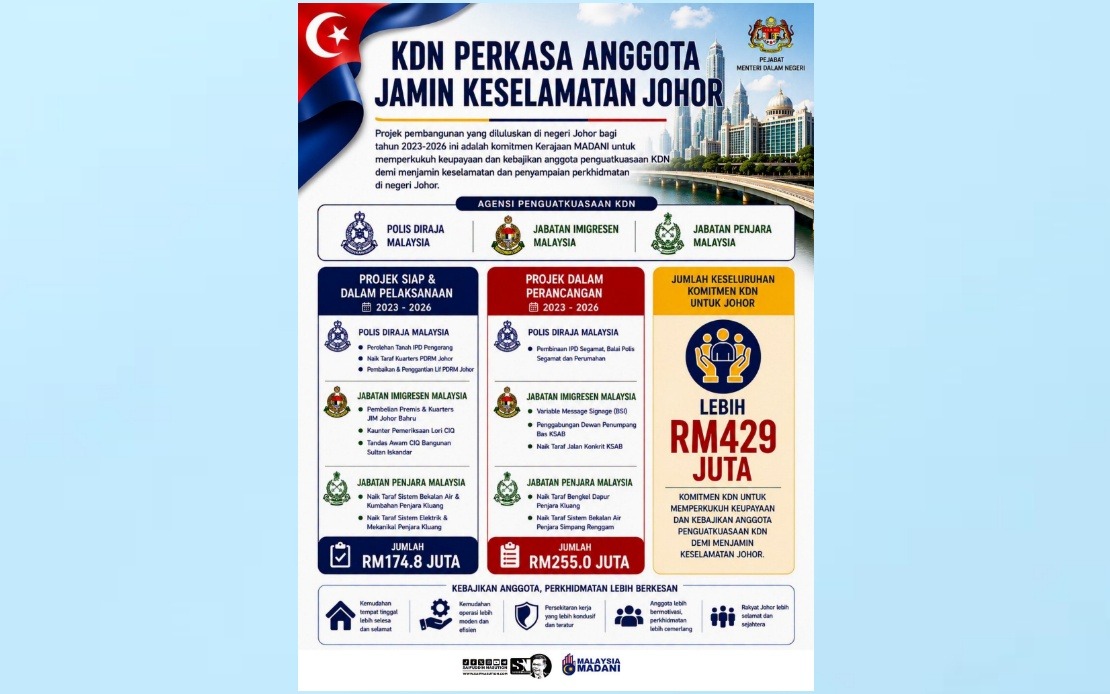
The Home Ministry has pledged more than RM429 million in funding since 2023 to fortify enforcement operations and improve working conditions for officers across Johor, addressing infrastructure gaps and workforce support in one of Malaysia's most strategically important states. Datuk Seri Saifuddin Nasution Ismail, the ministry's head, framed the initiative as integral to national security architecture, emphasising that adequate facilities and welfare provisions directly translate into more effective public safety outcomes for ordinary Malaysians.
The financial commitment encompasses three principal enforcement bodies: the Royal Malaysia Police, the Malaysian Immigration Department, and the Malaysian Prisons Department. Rather than distributing resources thinly across competing priorities, the Home Ministry structured the allocation into two distinct phases—RM174.8 million already deployed or currently advancing through implementation, and RM255 million earmarked for projects still in developmental stages. This phased approach allows flexibility while demonstrating concrete progress to stakeholders.
Saifuddin Nasution articulated a philosophy extending beyond conventional facility provision, characterising the investment as foundational to operational efficiency. His reasoning rests on a straightforward premise: when enforcement personnel work within modern environments equipped with appropriate amenities and functional quarters, their capacity to deliver services improves measurably. This perspective reframes welfare expenditure from discretionary benefit into strategic infrastructure spending that amplifies public security dividends across Johor's diverse communities.
Current implementation projects exemplify this dual focus on infrastructure and personnel support. The acquisition of land designated for Pengerang District Police Headquarters represents territorial expansion of policing capacity, whilst simultaneous acquisition of office and residential premises for the Johor Bahru Immigration Department addresses persistent accommodation shortages affecting officer deployment. At Kluang Prison, foundational facility upgrades address maintenance backlogs accumulated over years of intensive operational use, indirectly improving both staff welfare and incarceration conditions.
The pipeline of future projects reveals the ministry's longer-term vision for Johor's enforcement landscape. Construction of the Segamat District Police Headquarters, incorporating both operational police station facilities and residential quarters, will extend professional law enforcement infrastructure into a region where such facilities remain underdeveloped. The consolidation of bus passenger terminals at the Sultan Abu Bakar Complex responds to coordination challenges in one of Malaysia's busiest transport hubs, whilst the water supply upgrades at Simpang Renggam Prison address fundamental utilities that directly impact both safety and dignity within correctional facilities.
For Malaysian readers, particularly those in Johor, these investments carry immediate relevance. Enhanced police stations directly correlate with faster response times to emergencies and improved investigation capabilities affecting criminal case resolution. Improved immigration facilities streamline processing for legitimate travellers whilst augmenting border security operations, a concern of heightened importance given Johor's position as Malaysia's gateway to Singapore. Prison infrastructure upgrades reduce security risks and prevent incidents that might otherwise burden adjacent communities.
The allocation reflects broader positioning within the MADANI Government's development framework. Saifuddin Nasution situated the initiative within national-level commitments to equitable resource distribution across states, referencing Prime Minister Datuk Seri Anwar Ibrahim's recent parliamentary clarification that Johor's development and management allocation had surged to approximately RM14.6 billion from the previous RM10.2 billion. This contextual framing indicates Johor is receiving elevated priority within federal spending calculations, though analysts might question whether such allocations sufficiently address the state's infrastructure demands relative to other regions.
The emphasis on personnel welfare as a security multiplier distinguishes this initiative from purely capital-expenditure approaches common in earlier policy frameworks. By coupling physical infrastructure with officer comfort and safety provisions, the Home Ministry acknowledges human resource realities within enforcement sectors that often face recruitment challenges, high attrition rates, and occupational stress. Comfortable accommodation, functional equipment, and dignified working conditions become retention tools that preserve institutional knowledge and operational continuity.
For Southeast Asian observers, Johor's experience offers instructive lessons regarding enforcement capacity building in frontier regions. As a state experiencing substantial cross-border movement, trafficking vulnerabilities, and irregular migration pressures, Johor's enforcement agencies operate under distinctive strain compared to inland counterparts. Targeted investment acknowledges these geographic realities and the disproportionate demands placed on security personnel managing international boundaries.
The staged implementation approach—deploying immediate solutions whilst planning longer-term infrastructure—reflects pragmatic governance that balances urgent operational needs against aspirational facility development. Completed projects such as the ongoing Pengerang headquarters acquisition generate immediate operational improvements, whilst projects still in planning stages signal sustained commitment beyond immediate electoral cycles, theoretically insulating enforcement development from political discontinuity.
Sustainability questions linger regarding maintenance funding for these enhanced facilities once construction concludes. Historical patterns of Malaysian infrastructure projects reveal that capital expenditure often outpaces operational budget allocations, potentially undermining long-term asset performance. The Home Ministry's success will ultimately depend on whether recurrent budgets adjust proportionately to support expanded physical capacity and higher-standard facilities now promised to enforcement personnel.
Stakeholders should monitor implementation transparency, particularly regarding timeline adherence and budget accountability for the RM255 million allocated to planning-stage projects. Public reporting on completion rates and operational performance improvements would substantiate claims that welfare investments generate proportionate security benefits, establishing evidence-based foundations for future enforcement sector spending decisions across Malaysia.

