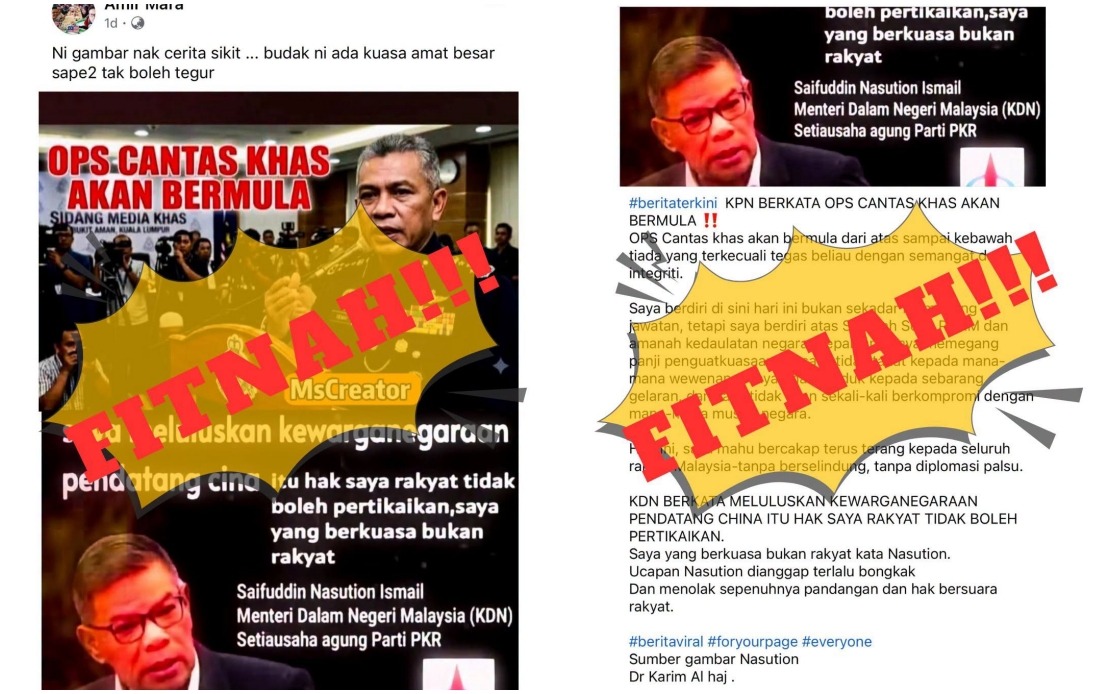
Home Minister Datuk Seri Saifuddin Nasution Ismail has moved to counter persistent allegations that the Home Ministry granted citizenship to large numbers of foreigners, including claims that 1.2 million Chinese nationals remain in Malaysia. Speaking from Putrajaya on August 19, Saifuddin Nasution characterised such assertions as false narratives deliberately resurfaced to mislead the public, despite having been comprehensively refuted on multiple occasions.
The minister's intervention addresses a recurring controversy that has gained traction on social media platforms, where various posters and videos alleging mass citizenship grants have circulated widely. Saifuddin Nasution stressed that he has previously addressed these claims with factual evidence and official data, yet some groups continue to propagate the same debunked allegations through different formats and channels. His exasperation reflects the challenge Malaysian authorities face in combating persistent misinformation in the digital age, where false claims can be rapidly repackaged and reshared to reach new audiences.
Saifuddin Nasution emphasised that the Home Ministry has already issued formal clarifications, supported by comprehensive documentation and media statements. These official records, he suggested, should serve as the authoritative reference point for members of the public seeking accurate information about citizenship policies and procedures. The minister's stance underscores a broader tension in contemporary governance: the difficulty of competing with misinformation campaigns that operate outside traditional institutional channels and exploit social media's viral dynamics.
The consequences of such unchecked misinformation extend beyond simple factual disputes, according to the Home Minister. He warned that deliberate dissemination of false claims damages not only individual and institutional reputations but poses more serious risks to national cohesion. When public confidence in state institutions erodes, Saifuddin Nasution argued, the foundations for social stability and public order weaken. Moreover, such narratives frequently weaponise sensitive matters relating to ethnicity and citizenship, thereby amplifying existing communal tensions and creating environments conducive to hatred and polarisation.
The minister's concerns reflect real anxieties about how misinformation intersects with Malaysia's delicate demographic and political landscape. Citizenship and immigration remain emotionally charged topics across Southeast Asia, where rapid demographic changes and cross-border migration have fuelled public anxiety in numerous countries. When unsubstantiated claims about mass citizenship grants circulate unchecked, they can feed into broader narratives about national sovereignty, cultural preservation, and the pace of demographic change—issues that resonate powerfully with sections of the Malaysian electorate.
Saifuddin Nasution called on all segments of Malaysian society to exercise greater responsibility when consuming and sharing information through digital platforms. He urged citizens to verify claims against official sources rather than accepting information at face value, particularly when such claims carry inflammatory implications. This appeal reflects a growing recognition among policymakers that tackling misinformation requires not only institutional responses but also active participation from an informed citizenry capable of critical evaluation.
The minister's message further emphasised the distinction between facts and interpretation. Official data, he stressed, provides an objective foundation for public discourse, yet this foundation means little if citizens do not consult it or if political actors deliberately misrepresent it for partisan advantage. In the Malaysian context, where multiple communities coexist and demographic anxieties have occasionally boiled over into communal friction, such appeals to factual rigour carry particular weight. The challenge lies in ensuring these appeals gain traction against the emotional resonance of sensationalised claims.
Saifuddin Nasution's intervention also points to the role of timing and political incentives in the circulation of such misinformation. Claims about mass citizenship grants, he implied, are strategically recycled during periods when they might generate maximum political attention or social media engagement. The deliberate nature of this recycling suggests coordination among actors with vested interests in amplifying such narratives, whether for electoral purposes, ideological reasons, or social media visibility. This pattern has become increasingly recognisable across Southeast Asian democracies, where misinformation campaigns often follow predictable cycles aligned with political events or communal sensitivities.
The Home Minister's call for responsible social media use reflects broader international concerns about platform governance and information integrity. Malaysia, like other Southeast Asian nations, has grappled with the challenge of maintaining free expression while preventing the weaponisation of social platforms for misinformation campaigns. Saifuddin Nasution's appeal suggests that the government views public education and voluntary compliance as essential components of any strategy to address this challenge, rather than relying solely on regulatory mechanisms that might themselves spark accusations of censorship or political manipulation.
Looking beyond the immediate dispute, Saifuddin Nasution's statements underscore the vulnerability of institutional credibility to sustained misinformation campaigns. Even when authorities provide comprehensive official clarifications, the digital environment allows false narratives to persist and mutate faster than institutional responses can address them. This dynamic creates a persistent credibility deficit that extends beyond the specific claims in question, potentially undermining public trust in government institutions more broadly. For Malaysian policymakers, this represents an ongoing challenge that requires not merely reactive refutations but proactive strategies to build and maintain institutional legitimacy.
The controversy also illuminates questions about how misinformation affects policy implementation and public perception of immigration governance. Whether or not the specific allegations hold any merit, their persistence shapes how Malaysian citizens understand their government's management of citizenship and immigration matters. This perception gap between official data and public belief can create political pressures that influence policy priorities and institutional behaviour, even when the original claims are factually baseless. Saifuddin Nasution's insistence on facts and data thus represents an attempt to recalibrate public discourse away from emotionally resonant narratives and back toward evidence-based understanding of citizenship policy.
Moving forward, the challenge for Malaysian authorities lies in developing strategies that go beyond simple denial or refutation. This might involve more proactive engagement with digital platforms, clearer communication of citizenship procedures and statistics, and sustained efforts to build public understanding of how immigration and naturalisation systems actually function. The persistence of these claims despite official refutations suggests that factual corrections alone are insufficient to shift public perceptions, particularly when misinformation taps into deeper anxieties about national identity and demographic change. Saifuddin Nasution's intervention, while necessary, points to the need for more comprehensive institutional responses to misinformation in the digital age.

